
Short-Run Digital Printing for Customized Packaging and Product Launches
Launching a new product shouldn’t mean ordering 10,000 boxes you may never use. This guide explains how short-run digital printing lets brands order small batches, skip costly printing plates, test designs, and launch faster. Learn real costs, ideal use cases, flexible packaging options, and how to choose the right printing partner.
What if your first 300 products could look as polished as a brand that ordered 30,000 boxes?
A few years ago, that wasn’t realistic. Packaging suppliers set minimums of 5,000 units or more, because printing plates and machine setup only made financial sense at scale. For a founder with a small first batch, that left two bad options: tie up cash in boxes you might never use, or launch in plain packaging and hope the product did the talking.
Digital printing changed that. Short run packaging printing lets you order exactly what you need, with full-color custom designs, quick turnaround, and no plate costs. You can test a design, launch in small batches, and reorder as sales grow.
In this guide, you’ll learn how it works, what it costs, which packaging types suit small runs, and how to choose the right printing partner.
What is short run packaging printing?
Short run packaging printing is the production of custom packaging in small quantities, often from a few dozen to a few thousand units, using digital presses instead of plate-based methods. It suits new products, seasonal items, test markets, and brands that want quality packaging without storing thousands of boxes.
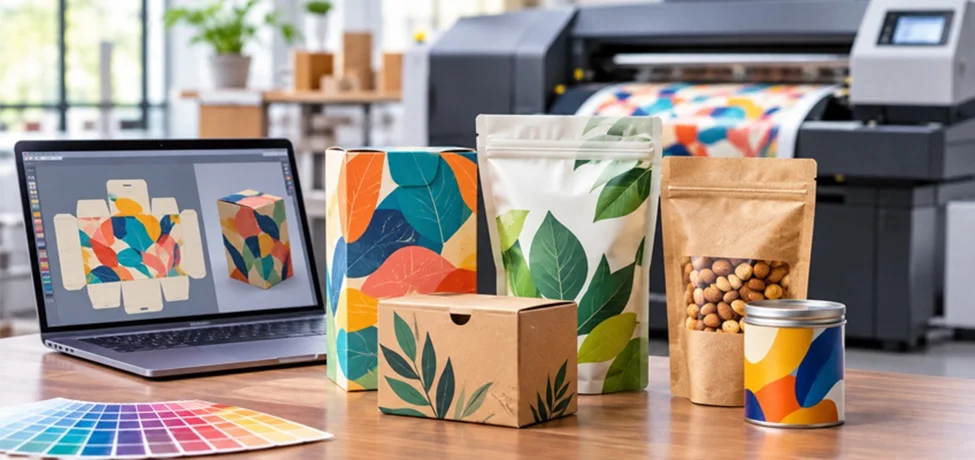
Short run digital printing packaging works much like an office printer, only far more advanced. Your design goes straight from a digital file onto the material, whether that’s a folding carton, a mailer box, a label, or a pouch.
Why do product launches need small batch packaging printing?
Launches are uncertain by nature, and small batch packaging printing reduces that risk. You can test demand, gather feedback, and refine your design before committing to a large run.
Picture a skincare founder launching a new serum. She isn’t sure whether customers will prefer a minimalist design or a bolder one. With traditional printing, she has to pick one and order thousands. With digital, she prints 250 of each, sells both, and sees which one wins.
Here’s what custom packaging for product launches gives you:
- Lower cash risk: you spend on packaging in proportion to what you’ll sell.
- Faster speed to market: no waiting weeks for plates to be made.
- Room to pivot: if the product changes, the packaging can change too.
- Better first impressions: your launch looks professional, not improvised.
That last point matters more than most founders expect, especially for custom packaging for new products. Packaging is often the first thing a customer touches, and a polished box tells them you take your product seriously.
How does packaging printing without printing plates work?
Digital presses apply ink directly from a digital file, so no physical plates are needed. Traditional methods like offset and flexo require a plate for every color in your design. Making those plates costs time and money, and the expense only pays off when it’s spread across a very large run.
Packaging printing without printing plates removes that setup cost. The flow is simple:
1. You send your artwork file.
2. The printer checks it and sends a proof.
3. The press prints your design straight onto the material.
4. The packaging is cut, folded, or finished and shipped.
Because there are no plates, changing a design between runs costs almost nothing. Print version A today and an updated version B next month, with no extra setup fees.
Digital vs. traditional printing: which is better for small runs?
For small quantities, digital printing is usually faster and cheaper per project. For very large volumes, traditional printing often wins on per-unit cost. Neither is universally better. It depends on your quantity and goals.
|
Factor |
Digital (Short Run) |
Traditional (Offset/Flexo) |
|
Typical order size |
Low to medium |
High volume |
|
Setup cost |
Very low or none |
Plates and setup required |
|
Turnaround |
Days to a couple of weeks |
Often longer |
|
Design changes |
Easy and cheap |
Costly (new plates) |
|
Per-unit cost at scale |
Higher |
Lower |
|
Best for |
Launches, tests, variants |
Established, stable products |
A smart path many brands follow is to start with digital printing for small batch packaging, prove the product sells, then move to traditional printing once volumes justify it.
What is low MOQ custom printed packaging, and who needs it?
MOQ stands for minimum order quantity. Low MOQ custom printed packaging means a supplier lets you order small quantities, sometimes just 50 to 500 pieces. It’s possible because digital production doesn’t depend on the large volumes that make traditional setups profitable.
Low volume custom packaging is especially useful for:
- Startups and D2C brands testing a first product.
- Seasonal or limited editions such as festival, holiday, or collaboration packs.
- Subscription boxes with rotating designs.
- Food and beverage makers with multiple flavors or SKUs.
- Corporate gifting where each batch is personalized.
- Established brands running regional or pilot campaigns.
If you sell ten flavors of a snack, you don’t need 10,000 of each. You need a few hundred of each, and that’s exactly where short run digital printing shines.
Can flexible packaging be printed in short runs?
Yes. Flexible packaging short run printing now covers pouches, sachets, wraps, and film, formats that once required large plate-based runs. Digital presses built for flexible materials let brands produce small quantities of stand-up pouches with vibrant, consistent color.
This is a big deal for food, coffee, supplements, and pet products, where flexible packaging is the norm. A small coffee roaster can now print a limited-edition pouch for a single seasonal blend without ordering a year’s worth of stock.
One tip: check material compatibility early. Barrier requirements, sealing methods, and food-safety standards vary, so confirm with your printer that the film and inks suit your product.
How does packaging prototyping fit in?
Packaging prototyping is creating a physical sample of your packaging before full production, so you can check fit, look, and function. Digital printing makes it fast and affordable, since a single sample can be printed without any plate cost.
A good prototype helps you catch problems like:
- A box that’s a few millimeters too tight for the product.
- Colors that look different on paper than on screen.
- Text that’s too small to read or too close to the fold.
- Structural weaknesses that only show up when you handle the box.
Think of packaging prototyping as cheap insurance. Fixing a mistake on one sample costs little. Fixing it after 3,000 units are printed is painful.
How much does short run packaging cost?
Cost per unit is higher in short runs than in mass production, but total spend is far lower, and you avoid setup fees and wasted inventory. Exact pricing depends on size, material, finish, quantity, and print complexity.
Here’s what typically affects the price:
- Packaging type: a simple mailer costs less than a rigid gift box.
- Material: standard paperboard versus specialty or recycled stocks.
- Finishes: foil, embossing, and spot varnish add cost.
- Quantity: unit price drops as volume rises.
- Turnaround speed: rush jobs cost more.
Don’t judge by unit price alone. Compare the total cost of launch: packaging spend, storage, and the risk of unsold or outdated stock. When you count those, small batches often come out ahead, especially for new products.
What is on demand packaging printing?
On demand packaging printing means producing packaging only when you need it, in the quantity you need. Instead of stockpiling boxes, you reorder as sales come in, often using the same saved artwork.
This keeps cash free for marketing and inventory, and it lets you update designs between orders, whether that’s a new claim, a certification, or a seasonal tweak.
How do you choose the right short run packaging partner?
Look for a printer that offers low minimums, clear proofing, relevant materials, and reliable turnaround. Before you commit, ask:
1. What is your minimum order for my packaging type?
2. Can I get a physical sample or prototype first?
3. Which materials and finishes are available at short run quantities?
4. How accurate is your color matching, especially for brand colors?
5. What’s the typical turnaround for first orders and reorders?
6. Can you scale with me if the product takes off?
The last question matters more than it seems. The best partner for a launch is one who can grow with you.
Common mistakes to avoid
- Skipping the proof. Always approve a proof or sample, especially for color.
- Ignoring dielines. Use the printer’s template so your artwork fits the structure.
- Overdesigning too early. Heavy finishes can inflate small-run costs. Start simple.
- Ordering too little. A tiny run can leave you scrambling if the launch goes well. Leave a buffer.
- Forgetting compliance. Food, cosmetics, and supplements have labeling rules. Check them before printing.
Frequently asked questions
What is the minimum order for short run packaging?
It varies by supplier and packaging type. Some digital printers accept orders in the tens or low hundreds, while others start higher. Always confirm before you design.
Is digital printing good quality for packaging?
Yes. Modern digital presses deliver sharp detail and vibrant color suitable for retail packaging. Quality depends on the press, the material, and how well your file is prepared.
How long does short run packaging take?
Many orders ship within days to a couple of weeks, depending on complexity and finishing. With no plate-making, digital is usually faster to start.
Can I print different designs in one order?
Often yes. Since there are no plates, many printers can run multiple versions or flavors in one batch, which is ideal for variety packs and SKU testing.
When should I switch to traditional printing?
When your volume is steady and high enough that lower per-unit costs outweigh setup fees. Many brands make the switch once the product has proven itself.
Final thoughts
A great product deserves packaging that matches it, and you shouldn’t need a giant budget to get there. Short run packaging printing gives new brands the flexibility to launch small, learn fast, and scale when the numbers support it. From prototyping and low MOQ orders to flexible pouches and on demand reprints, the tools are finally within reach.
If you’re planning a launch, start with one prototype, one small batch, and one honest look at how customers respond. It’s a much lower-risk way to find out what works.
 Our Services
 Media Pack Download
 Newsletters
 Industrial Events