

Top Flexible Packaging Materials Used in Food and Retail Industries
Introduction: The Strategic Role of Flexible Packaging in Modern Supply Chains
Flexible packaging is not considered as an economic solution to hard containers anymore but as a performance and branding and sustainability facilitator in both the food and retail markets across the entire world. With changing consumer demand to convenience, portability and green buying, the manufacturers and retailers are re-evaluating the type of material that is utilized in flexible food packaging and its ability to impact the shelf life, compliance, recyclability and efficiency of logistics involved.
The B2B scenario requires the procurement departments, packaging engineers, sustainability officials, and brand managers to consider the most suitable flexible packaging materials to use in food products not just based on the technical perspective, but also through the prism of regulatory compliance, cost reduction, and sustainability in the short and long term.
Understanding Flexible Packaging Materials in Food and Retail
The question posed by industry players on what materials are used in flexible food packaging would be a multitude of polymer and non-polymer substrates that are designed to provide barrier protection, mechanical strength, printability, and sealing performance.
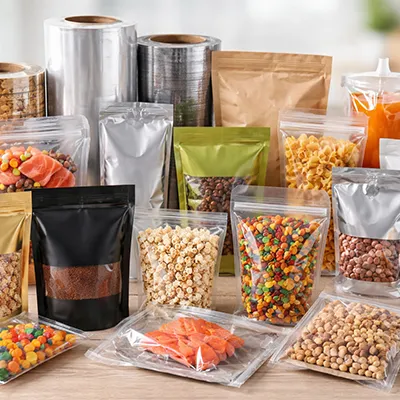
Flexible packaging is usually constructed of films, pouches, wraps, sachets, laminates, and including aluminum foil, paper-based laminates, and new bio-based substrates. Multilayer constructions of these materials are common to compromise oxygen, moisture and light barriers and aroma demands.
In retail uses the selection of the material determines the integrity of products and on shelf differentiation. Food brands which deal with snacks, dairy, frozen food, beverages, and ready-to-eat meals rely on packaging systems that ensure the preservation of freshness and merchant distribution, and merchandising are the most efficient.
Polyethylene (PE): The Versatile Foundation of Food Packaging
Polyethylene is also one of the most common types of flexible package packaging in food and retail industries. PE comes in low-density, linear low-density and high-density, and is appreciated because of its ability to barrier moisture, flexibility, sealability, and affordability.
PE is commonly employed as a sealing material in multilayer laminates, as well as, independently in bags, liners and pouches. Mono-material PE structures are on the rise when it comes to brands that require recyclable flexible packaging to the food industry. The structures make recycling streams easier than the traditional multi-polymer laminates.
Polyethylene offers durability in fresh produce, bakery and frozen food applications without obscuring the visibility of the product or making them machinable on high-speed form-fill-seal lines.
Polypropylene (PP): Strength and Clarity for Premium Retail
Biaxially orientated polypropylene (BOPP) is a type of polypropylene that is crucial for snack and candy packaging. It has a great deal of clarity, stiffness, waterproofing and can be printed.
Snacks and dry foods with metallization or with other layers is commonly utilized in high barrier flexible packaging. This renders them appropriate in products with a long shelf life and aroma stability like chips, nuts and breakfast cereals.
Polypropylene is suitable in the instance of the retail brands whose concerns are appearance-based; bright graphics and smooth finishes can be applied on the shelves without impairing shelf functions.
Polyethylene Terephthalate (PET): Structural Integrity and Thermal Stability
PET is a powerful material that is commonly used as an outer layer of flexible laminates since it is powerful, heat resistant, and does not change dimensionally. It is good in retort package, ready meal application, and product that needs high mechanical strength.
PET can be used in combination with other materials to provide oxygen barrier in multilayer arrangements. PET-based laminates are commonly used in cases of food grade suppliers of flexible packaging material when the product is of premium quality and has to be transported abroad where its durability is essential.
With the growth in recycling infrastructure, recycled PET content is being incorporated into the flexible packaging system, which meets the requirements of a circular economy.
Aluminum Foil and Metallized Films: Advanced Barrier Solutions
The high barrier flexible packaging systems of snacks and dry foods have aluminum foil and metallized films. These materials offer high level of protection against oxygen, moisture and light and have a long shelf life of products.
In case of sensitive products like coffee, powdered beverages, spices, and dairy powders, foil laminates hinder the loss of flavor and oxidation. Nevertheless, the foil laminates that were used traditionally are not easily recyclable.
To ensure this, the manufacturers are coming up with thinner foil gauges and other forms of high-barrier coatings that can support recyclable flexible packaging in the food industry, although at the same time, the performance is maintained at par.
Paper-Based Laminates: Bridging Sustainability and Performance
The retailers are demanding more and more ecologically friendly flexible packaging materials that can be used in foods that minimize the use of plastics without affecting food safety. Laminates made of paper have become a hybrid, a mixture of renewable fiber base with a barrier coating.
Common uses of these materials include dry food, bakery and secondary packaging. Although pure paper structures are not necessarily always high-barrier structures, they are being improved in functionality by sophisticated coatings and extrusion technologies.
Sustainable flexible packaging solutions to retail brands that are interested in enhancing brand perceptions as well as meeting the emerging environmental standards have found paper laminates to be very appealing.
Bio-Based and Compostable Materials: Emerging Innovations
Plant-based polymers are used to produce bio-based films which are increasingly becoming popular as part of overall sustainability policies. Even though it does not apply to all types of food, they provide a possibility in the niche application in which compostability or renewable sourcing is a priority.
In the case of B2B purchase, the materials should be assessed based on their lifecycle, regulatory analysis, and the compatibility to other machinery. Adoption should have a compromise between environmental claims and performance reliability.
Recyclable Mono-Material Structures: Simplifying Circularity
The movement to a mono layer flexible retail packaging is a trend in the industry, which is also one of the most important. Although the traditional multilayer laminates are good in barrier performance, they tend to mix materials which cannot be easily recycled.
Single-material solutions, especially all-PE or all-PP structures are designed to provide similar performance with the enhanced recyclability. The above innovations form the foundation of sustainable reusable packaging of retail brands that have pledged to achieve long producer responsibility objectives and company ESG objectives.
These structures need to be made using high selection of resin, high film orientation and high performance sealing technologies to imitate the functionality of multifaceted laminates.
Flexible Packaging vs Rigid Packaging for Food Products
Flexible food packaging over rigid packaging continues to be one of the major strategic consideration in procurement discussions. Flexible packaging consumes less raw material, it generates less weight during transportation, and it has high storage efficiency.
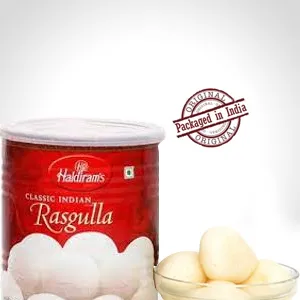
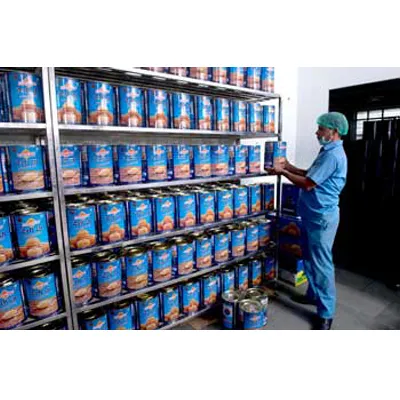
Rigid packaging is a type of packaging that creates structural integrity and high-end positioning but tends to be more expensive to ship, and with a greater carbon footprint such as glass jars, metal cans, and plastic containers.
Lifecycle Flexible formats have the potential to reduce the total environmental impact because of decreased consumption of materials and improved logistics. Nevertheless, recycling structures and material construction eventually dictate upon the end-of-life results.
Advantages of Flexible Packaging in Retail Industry
Cost savings are not the only benefits of the flexible packaging in the context of the retail industry. Flexible formats allow partial control, re-sealing design, convenience and stand-up displays, which promote consumer experience.
Retailers also enjoy the advantage of enhanced shelf density, reduced breakage and enhanced visual merchandising. Brands acquire additional space of printable material of storytelling, regulatory information as well as promotional message.
Flexible packaging also helps in omnichannel retailing such as e-commerce, by minimizing shipping damages and freights based on weights.
Supply Chain Considerations and Material Sourcing
In the case of global food manufacturers, choosing the suppliers of food grade flexible packaging material is not just a matter of price comparison. Suppliers need to be able to exercise regulatory compliance, traceability, quality assurance, and scalability.
The standards of certification, production capacity, innovation, and sustainability roadmap are the key procurement criteria. Brands can also collaborate with highly developed converters to co-design recyclable flexible packaging to use in food industry and still operate efficiently.
Long-term partnership with suppliers also refines the process of material qualifications and provides against volatility of raw materials.
Regulatory and Compliance Frameworks
The food packaging materials need to meet the food safety requirements of the region and other international standards. The compliance must include migration testing, chemical composition and documentation transparency.
With the government increasing environmental regulations, the packaging materials have to meet the requirements of recycling and reduction of plastics. The regulatory pressure and the expectation of the consumers are increasingly determining sustainable flexible packaging solutions to retail brands.
Performance Comparison Table
| Material Type | Barrier Strength | Recyclability Potential | Common Applications |
| Polyethylene | Moderate moisture barrier | High in mono-material streams | Frozen foods, liners |
| Polypropylene | Strong moisture barrier | High in PP streams | Snacks, confectionery |
| PET Laminates | Good structural integrity | Moderate depending on layers | Ready meals |
| Aluminum Foil | Excellent oxygen/light barrier | Limited unless redesigned | Coffee, powders |
| Paper Laminates | Moderate barrier with coatings | Improving |
Dry foods, bakery |
Industry Outlook and Innovation Trends
Digital integration of printing, smart packaging solutions and more sophisticated barrier coatings that remove non-recyclable elements will also determine the future of the flexible packaging in food and retail industries.
Organisations that invest in research and development are transforming the concept of the most appropriate flexible packaging materials to use when packaging food products by combining performance with sustainability.
Carbon footprint transparency, automation compatibility and downgauging strategies will be commonly evaluated metrics. The retailers will be demanding more and more evidence-based assertions of the ways in which eco-friendly elastic packaging material to store food will partake in the reduction of environmental impact which can be quantified.
Conclusion: Strategic Material Selection as a Competitive Advantage
Flexible packaging has emerged as a pillar in food and retail ecosystems of the present day. Knowledge on the materials to be utilized in flexible food packaging can enable businesses to make effective decisions that are performance-cost-sustainable and regulatory-compliant.
Since polyethylene and polypropylene are used and then there is PET laminates, aluminum barriers and recyclable mono-materials, every substrate has its strategic role. The move towards recyclable flexible packaging of the food industry and recyclable mono layer flexible packaging of retail highlight the industry in investing in circularity.
With the argument of flexible and rigid packaging on food products raging on, statistics are consistent on the benefits of flexible packaging within the retail industry setting, specifically in areas of logistic effectiveness and flexibility of convenience to the consumer.
In the case of the B2B stakeholders, it is no longer an option to ensure that the commitment is realized by aligning with credible suppliers of food grade flexible packaging materials and channels investment into sustainable flexible packaging solutions of the retail brands. It is an important measure towards operational resilience, compliance, and sustainable market leadership in the long term.
 Our Services
 Media Pack Download
 Newsletters
 Industrial Events