


Next-Generation Food Labelling: Digital Labels, Traceability, and Global Compliance
For most of its history, the food label has been a static, one-way communication tool: a printed panel that told a shopper what was inside a package and little else. That era is ending. Across the food and beverage sector, manufacturers, retailers, and regulators are converging on a new model — one where the label is a live data connection rather than a fixed piece of print. This shift is being driven simultaneously by consumer demand for transparency, tightening regulatory requirements, and the operational need for tighter food supply chain traceability. For industry leaders, understanding where digital labelling is headed is no longer optional; it is becoming a condition of market access.
Why the Static Label Has Reached Its Limits
A traditional label has finite space and, once printed, cannot be updated. Yet the information consumers, auditors, and regulators now expect — allergen updates, sourcing details, sustainability claims, certification status, batch-level origin data — changes far more frequently than packaging print runs allow. Recalls, ingredient substitutions, and evolving regulatory labeling requirements all expose the fragility of a system where the only way to change what a label says is to reprint and relabel physical stock.
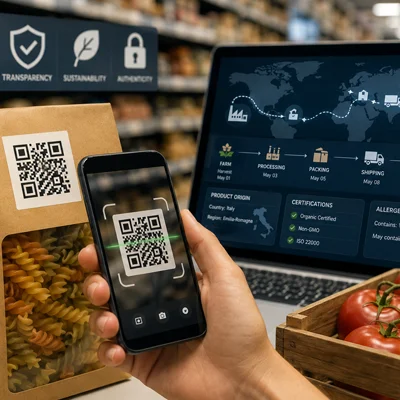
This is the core problem digital food labels solve. By linking a physical product to a dynamic, cloud-hosted data record — typically through a QR code food labeling approach or embedded NFC — brands can update information after the product has already left the factory. A single scan can surface allergen warnings, country-of-origin detail, or a certificate of analysis, all without touching the physical package. For companies operating across multiple markets, this decouples product content from the regulatory patchwork of each destination country, since the same physical unit can serve different label data depending on where and when it is scanned.
| Also Read: Innovative Packaging Design for Food & Beverage Brands: Enhancing Shelf Appeal, Product Protection, and E-Commerce Performance |
Traceability as the Backbone of Trust
Food traceability is not new — HACCP and various national frameworks have required lot-level tracking for decades. What has changed is the granularity and speed regulators and buyers now expect. The U.S. FDA's Food Safety Modernization Act Section 204 (FSMA 204) requires enhanced traceability recordkeeping for high-risk foods, mandating that firms be able to trace a product's movement through the supply chain using standardized data elements and Critical Tracking Events. The EU's General Food Law and forthcoming digital initiatives push in a similar direction, requiring documented food origin tracking from farm to shelf.
This regulatory pressure is reshaping how supply chain data is captured and shared. Rather than each trading partner keeping isolated paper or spreadsheet records, next-generation systems record Critical Tracking Events — harvesting, processing, packing, shipping, receiving — against a shared, interoperable data structure. When a contamination event or recall occurs, this level of food supply chain traceability is what allows a firm to isolate the affected lot within hours rather than pulling entire product categories off shelves for days while investigators work backward through fragmented records.
Crucially, robust traceability infrastructure also underpins food label compliance. A label claim — "wild-caught," "single origin," "regeneratively farmed" — is only defensible if the underlying supply chain data can substantiate it on demand. As authorities and retailers increase scrutiny of such claims, the label and the traceability system behind it are becoming inseparable.
GS1 Digital Link and the Standardization of Smart Labels
One of the most consequential developments in this space is the maturation of GS1 Digital Link, a standard that allows a single barcode — typically a 2D QR-style code — to encode both the traditional retail identifier (GTIN) and a web URL carrying rich product data. This matters because it solves a fragmentation problem that has slowed digital labelling adoption: rather than every brand building proprietary QR systems that only its own app can interpret, GS1 Digital Link creates a common, machine-readable syntax that any compliant scanner, retail POS system, or consumer smartphone can resolve.
For manufacturers, this standardization is what makes smart labeling solutions commercially viable at scale. A single 2D code on a package can simultaneously serve as the point-of-sale barcode, a link to allergen and nutritional data, a gateway to sustainability documentation, and a verification point for product authentication labels — all through infrastructure that is retailer- and border-agnostic. Major retailers in North America and Europe have already committed to 2D barcode transitions at point of sale, which is accelerating adoption well beyond early pilots.
The Digital Product Passport: A New Compliance Frontier
The most structurally significant development on the horizon is the digital product passport (DPP), a concept originating in the EU's Ecodesign for Sustainable Products Regulation but with clear implications for food and agri-food products as the framework expands. A DPP is a standardized digital record, tied to a specific product or batch, that consolidates data on composition, origin, environmental footprint, compliance certifications, and supply chain history into a single accessible profile.
For food businesses, the DPP concept represents a convergence point: it is where food origin tracking, sustainability reporting, and regulatory labeling requirements meet in one data architecture. Rather than managing separate systems for nutrition labelling, carbon footprint disclosure, and traceability recordkeeping, forward-looking manufacturers are beginning to architect their data infrastructure so a single product record can serve all three purposes. Companies that treat these as isolated compliance projects today are likely to face costly rework as DPP-style requirements extend into food categories over the coming years.
Electronic Shelf Labels and In-Store Dynamics
While much of the digital labelling conversation centers on packaging, electronic food labels at the shelf level are a parallel and complementary development. Electronic shelf labels (ESLs) allow retailers to update pricing, promotional information, and — increasingly — sourcing or allergen data in real time, synchronized with backend inventory and supply chain systems. When paired with package-level digital labels, ESLs create a consistent data experience: the same product information a shopper can scan on the package is reflected instantly at shelf, reducing the mismatch between promotional claims and what is legally substantiated on the product itself.
This convergence is particularly relevant for private label and fresh categories, where product specifications, sourcing, and even pricing can change week to week. Static printed shelf tags simply cannot keep pace with that velocity; dynamic systems can.
Navigating a Fragmented Global Regulatory Landscape
One of the persistent challenges for multinational food businesses is that global food labeling standards remain anything but uniform. The EU's Food Information to Consumers regulation, the U.S. FDA's labeling requirements, Codex Alimentarius guidelines, and a growing set of national digital-traceability mandates in markets from China to the Gulf states each impose distinct — and sometimes conflicting — data requirements. Allergen declaration formats, nutrient panel structures, and origin-labelling thresholds all vary by jurisdiction.
Digital labelling offers a practical way through this fragmentation. Because a QR code or Digital Link URL can resolve to different content based on the geolocation or language settings of the scanning device, a single physical product design can serve multiple regulatory regimes without separate print runs for each market. This does not eliminate the compliance burden — data still has to be accurate, current, and defensible in each jurisdiction — but it significantly reduces the operational cost of maintaining that compliance across borders. For companies exporting into multiple regions, this alone is often the strongest business case for early digital labelling investment.
Building Consumer Trust through Transparency
Beyond regulation, there is a clear commercial driver: consumers increasingly expect transparent food labeling as a baseline, not a premium feature. Surveys across major markets consistently show rising interest in knowing where food comes from, how it was produced, and whether sustainability and ethical sourcing claims are verifiable. A scannable code that opens onto a genuine, auditable data trail — rather than a marketing microsite — is what separates credible transparency claims from greenwashing in the eyes of increasingly skeptical buyers.
This is also where product authentication labels intersect with brand protection. Counterfeiting and grey-market diversion remain persistent problems in categories like premium spirits, infant formula, and specialty ingredients. Cryptographically secured digital labels, tied to unique serialized identifiers, allow both consumers and customs authorities to verify authenticity at the point of scan — a capability static printed labels simply cannot offer.
Practical Steps for Industry Leaders
For food businesses evaluating this transition, a few priorities stand out. First, data infrastructure should be built around open standards — GS1 Digital Link in particular — rather than proprietary QR systems that limit interoperability with retailers and regulators. Second, traceability systems should be designed to capture Critical Tracking Events at a granularity fine enough to satisfy the strictest applicable regulation (FSMA 204 is a reasonable benchmark even outside the U.S.), since retrofitting granular tracking after the fact is far more expensive than building it in from the start. Third, label content architecture should anticipate the digital product passport model, consolidating compliance, sustainability, and traceability data into a unified product record rather than siloed systems.
The direction of travel is clear. Regulators are moving toward mandatory digital traceability, retailers are moving toward 2D barcodes at point of sale, and consumers are moving toward expecting verifiable transparency as standard. Food businesses that treat digital labelling as core infrastructure — rather than a marketing add-on — will be the ones best positioned to move fluidly across markets, respond quickly to recalls, and maintain the trust that increasingly determines shelf space.
 Our Services
 Media Pack Download
 Newsletters
 Industrial Events