


The Ultimate Guide to Smart Packaging: Technologies, Benefits & Industry Trends
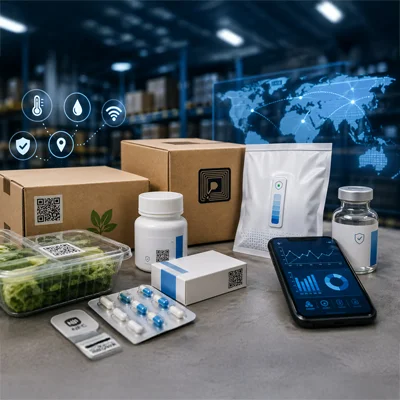
Packaging has usually been ignored. It protected the product, carried a label, and did its job quietly. That’s no longer the case.
In many industries today—especially food, pharma, and logistics—packaging is starting to behave less like a container and more like a system. It can sense changes, store information, and in some cases, even “talk” to other devices. That shift is what’s driving the rise of Smart Packaging Solutions.
But the reality is, for all the talk, smart packaging is glossed over. It's not a single technology and it's certainly not about tacking a QR code on to a product and declaring it "innovative".
It All Starts With a Little Change: Passive to Responsive
Smart packaging is about a shift from passive to active.
Some solutions physically interact with the product. Others simply observe and report. That’s where the distinction between Active and Smart Packaging and Intelligent Packaging Technology usually comes in.
Active systems do things like absorb oxygen or control moisture. They're doing their job behind the scenes to increase shelf life. Smart systems, on the other hand, are more about monitoring - such as measuring temperature, recording the history of how a product has been handled or alerting when something goes astray.
The truth is companies seldom do one or the other. A vaccine shipment, for instance, might rely on both—materials that help maintain stability and sensors that make sure nothing drifts out of range.
The Real Enabler: Sensors That Don’t Cost a Fortune Anymore
A few years ago, embedding electronics into packaging sounded expensive and impractical. That’s changed faster than many expected.
The use of IoT and sensors in smart packaging solutions has become far more accessible. Sensors today are smaller, cheaper, and easier to integrate into different packaging formats.
| Read More: How Smart Packaging Technology Enhances Consumer Engagement and Safety |
And they’re not doing anything overly complex. Most of the time, they’re just answering basic questions:
- Did the temperature stay within range?
- Was there excess humidity?
- Did the package experience shock or rough handling?
Simple questions—but the answers can save entire shipments.
Once these sensors connect to cloud platforms, you get something much more valuable: real-time product tracking. Not just location tracking, but condition tracking.
That difference matters. Knowing a shipment is delayed is one thing. Knowing it’s been sitting outside temperature limits for three hours is something else entirely.
Visibility Is Becoming Non-Negotiable
Supply chains have become too complex—and too fragile—for guesswork.
This is where Connected Packaging Systems are gaining attention. Rather than packaging being a throwaway, it's becoming a sensor in a system.
Through the use of RFID, low-power telemetry and cloud-based dashboards, packaging can tell a tale. Origin, exposure and condition of the product. From a B2B standpoint, that changes conversations.
It’s no longer just about delivery timelines. It’s about accountability. If something goes wrong, you can trace it. Not theoretically—actually trace it.
Not All Smart Packaging Is High-Tech (And That’s a Good Thing)
There’s a tendency to associate innovation with complexity. But one of the most widely used tools in this space is also one of the simplest: QR code packaging.
It works because it doesn’t require infrastructure. No special hardware. Just a printed code and a smartphone.
And yet, that single code can handle multiple functions:
- Product authentication
- Batch-level traceability
- Instruction access
- Customer interaction
For many businesses, especially those testing the waters, QR codes are the starting point.
They’re also surprisingly effective in building trust, particularly in export markets where buyers want quick verification.
NFC Is Slower to Scale—but Stronger in Specific Use Cases
NFC packaging hasn't taken off quite so much as QR codes. But where it’s in use, it is intentional.
NFC adds a layer of control. It’s harder to duplicate, doesn’t rely on visual scanning, and feels more seamless from a user perspective.
That’s why it shows up more often in:
- Pharmaceuticals
- Specialty chemicals
- High-value goods
It also plays a role in anti-counterfeiting packaging, which is becoming less of a niche concern and more of a baseline requirement.
Counterfeiting Is Quietly Driving This Market
If you strip away the marketing language, one of the biggest drivers behind smart packaging isn’t engagement—it’s risk.
Counterfeit products aren’t just a brand problem. In industries like pharma, they’re a safety issue.
That’s pushed companies toward layered solutions:
- Serialized codes
- NFC verification
- Tamper-evident designs
- Even blockchain-backed records in some cases
Engagement Is Still There—But It’s Evolving
There was a phase where interactive packaging solutions for consumer engagement leaned heavily into novelty—AR filters, gamified experiences, and so on.
Some of that still exists. In business-to-business and regulated markets, however, the game is changing.
Now, interaction is more practical:
- Accessing compliance documents
- Viewing usage instructions
- Checking safety guidelines
- Enabling reorders directly
That is, packaging is becoming a channel-not only for marketing, but for communication.
The Food and Pharma Difference
When discussing the benefits of smart packaging in food and pharmaceutical industries, adoption patterns make sense when you look at the risks involved.
In food, the issue is shelf life. They can be damaged by variations in temperature and humidity.
And for pharmaceuticals, life is at stake. A compromised product isn’t just waste—it can affect patient safety.
So both industries are investing in moving from periodic checks to monitoring.
Certainly not about innovation, but certainty.
Sustainability is No Longer "The Other Issue"
Previously, smart packaging and sustainability were never mentioned in the same sentence.
- Reducing environmental impact
- Improving operational efficiency
Improved monitoring means less spoilage. Smarter design means less excess material. Data helps optimize distribution.
Admittedly, there is a problem - particularly with electronics. Recycling smart packaging is not easy.
But it’s an area where a lot of development is happening quietly in the background.
What’s Actually Changing in 2026
If you look at the latest trends in smart packaging technologies 2026, the shift isn’t about one breakthrough technology.
It’s about convergence.
- Sensors are getting cheaper
- Connectivity is becoming standard
- Data platforms are getting smarter
Individually, none of these are new. But together, they’re making smart packaging more practical—and more scalable.
What used to be limited to high-value shipments is slowly moving into mid-tier products.
Final Thought
Smart packaging isn’t a future concept anymore. It’s already being used—just not always in obvious ways.
The companies seeing the most value aren’t necessarily the ones using the most advanced tech. They’re the ones using it where it actually solves a problem.
And that’s probably the simplest way to look at it.
Not as a trend. Not as a feature.
But as a tool that, when used right, quietly fixes things that used to go wrong.
 Our Services
 Media Pack Download
 Newsletters
 Industrial Events