



Articles
Automated Packaging Equipment Buying Guide for Efficiency and ROI
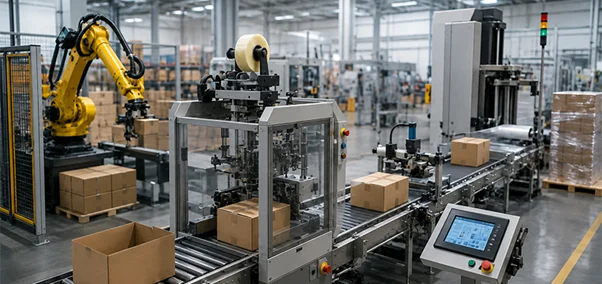
Table of Contents
- What Is Automated Packaging Equipment?
- Types of Packaging Automation
- Packaging Equipment Selection Criteria
- How to Choose Packaging Equipment for Your Line
- Manual vs Automated Packaging: When to Make the Switch
- Packaging Automation ROI
- How to Calculate Packaging Equipment ROI
- Packaging Equipment Total Cost of Ownership
- Questions to Ask Packaging Equipment Suppliers
- Packaging Equipment Purchase Checklist
- Frequently Asked Questions
1. What Is Automated Packaging Equipment?
Automated packaging equipment covers any machine that takes over a packaging task previously done by hand — filling, sealing, wrapping, case erecting, labeling, palletizing, or carton forming. Instead of a worker measuring, folding, or taping each unit, a machine performs the task at a set speed, with far less variation from one unit to the next.
This automated packaging equipment buying guide is built for operations teams, plant managers, and procurement leads who are evaluating whether — and which — automation makes sense for their packaging line. The right equipment choice depends less on brand reputation and more on matching machine capability to your actual product mix, volume, and labor situation.
Automation isn't an all-or-nothing decision. Many facilities start with a single bottleneck station — often case sealing or labeling — before expanding into a fully integrated line.
Buyer Tip: Map your current packaging process step by step before shopping for equipment. The station with the most labor hours or the highest error rate is usually the best place to start.
2. Types of Packaging Automation
Packaging automation spans a wide range of machine categories, each solving a different part of the process:
- Case Erectors and Sealers — Form flat blanks into boxes and seal them with tape or glue
- Fill and Seal Systems — Dispense product by weight or count and seal the package
- Wrapping Equipment — Stretch wrap, shrink wrap, or overwrap for unitized or retail loads
- Labeling and Coding Systems — Apply labels, barcodes, or date/lot codes at line speed
- Palletizers — Stack finished cases onto pallets, either robotic or mechanical
- Checkweighers and Inspection Systems — Verify weight, fill level, or seal integrity before shipment
Most operations combine two or three of these categories rather than automating a single station in isolation, since a faster sealer paired with a manual palletizing step just shifts the bottleneck downstream.
3. Packaging Equipment Selection Criteria
Before comparing specific machines, it helps to define the packaging equipment selection criteria that actually matter for your operation:
- Throughput requirement — units or cases per minute needed at peak demand
- Product variability — how many SKUs, sizes, or package formats the machine must handle
- Changeover time — how long it takes to switch the line between formats
- Footprint — available floor space, including infeed/outfeed clearance
- Integration — compatibility with existing conveyors, ERP, or line control systems
- Operator skill level — how much training staff will need to run and troubleshoot the machine
Buyer Tip: Throughput specs on a spec sheet are usually tested under ideal conditions. Ask suppliers for real-world throughput data based on your actual product and package format, not the manufacturer's benchmark run.
4. How to Choose Packaging Equipment for Your Line
Knowing how to choose packaging equipment starts with sequencing your evaluation correctly, rather than jumping straight to vendor demos.
Start by quantifying your current bottleneck in hard numbers — units per hour, labor cost per case, error or rework rate. Next, define your must-have specs (throughput, format flexibility, footprint) separately from nice-to-haves (touchscreen controls, remote diagnostics, tool-less changeover). Then request equipment recommendations from two or three suppliers based on the same brief, so quotes are comparable line-for-line.
As a general rule of thumb: semi-automatic equipment suits lower-volume or highly variable product lines where full automation would sit idle much of the time, while fully automatic systems make sense once volume is consistent and predictable enough to justify the higher upfront cost. If you're unsure where your operation falls, most reputable suppliers will run a line audit and recommend a tier based on your actual production data — it's worth requesting this in writing before finalizing a purchase.
5. Manual vs Automated Packaging: When to Make the Switch
The manual vs automated packaging decision usually comes down to volume, consistency, and labor cost trends rather than any single fixed threshold. Manual packaging keeps capital costs low and offers flexibility for constantly changing SKUs, but it scales linearly with labor — doubling output means roughly doubling headcount, and quality varies with operator fatigue and turnover.
Automated packaging equipment carries a higher upfront cost but decouples output growth from headcount growth, tightens consistency, and reduces repetitive-strain injury risk. As a rough guide, if a single packaging task consumes more than one or two full-time equivalents per shift, or if your error/rework rate is affecting customer satisfaction, it's usually time to run the ROI numbers on automation.
6. Packaging Automation ROI
Packaging automation ROI is the figure that ultimately justifies — or rules out — a purchase, and it should be calculated before equipment is shortlisted, not after.
The return comes from several sources at once: reduced direct labor, lower material waste (automated fill and seal systems are typically more precise than hand-filling), fewer quality-related returns, and the ability to redeploy staff to higher-value work. Some of these are easy to quantify; others, like improved on-time shipping performance, take a few months of data to measure accurately.
Buyer Tip: Build your ROI case using conservative estimates for savings and a realistic (not best-case) estimate for downtime during installation and staff training. Overly optimistic ROI projections are one of the most common reasons automation purchases fail to meet expectations in year one.
7. How to Calculate Packaging Equipment ROI
A straightforward way to approach how to calculate packaging equipment ROI is to compare total costs and total savings over a fixed time horizon, typically 12 to 36 months.
Start with the total investment: equipment purchase price, installation, integration with existing lines, operator training, and any facility modifications. Then estimate annual savings: labor hours eliminated or redeployed, reduced material waste, lower error/rework costs, and any throughput gains that translate into revenue (such as meeting demand without overtime).
A simplified formula many buyers use:
ROI (%) = (Annual Savings − Annual Operating Cost) ÷ Total Investment × 100
Run this calculation across a few volume scenarios — conservative, expected, and optimistic — rather than a single projection, since actual throughput in the first few months after installation is often lower than steady-state performance once operators are fully trained. This is also where the packaging equipment payback period comes in: most buyers treat 12–24 months as a reasonable payback window for mid-range equipment, with longer windows acceptable for higher-complexity systems.
8. Packaging Equipment Total Cost of Ownership
Purchase price is only one line item in packaging equipment total cost of ownership. A full TCO picture includes:
- Upfront costs — equipment, freight, installation, and integration
- Recurring costs — consumables (film, tape, labels), spare parts, and scheduled maintenance
- Energy consumption — especially relevant for shrink-wrap and heat-seal equipment
- Downtime cost — estimated cost per hour if the machine goes offline unexpectedly
- Software and support — licensing fees for line control software, plus service contract costs
- End-of-life — resale value or decommissioning cost when the equipment is eventually replaced
Buyer Tip: Ask suppliers for a five-year TCO estimate, not just a purchase quote. Two machines with similar sticker prices can have very different lifetime costs once consumables and service contracts are factored in.
9. Questions to Ask Packaging Equipment Suppliers
A short but pointed list of questions to ask packaging equipment suppliers can surface issues that spec sheets don't reveal:
- What is the real-world throughput on our specific product and package format?
- What is the typical changeover time between our SKU variants?
- What consumables does the machine require, and what do they cost annually?
- What is the expected lead time for spare parts, and is local service available?
- What training is included, and how long does it take an operator to reach full proficiency?
- Can we speak with a reference customer running a similar product line?
- What warranty and service contract options are available, and what do they cover?
Buyer Tip: Ask for the reference customer's contact directly rather than a case study — a short call often reveals real-world quirks that marketing materials leave out.
10. Packaging Equipment Purchase Checklist
Before signing off on a purchase, run through this packaging equipment purchase checklist:
- Confirm throughput has been tested on your actual product and package format
- Verify footprint, utility requirements (power, air, water), and facility compatibility
- Request a full five-year total cost of ownership estimate, not just purchase price
- Confirm changeover time and format flexibility for all current SKUs
- Check integration compatibility with existing conveyors, ERP, and line control systems
- Clarify training, warranty, and service contract terms in writing
- Request references and, if possible, a site visit to see the equipment running live
11. Frequently Asked Questions
What's the difference between semi-automatic and fully automatic packaging equipment?
Semi-automatic equipment still requires an operator to load, position, or trigger part of the cycle, while fully automatic equipment runs continuously with minimal manual intervention, usually integrated into a conveyor line. Semi-automatic systems generally cost less and suit lower or variable volumes; fully automatic systems suit high, consistent volumes where the higher upfront cost is offset by labor savings over time.
How long does packaging automation take to pay for itself?
The packaging equipment payback period varies widely by application, but many mid-range case sealing, wrapping, or labeling systems pay back within 12 to 24 months when replacing a labor-intensive manual process. Higher-complexity systems, such as robotic palletizers, often have a longer payback period but deliver larger long-term savings once fully utilized.
Is automation worth it for a smaller operation?
It depends on volume consistency more than company size. A smaller operation with steady, repetitive packaging needs can see a faster payback than a larger operation with highly variable, low-volume SKUs. Running the ROI calculation on your specific numbers is more reliable than assuming automation only makes sense at large scale.
What should I budget beyond the equipment purchase price?
Plan for installation, integration with existing lines, operator training, and a cushion for lower-than-expected throughput during the first few weeks of operation. Suppliers can usually provide a total cost of ownership estimate that accounts for these factors alongside ongoing consumables and maintenance.
How do I know if a supplier's ROI projections are realistic?
Ask how the projection was calculated and request the underlying assumptions — labor rate, throughput, and downtime estimates in particular. Reputable suppliers will walk through their math and adjust it based on your actual production data rather than presenting a single fixed number.
 Our Services
 Media Pack Download
 Newsletters
 Industrial Events