




Industry Leadership Interview
Insights on Brand Recognition, Consumer Memory and Brand Evolution How brands can identify, protect and strengthen the assets consumers already remember. The role of behavioral data, experimentation and AI in making smarter redesign decisions.

About the Expert: Olga Cuzuioc Sinchevici - Creative Brand & Innovation Leader
Olga Cuzuioc Sinchevici is a creative brand leader and curious builder whose work sits at the intersection of distinctive brand assets, behavioral science, creativity, consumer evidence and AI. She is developing a proprietary brand-memory methodology designed to help organizations understand what to protect, strengthen and explore - so brands can become recognized, remembered and chosen.

Georgia-Pacific LLC
1. Before a brand considers a redesign, what should leaders first understand about the existing brand - and why is this diagnostic step often overlooked?
I have a simple belief: before you change a brand, you need to understand how it is already remembered.
Organizations spend years - and sometimes decades - building associations in people's minds. A color. A shape. A character. A particular typography. A phrase. A package structure. Even something the organization considers dated may be doing important work for the consumer.
That is why I like to start with curiosity rather than creation.
What does the brand believe it stands for? What does the consumer actually recognize and remember? What shows up consistently across packaging, communication, digital experiences and culture? And where are the gaps between those things?
The temptation in creative work is to immediately imagine what something could become. That's the fun part. But transformation without understanding can accidentally erase value that took years and significant investment to build.
My philosophy is: LEARN > UNDERSTAND > IMAGINE > BUILD > TEST > SCALE.
Transformation comes later in that sequence for a reason.
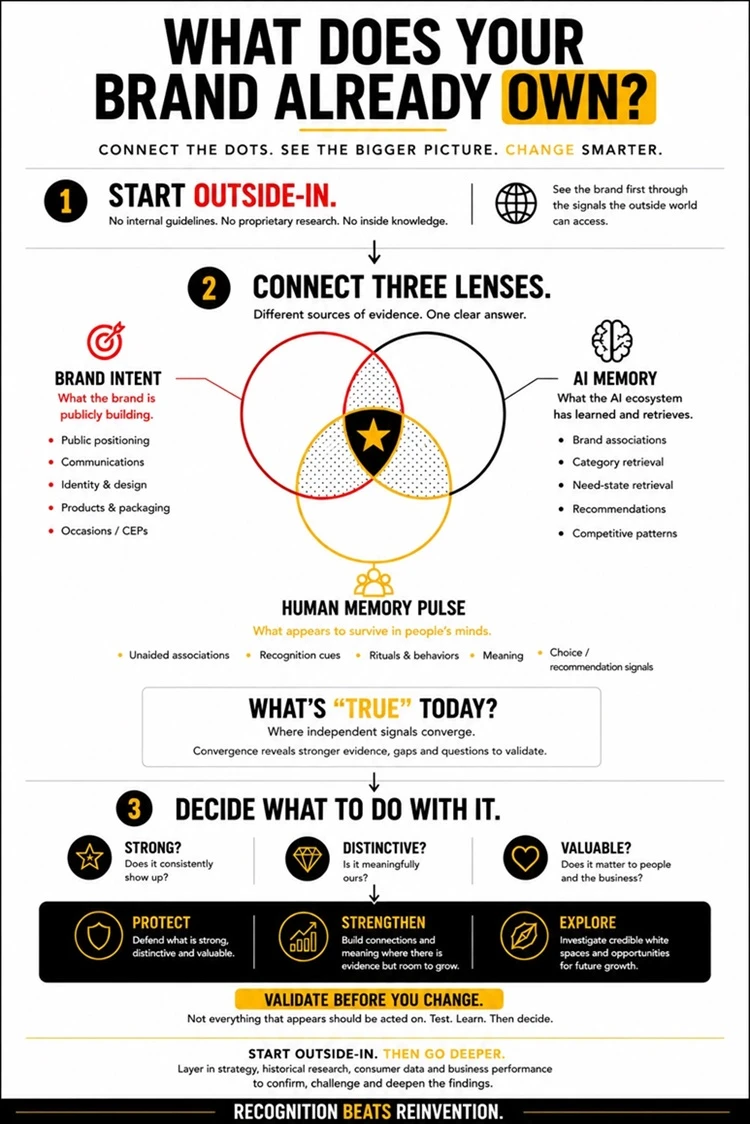
Proprietary framework by Olga Cuzuioc Sinchevici / O.da.
2. How can companies identify the brand assets that are already creating recognition and memorability, even when those assets may not appear obviously distinctive?
I think this is where brands have to look beyond the logo.
Consumers don't experience brands as a collection of brand-guideline pages. They experience combinations of cues: color, shape, typography, characters, language, sonic cues, package architecture, patterns, photography and even behaviors.
And sometimes the most valuable asset isn't the one the organization is most proud of creatively.
I like looking at the brand through several lenses: what the company consistently communicates, what consumers recognize and associate with the brand, what competitors can or cannot easily own, and what persists across channels and over time.
That last part matters. Distinctiveness is not simply about being visually unusual. An asset becomes powerful when it consistently helps someone think, "I know who this is."
That is where behavioral science becomes very interesting to me. Familiarity, repetition and associative memory can create enormous value from seemingly simple cues.
3. What signals help determine whether a particular brand element should be protected, strengthened or evolved?
I look at three questions first: Is it strong? Is it distinctive? Is it valuable?
Strong asks whether the signal consistently shows up. Distinctive asks whether it is meaningfully ours. Valuable asks whether it matters to people and to the business.
From there, I think in three actions: PROTECT, STRENGTHEN or EXPLORE.
Protect what is strong, distinctive and valuable. Strengthen assets where there is evidence and equity, but room to build clearer connections or meaning. Explore credible white spaces and opportunities that could become future sources of growth.
The important part is that those decisions shouldn't come exclusively from personal preference. I want evidence from multiple places: consumer recognition, competitive distinctiveness, historical consistency, strategic relevance, performance across touchpoints and, increasingly, what we can learn from digital and AI-assisted analysis.
No single signal gives you the answer. The interesting part is where those signals converge - and where they don't.
4. How do you distinguish between a genuine brand problem and a situation where the brand simply feels outdated to its internal stakeholders?
I love this question because I've seen this tension many times.
When you work with a brand every day, you get tired of it much faster than consumers do. Internal familiarity can create a desire for novelty: "We've had this forever. We need something new." But consumers aren't sitting in the conference room looking at that identity every day.
So, one of my favorite questions is: "Is the consumer tired of it - or are we?"
Those are very different problems.
If consumers no longer notice it, understand it, associate it with the brand or find it relevant, we have evidence of a problem. If internal stakeholders simply want something fresh, that's a creative desire - not yet a consumer problem.
Sometimes evolution is absolutely necessary. But I want us to diagnose the reason before prescribing the solution.
5. What role should consumer research and behavioral data play in deciding what stays and what changes during a brand evolution?
A significant one - but I don't believe research should design the brand for us.
Research helps us understand what is happening and why. Creative thinking helps us imagine what could happen next.
I am particularly interested in measuring recognition before asking preference. Those aren't the same thing.
Someone can prefer a beautiful new design while still recognizing the existing design much faster. If we only ask, "Which one do you like?", we may miss something commercially important.
I want to understand recognition, associations, comprehension, attention, distinctiveness and choice - not simply aesthetic preference.
Then creative intuition and consumer evidence can work together rather than compete with each other.
6. Can you share a practical methodology or framework that teams can use to audit their brand assets before beginning a redesign?
At a high level, yes. I start outside-in - before layering in internal guidelines, proprietary research or inside knowledge - and connect three independent lenses:
BRAND INTENT: what the brand is publicly and deliberately building.
HUMAN MEMORY PULSE: what appears to survive in people's minds - from unaided associations and recognition cues to rituals, behaviors, meaning and choice signals.
AI MEMORY: what the AI ecosystem has learned and retrieves about the brand, including associations, category and need-state retrieval, recommendations and competitive patterns.
I'm interested in where those signals converge, because convergence gives us stronger evidence. I'm equally interested in the gaps, because gaps give us questions to validate.
Then I ask whether an asset is STRONG, DISTINCTIVE and VALUABLE, and use that evidence to decide what to PROTECT, STRENGTHEN or EXPLORE.
I intentionally describe this as a diagnostic rather than a redesign process. The output isn't automatically "change." Sometimes the most valuable recommendation is: don't touch this. Other times it shows where a brand has room to build something new.
The full diagnostic and evaluation system is proprietary, but the principle is simple: start outside-in, then go deeper. Understand the memory you're working with before you try to create a new one. Validate before you change.
7. How should brands balance consistency and familiarity with the need to remain culturally relevant and responsive to changing consumer expectations?
I don't see consistency and evolution as opposites.
Strong brands can evolve enormously while retaining enough familiar signals to remain unmistakably themselves.
Coca-Cola is a useful public example. Its expressions have changed continuously across packaging, campaigns, channels and culture, while recognizable memory structures - the contour bottle, red and white, the script, refreshment and familiar rituals - create continuity.
The opportunity isn't to freeze those assets in time. It's to let new meaning and innovation inherit from the memory system people already know.
The question isn't, "Should we change?" It's: "What can change without making us less recognizable?"
That creates much more interesting creative possibilities.
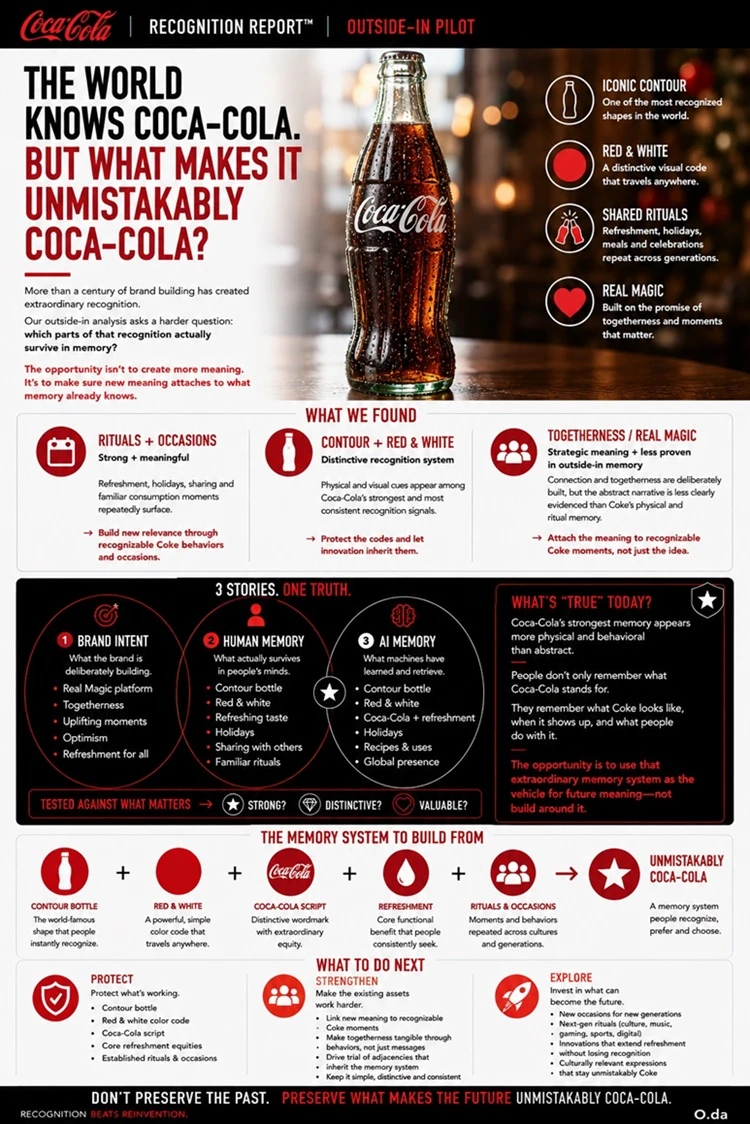
Coca-Cola Recognition Report™;
Independent outside-in pilot based on publicly available information; not commissioned by or affiliated with The Coca-Cola Company.
8. What are some common mistakes companies make when redesigning a brand, particularly when they change recognizable assets without fully understanding their value?
One is confusing simplicity with distinctiveness.
Another is treating every inherited element as baggage.
And perhaps the biggest is changing multiple memory cues simultaneously without understanding the cumulative effect.
A logo changes. The color changes. The typography changes. The package architecture changes. Photography changes. Tone changes.
Individually, each decision may be beautifully rationalized. Collectively, you've potentially asked the consumer to relearn the brand.
Cracker Barrel is an interesting public example because its recognition is not carried by one graphic asset alone. The rocking chairs, country store, comfort food, decor, hospitality and familiar rituals work together as an experience system. Looking only at the logo would miss much of the memory people actually carry.
I like transformation. But transformation should create value - not simply demonstrate that something changed. Don't preserve everything. Preserve what makes the future unmistakably yours.
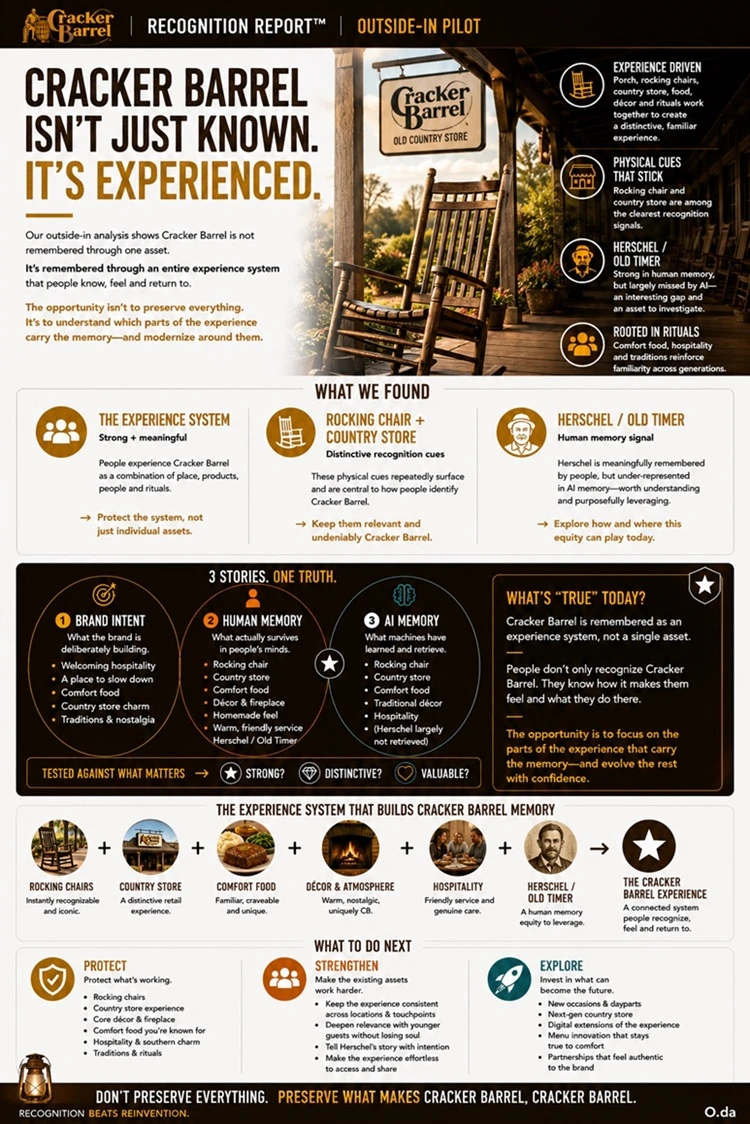
Cracker Barrel Recognition Report™
Independent outside-in pilot based on publicly available information; not commissioned by or affiliated with Cracker Barrel Old Country Store, Inc.
9. How can experimentation - such as A/B testing, prototyping or controlled market testing - help brands make more informed creative decisions before committing to a major redesign?
This is one of the areas I'm most passionate about.
We often treat creative development as a linear process: brief -> concepts -> research -> final answer.
I prefer thinking more like a builder.
Make something. Test it. Learn. Adjust. Build again.
And not every experiment needs to become an enormous research program.
We can prototype package architectures, test recognition at different exposure times, explore asset combinations, evaluate digital shelf performance, compare communication hierarchies or run controlled experiments before committing to a complete system.
AI makes the cost and speed of some of those experiments dramatically different than they were even a few years ago.
For me, experimentation isn't about replacing creativity with optimization. It's about learning before scaling.
10. Where do you see AI and other emerging tools adding value to brand diagnosis, creative exploration and experimentation - and where should human judgment remain central?
I see AI as an extraordinary accelerator of curiosity.
It allows us to ask more questions, explore more possibilities, analyze larger bodies of information and prototype ideas faster.
I use it across different stages of the creative process: diagnosis, synthesis, exploration, visualization and experimentation.
But speed creates another risk: because we can generate hundreds of possibilities, we can mistake abundance for insight.
AI can help identify patterns. It can help us explore. It can help us challenge assumptions.
But humans still have to decide what matters.
Strategy, empathy, cultural nuance, taste, judgment and the ability to connect seemingly unrelated signals remain deeply human responsibilities.
The future I'm interested in isn't AI versus creativity. It's what becomes possible when curious creative people have much more powerful tools.
11. Could AI potentially help brands uncover overlooked or underused brand assets by analyzing consumer responses, visual systems, language and historical brand data?
Absolutely, and I think this is one of its more interesting applications.
Imagine being able to examine years of packaging, advertising, consumer language, social conversation, imagery and brand documentation and ask: What keeps showing up? What do consumers repeatedly associate with us? What are we overlooking because it has become invisible to the people closest to the brand?
AI can help surface patterns across volumes of information humans simply couldn't review with the same speed.
But I wouldn't treat the output as truth. I'd treat it as a hypothesis generator.
That is also why I don't look at AI memory in isolation. I want to compare what machines retrieve with what the brand is deliberately building and what appears to survive in human memory. The differences can be as useful as the overlaps.
Then we validate those hypotheses using consumers, behavioral evidence and human judgment.
That's a much more powerful role for AI than simply asking it to make another logo.
12. How should organizations manage the tension between data-driven recommendations and creative intuition when the two point in different directions?
I don't think one should automatically win.
Data tells us something about what has happened or how people respond under particular conditions. Creative intuition allows us to imagine something that doesn't exist yet.
Some of the most interesting opportunities happen when those two disagree.
Instead of asking, "Who is right?", I ask: "What would we need to learn to make this decision?"
Then design the experiment.
That changes disagreement from politics and opinion into curiosity.
And curiosity is one of the most useful creative tools we have.
13. For brands operating across multiple markets, products or channels, how can they determine which elements should remain globally consistent and which can evolve locally?
I've worked with brands across markets, and one thing I've learned is that consistency doesn't mean identical execution everywhere.
The goal is to identify the non-negotiable memory structures that make the brand recognizable, while allowing enough flexibility for cultural relevance, language, channel and local consumer behavior.
I think of strong brand systems less as rigid rulebooks and more as systems with a strong center and intelligent flexibility around it.
If everything is flexible, the brand fragments.
If nothing is flexible, the brand can become culturally tone-deaf or operationally impractical.
The craft is knowing which is which.
14. If a brand leader is considering a redesign today, what three questions should they answer before changing anything - and what would you advise them to measure after the change?
I would ask:
1. What are consumers already remembering about us?
2. Which of those memory structures are helping us - and which are holding us back?
3. What evidence will tell us that the change made the brand stronger rather than simply different?
And after launch, don't only measure whether people like the new design.
Measure whether they recognize it, understand it, remember it and ultimately choose it.
Because ultimately, that's the work:
Be recognized.
Be remembered.
Be chosen.
Editorial note on supporting visuals:
The Recognition Report™ examples included in this interview are independent, outside-in analyses created as exploratory pilots using publicly available information. They are included to illustrate the methodology and are not client engagements, endorsements or commissioned work. The underlying diagnostic, evaluation and scoring mechanics remain proprietary.