


Articles
Corrugated Boxes & Cartons Buying Guide
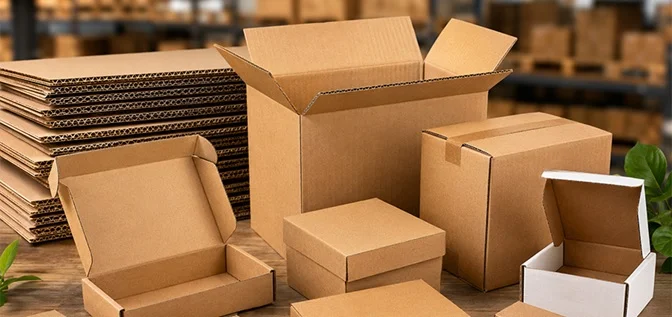
Table of Contents
1. What Are Corrugated Boxes?
2. Types of Corrugated Board
3. Key Specifications to Check
4. How to Choose the Right Box Size & Style
5. MOQ, Lead Time & Pricing Factors
6. Custom Printing Options
7. Sustainability & Recyclability
8. Supplier Verification Checklist
9. Common Mistakes Buyers Make
10. Frequently Asked Questions
1. What Are Corrugated Boxes?
Corrugated boxes are packaging made from corrugated fiberboard — a material built from one or more fluted (wavy) paper layers glued between flat linerboards. The fluting creates air pockets that give the board its strength, cushioning, and insulation properties, making it the standard choice for shipping, storage, and retail packaging across almost every industry.
They are used for everything from e-commerce parcels and retail product boxes to heavy industrial shipments and export crates. Because the material, strength, and construction can be customized, corrugated boxes are one of the most versatile and cost-effective packaging formats on the market.
Corrugated is the dominant packaging material across industries for a simple reason: it offers the best balance of strength-to-weight ratio, cost, and customizability of any packaging format available at scale. A single supplier can typically produce boxes ranging from small retail cartons to large industrial crates using the same base material, just with different wall constructions and flute combinations — which is part of why it remains the default choice for procurement teams across sectors like e-commerce, FMCG, electronics, automotive parts, pharmaceuticals, and industrial manufacturing.
It's also one of the most sustainable mainstream packaging materials, since it's made primarily from recycled paper fiber and is itself recyclable — a growing consideration for buyers with sustainability sourcing requirements (more on this in Section 7).
Buyer Tip: If you're sourcing packaging for the first time, start by defining your product's weight, fragility, and shipping distance — these three factors drive almost every specification decision that follows.
2. Types of Corrugated Board
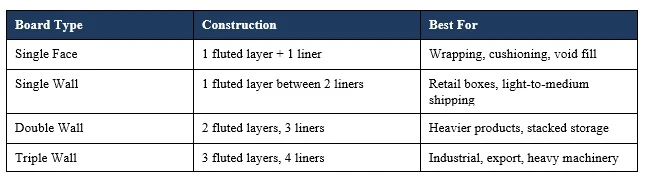
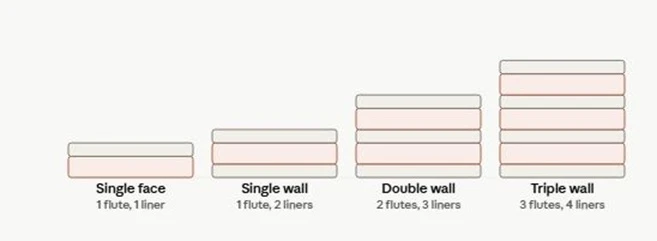
Corrugated board comes in different wall constructions, each suited to different load and protection requirements.
Flute Types
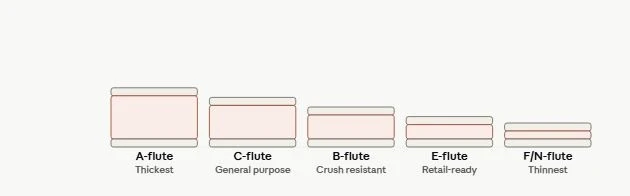
Flute size affects cushioning, stacking strength, and print quality:
- A-Flute — Largest flute, best cushioning and stacking strength
- B-Flute — Good crush resistance, commonly used for retail packaging
- C-Flute — Balance of cushioning and printability; most common general-purpose flute
- E-Flute — Thin profile, strong print surface, ideal for retail-ready packaging
- F/N-Flute (Micro-flute) — Very thin, used for premium retail and point-of-sale boxes
Which Type Should You Choose?
As a general rule of thumb: single wall board covers the vast majority of e-commerce and retail shipping needs, double wall is worth the extra cost once product weight exceeds roughly 15–20 kg or when boxes will be stacked several layers high in a warehouse, and triple wall is reserved for heavy machinery, palletized industrial goods, or export shipments that face rough handling across multiple transit legs. If you're unsure, most suppliers will recommend a construction based on your product weight, dimensions, and shipping method — it's worth asking for this recommendation in writing before finalizing an order.
3. Key Specifications to Check
Before placing an order, confirm these specifications with your supplier — they determine whether the box will actually perform under your shipping and storage conditions.
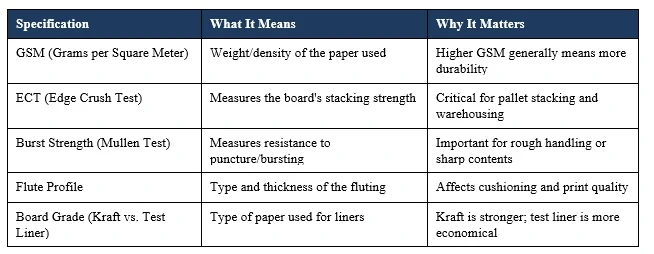
Buyer Tip: Always ask for ECT and burst strength ratings in writing — not just 'heavy duty' or 'export quality' as a description. These vague terms aren't standardized and can lead to under-specified packaging.
4. How to Choose the Right Box Size & Style
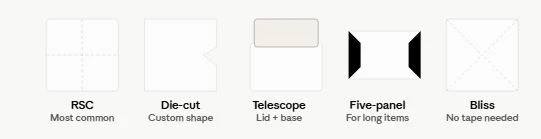
Box style should match your product shape, fulfillment method, and branding needs.
- RSC (Regular Slotted Container) — The most common style; economical and easy to assemble
- Die-Cut Boxes — Custom shapes for branding or product-specific fit, ideal for retail-ready packaging
- Telescope Boxes — Separate lid and base, used for premium or oversized products
- Five Panel Folder (FPF) — Wraps around long or flat products with added edge protection
- Bliss Boxes — Made from a single blank without taping; good for lightweight, quick-assembly needs
When sizing boxes, leave minimal void space (under 10–15%) to reduce the need for excess filler material and prevent in-transit shifting, while still allowing your cushioning method to function properly.
5. MOQ, Lead Time & Pricing Factors
Corrugated packaging pricing and order quantities vary significantly based on customization level and supplier capacity.


Key cost drivers include board grade, wall type, box dimensions, print complexity, and order volume. Buying in bulk and standardizing box sizes across SKUs are the two most effective ways to reduce per-unit cost.
Beyond volume, a few less obvious factors influence pricing: raw material (kraft paper) costs fluctuate with global pulp prices, so quotes can shift month to month; box dimensions that are non-standard or oversized may require custom die-cutting tools, adding a one-time setup fee; and rush orders with compressed lead times typically carry a premium of 10–25% over standard turnaround. If your order volume is predictable, locking in a quarterly or annual rate with a supplier is often more cost-effective than repeated spot orders.
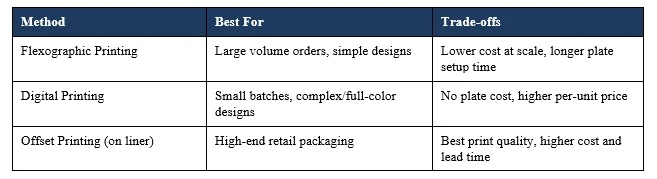
6. Custom Printing Options
If you need branded packaging, understanding the printing method helps you evaluate quotes and set realistic expectations for turnaround and cost.
7. Sustainability & Recyclability
Sustainability has moved from a nice-to-have to a sourcing requirement for many buyers, particularly those supplying retail chains, export markets, or brands with public environmental commitments. Corrugated packaging has a genuine advantage here compared to plastic-based alternatives: it's typically made from 70–90% recycled fiber, is fully recyclable through standard paper recycling streams, and biodegrades far faster than plastic packaging if it ends up in landfill.
When sustainability matters for your sourcing decisions, look for the following from suppliers:
- FSC (Forest Stewardship Council) certification — confirms the paper fiber comes from responsibly managed forests
- Recycled content percentage — ask suppliers to specify, since this varies by board grade
- Water-based or soy-based inks for printing — lower environmental impact than solvent-based alternatives
- Minimal or no plastic lamination — laminated boxes are harder to recycle through standard paper streams
Buyer Tip: If your buyers or retail partners require sustainability documentation, ask suppliers for certifications upfront — retrofitting compliance after an order is placed is far more difficult than screening for it during sourcing.
8. Supplier Verification Checklist
Before committing to a supplier, verify the following to reduce sourcing risk:
- Request physical samples before placing a bulk order
- Confirm board specifications (GSM, ECT, flute type) in writing
- Check certifications relevant to your industry (ISO 9001, FSC, food-grade compliance if applicable)
- Ask for references or verified transaction history on the marketplace
- Clarify MOQ, lead time, and payment terms upfront
- Confirm packaging tolerances (size, print alignment) and defect/return policy
9. Common Mistakes Buyers Make
- Choosing a box based on price alone without checking ECT/burst strength ratings
- Leaving excess void space, leading to product movement and damage in transit
- Not requesting a sample before a bulk production run
- Overlooking climate/humidity conditions during storage or shipping, which affect board performance
- Failing to confirm die-line and print proofs before mass production
Buyer Tip: A small investment in sampling and spec verification upfront is far cheaper than a bulk order that fails during shipping or storage.
10. Frequently Asked Questions
What's the difference between corrugated and cardboard?
“Cardboard” is a general consumer term often used loosely to describe any thick paper packaging. “Corrugated” specifically refers to fluted board construction (linerboard-flute-linerboard), which is what's used for shipping boxes. A cereal box, by contrast, is usually made of paperboard — a single, non-fluted layer that's thinner and less durable.
How long does a custom corrugated box order take?
Standard stock sizes can ship within 3–7 days. Custom printed or die-cut orders typically take 2–4 weeks, factoring in artwork approval, plate or die setup, and production scheduling. Building in buffer time for your first order with a new supplier is recommended, since first-run approvals can add a few extra days.
Can corrugated boxes be reused?
Yes, within reason. Single and double wall boxes can often be reused 2–3 times for non-critical shipments before the board's crush resistance degrades meaningfully. For regulated industries (food, pharma) or export shipments, using fresh boxes for each shipment is generally recommended to ensure consistent structural performance.
What's the minimum order quantity for a small business?
Many suppliers on B2B marketplaces offer MOQs as low as 100–500 units for stock sizes, making corrugated packaging accessible even for small businesses or early-stage e-commerce sellers. Custom printed boxes generally require higher MOQs due to setup costs, though digital printing options have lowered this barrier in recent years.
How do I know if a box is strong enough for my product?
Request the box's ECT and burst strength ratings and compare them against your product's weight and your typical shipping conditions (number of transit legs, stacking height in storage, distance). Reputable suppliers can recommend a specification based on these details, and it's worth requesting a test sample before committing to a full production run.
 Our Services
 Media Pack Download
 Newsletters
 Industrial Events