

Flexible Packaging Materials Buying Guide for Marketing and Sales Teams
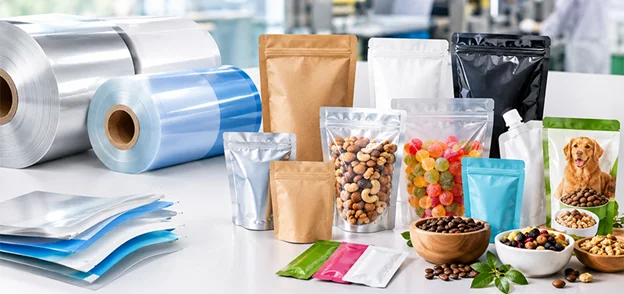
Table of Contents
- What Is Flexible Packaging?
- Types of Flexible Packaging Films
- Key Specifications to Check
- High Barrier & Metallized Options
- MOQ, Lead Time & Pricing Factors
- Custom Printing Options
- Sustainability & Recyclability
- Supplier Verification Checklist
- Common Mistakes Buyers Make
- Frequently Asked Questions
1. What Is Flexible Packaging?
Flexible packaging refers to any package made from materials - usually films, foils, or paper - that can be readily changed in shape when filled or sealed, unlike rigid containers such as bottles, jars, or boxes. Common formats include stand-up pouches, flat bags, rollstock, sachets, and shrink wrap.
This flexible packaging material guide exists because most flexible packages aren't made from a single material - they're built from two to four layers laminated together, each layer doing a different job: one for print quality, one for strength, one for sealing, and sometimes a dedicated barrier layer for shelf life. Understanding this layered structure is the single most useful thing a marketing or sales professional can know before a supplier call, because it explains why two "similar-looking" pouches can have very different costs and performance.
Flexible packaging is widely used across food and beverage, pharmaceuticals, personal care, pet food, and industrial goods - and it's increasingly replacing rigid packaging in categories where brands want lower shipping weight, better shelf standout, and reduced material use.
Buyer Tip: Before any supplier conversation, define three things - what the product needs protection from (oxygen, moisture, light), how long it needs to stay fresh, and how it will be sold (shelf, e-commerce, bulk). These three answers drive almost every material decision that follows.
2. Types of Flexible Packaging Films
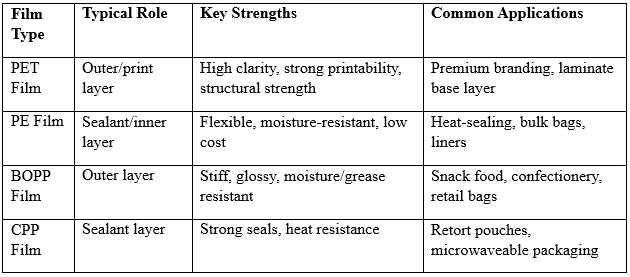
Each film in a laminate structure serves a distinct purpose — outer layers handle print and strength, inner layers handle sealing, and middle layers handle barrier.
PET Film for Flexible Packaging
PET is the go-to outer layer when a package needs sharp graphics and a glossy, premium look. It also adds structural strength to the laminate, which is why it's rarely used as a standalone film but almost always appears as the outermost layer.
PE Film for Flexible Packaging
PE film is typically the innermost layer - the part that actually seals when heat is applied. It comes in several grades (LDPE, LLDPE, HDPE), each offering a different balance of flexibility and seal strength.
BOPP Film for Packaging
BOPP gives packaging that recognizable "crinkly," glossy snack-bag feel. It's stretched in two directions during manufacturing, which improves stiffness and clarity - making it a favorite for shelf-forward retail packaging.
CPP Film for Packaging
Often confused with BOPP, CPP is a different process altogether - softer, with stronger seals and better heat resistance, which is why it's the standard choice for retort pouches that need to survive sterilization.
Which Should You Choose?
As a general rule: PET or BOPP for outer layers when print quality and shelf appeal matter most, and PE or CPP for inner sealant layers when reliable heat-sealing is the priority. Most suppliers will recommend a laminate combination once they know your product, shelf-life target, and sealing equipment.
3. Key Specifications to Check
Before finalizing an order, confirm these specifications in writing - vague terms like "food grade" or "high barrier" aren't standardized on their own.
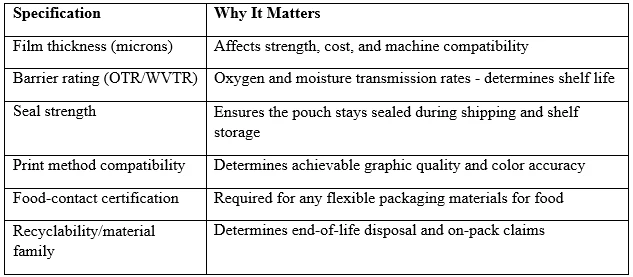
Buyer Tip: Always request OTR (oxygen transmission rate) and WVTR (water vapor transmission rate) numbers in writing, not just a "high barrier" label - these figures are what actually determine shelf life, and they're comparable across suppliers.
4. High Barrier & Metallized Options
Standard films alone rarely deliver long shelf life. For that, packaging relies on dedicated barrier layers.
High barrier packaging materials block oxygen, moisture, light, and aroma transfer far more effectively than a single film can. These are essential for coffee, dried snacks, pet food, pharmaceuticals, and other long-shelf-life products. Barrier is typically achieved by adding a specialty layer - EVOH, metallized film, or foil - into the laminate.
Metallized film packaging applies a thin, vaporized aluminum layer onto a base film (usually PET or BOPP), boosting barrier performance against light and oxygen while giving packaging a reflective, premium look - at a fraction of the weight and cost of real foil. It's the most common middle-ground choice for snacks, coffee, and confectionery.
Aluminum foil flexible packaging remains the gold standard when a product needs near-total barrier protection - pharmaceuticals, retort pouches, and products with zero tolerance for oxygen or moisture. The tradeoff is cost, weight, and recyclability: foil laminates typically can't go through standard film recycling streams.
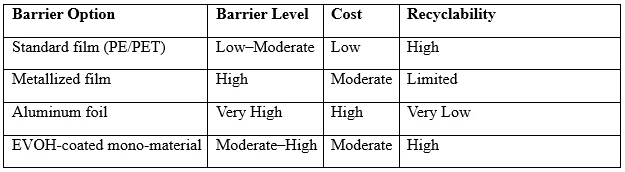
Buyer Tip: If your product doesn't need multi-year shelf stability, ask your supplier whether a metallized film or EVOH-coated mono-material can meet your barrier needs before defaulting to foil - it's often a meaningful cost and sustainability improvement with little performance tradeoff.
5. MOQ, Lead Time & Pricing Factors
Flexible packaging pricing and minimum order quantities vary based on film type, print complexity, and supplier capacity.
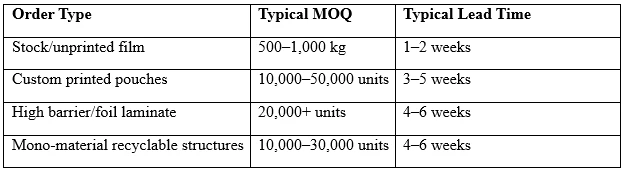
Key cost drivers include film type, number of laminate layers, barrier requirements, print complexity, and order volume. Beyond volume, resin and aluminum prices fluctuate with global commodity markets, so quotes can shift month to month; non-standard pouch sizes may require custom tooling with a one-time setup fee; and rush orders typically carry a 10–20% premium over standard lead times. If your volume is predictable, negotiating a quarterly rate is usually more cost-effective than repeated spot orders.
6. Custom Printing Options
For branded packaging, the printing method affects both cost and achievable visual quality.
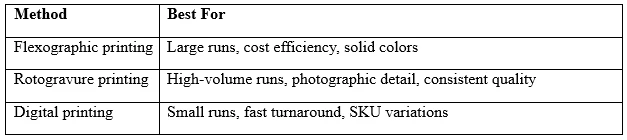
Buyer Tip: If you're testing a new product line or running seasonal SKUs, digital printing lets you order smaller batches without the setup cost of gravure cylinders - useful for marketing teams that need flexibility over volume pricing.
7. Sustainability & Recyclability
Sustainability has shifted from a marketing talking point to a hard sourcing requirement for many retailers and brand owners - but flexible packaging's traditional multi-material laminates make this genuinely tricky.
Mono material flexible packaging refers to structures built from a single polymer family - typically all-PE or all-PP - instead of a mixed laminate like PET/foil/PE. Because the whole structure is chemically similar, it can go through existing single-polymer recycling streams. The tradeoff is barrier performance: mono-material structures generally can't match foil or EVOH laminates, so they suit products like rice, pasta, or personal care better than coffee or shelf-stable meat.
Sustainable flexible packaging materials is the broader category, including mono-material films, post-consumer recycled (PCR) content, compostable films, and down-gauged films that use less material overall. When evaluating suppliers, ask specifically whether a material is:
- Recyclable - technically capable, if the right infrastructure exists
- Recycled - has verified collection and reprocessing streams
- Compostable - usually requires industrial composting, not backyard conditions
These distinctions matter for how marketing teams can legally and credibly make on-pack sustainability claims.
Buyer Tip: If retail partners or regulators require sustainability documentation, ask suppliers for certifications and testing data upfront - retrofitting compliance after production is far harder than screening for it during sourcing.
8. Supplier Verification Checklist
Before committing to a supplier, verify the following:
- Request physical samples before placing a bulk order
- Confirm film specifications (thickness, barrier rating, seal strength) in writing
- Check relevant certifications (ISO 9001, food-grade compliance, BRC/FSSC for food packaging)
- Ask for references or verified transaction history
- Clarify MOQ, lead time, and payment terms upfront
- Confirm print proof approval process and defect/return policy
9. Common Mistakes Buyers Make
- Choosing a film based on price alone without checking barrier ratings (OTR/WVTR)
- Assuming "recyclable" and "recycled" mean the same thing
- Not requesting a sample before a bulk production run
- Overlooking food-contact certification requirements for edible products
- Failing to confirm print proofs and die-lines before mass production
- Selecting foil or high-barrier laminates by default, even when a lighter structure would work
Buyer Tip: A small investment in sampling and spec verification upfront is far cheaper than a bulk order that fails to seal properly or falls short on shelf life.
10. Frequently Asked Questions
What is the most sustainable flexible packaging material?
Mono-material PE or PP structures are currently the most recyclable option, since they can be processed through existing single-polymer recycling streams, though they offer lower barrier performance than foil or metallized alternatives.
Which film gives the best barrier protection for coffee packaging?
Metallized film or aluminum foil laminates provide the strongest oxygen and light barrier for coffee, which is why most coffee bags use one of these two options along with a one-way degassing valve.
Is BOPP the same as CPP?
No. BOPP (biaxially oriented polypropylene) is stiffer and glossier, typically used as an outer print layer, while CPP (cast polypropylene) is softer with better seal strength and heat resistance, typically used as a sealant layer.
Can flexible packaging be both high-barrier and recyclable?
It's improving but still difficult - newer mono-material structures with specialty barrier coatings are closing the gap, though traditional foil and metallized laminates still outperform them on pure barrier at the cost of recyclability.
What certifications should food-grade flexible packaging have?
Look for food-contact safety certification (FDA, EU 10/2011, or the equivalent in your market), and for higher-risk categories, BRC or FSSC 22000 certification from the supplier's facility.
How do I choose between PET, BOPP, and PE for my product?
Match the film to the job: PET or BOPP for outer layers needing print quality and stiffness, and PE or CPP for inner sealant layers needing flexibility and reliable heat-sealing.
 Our Services
 Media Pack Download
 Newsletters
 Industrial Events