

Articles
Form Fill Seal Machines Buying Guide for Packaging Specialists
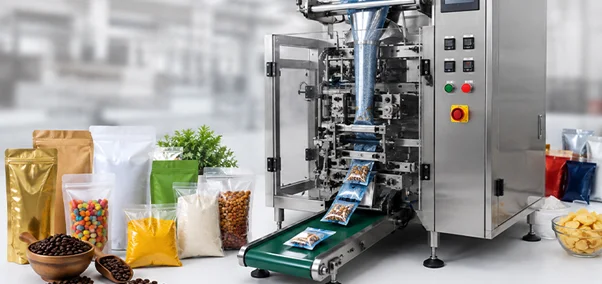
Table of Contents
- What Are Form Fill Seal Machines?
- Types of Form Fill Seal Machines
- Key Specifications to Check
- How to Choose the Right Machine for Your Product
- MOQ, Lead Time & Pricing Factors
- Automation Levels & Add-On Features
- Hygiene, Safety & Compliance
- Supplier Verification Checklist
- Common Mistakes Buyers Make
- Frequently Asked Questions
1. What Are Form Fill Seal Machines?
Form fill seal machines are automated packaging systems that form a pouch or bag from a roll of film, fill it with product, and seal it — all in a single continuous cycle. This three-in-one process is why they're a staple across food, pharmaceutical, chemical, agricultural, and consumer goods manufacturing: a single form fill seal packaging machine can replace several separate stations (bag-making, filling, sealing) with one integrated line, cutting labor costs and reducing product handling.
The category spans a wide range of machine sizes and configurations, from compact tabletop units for small-batch producers to high-speed industrial lines running thousands of pouches per hour. Because of this range, a form fill seal machine buying guide is useful whether you're a startup packaging spice blends or a plant manager sourcing equipment for a multi-shift snack food line.
Form fill seal machines have become the default choice for flexible packaging because they offer a strong balance of speed, film efficiency, and adaptability to different product types — powders, liquids, granules, and solid pieces can often run on the same base platform with different filling modules.
Buyer Tip: Before contacting manufacturers, define your product's flow characteristics (free-flowing powder, sticky paste, chunky solid, liquid), your target output rate, and your desired bag style — these three factors narrow down machine type faster than any other specification.
2. Types of Form Fill Seal Machines
Form fill seal equipment is generally divided by the orientation in which the bag is formed and filled.
Machine Type | Best For | Typical Products Vertical Form Fill Seal (VFFS) | High-speed pouch production, gravity-fed filling | Powders, granules, snacks, liquids Horizontal Form Fill Seal (HFFS) | Flat or shaped pouches, delicate products | Bars, wipes, sachets, solid pieces Pre-Made Pouch FFS | Premium or complex pouch styles | Stand-up pouches, spouted pouches
Vertical vs. Horizontal
A vertical form fill seal machine forms the film into a tube, fills product from above using gravity, and seals bottom-to-top as the pouch descends — making it the go-to choice for powders, granules, and free-flowing products where speed matters. A horizontal form fill seal machine, by contrast, moves film through the machine on a flat plane, which suits products that need to be placed precisely (bars, wipes, delicate solids) or that require a flat-bottom or shaped pouch. Neither type is universally "better" — the right choice depends entirely on product characteristics and desired bag style.
Which Type Should You Choose?
As a general rule of thumb: VFFS machines dominate high-volume powder and granule packaging because of their speed and smaller footprint, HFFS machines are preferred when product placement or shape matters more than raw throughput, and pre-made pouch systems are worth the added cost when brand differentiation (stand-up pouches, resealable zippers, spouts) is a priority. If you're unsure which fits your line, most form fill seal machine manufacturers will run a trial with your actual product and film before you commit to a purchase.
3. Key Specifications to Check
Before finalizing an order, confirm these specifications with your supplier — they determine whether the machine will actually hit your target output and pouch quality.
Specification | Why It Matters Output speed (bags/min or pouches/hour) | Determines whether the line meets production targets Film width & bag size range | Confirms compatibility with your packaging format Filling accuracy (+/- grams or ml) | Affects product giveaway and compliance with declared weights Sealing method (heat, ultrasonic, impulse) | Impacts seal integrity across film types Compatible film types | Confirms material compatibility (laminates, mono-film, foil) Control system & changeover time | Affects flexibility across multiple SKUs
Buyer Tip: Always request documented form fill seal machine specifications in writing — including tested output rates on your actual product, not just the manufacturer's rated maximum speed on an ideal test material. Rated speeds are often achieved under conditions that don't reflect real production runs.
4. How to Choose the Right Machine for Your Product
Choosing the right equipment starts with matching machine type to product behavior, not the other way around.
Powders & Granules — Best suited to VFFS with auger or volumetric fillers for consistent dosing Liquids & Pastes — Require piston or pump fillers integrated with a VFFS or HFFS frame Solid & Irregular Pieces — Often better suited to HFFS with precise product placement Multi-SKU Operations — Favor machines with quick-change tooling and programmable recipes to minimize downtime between runs
When evaluating form fill seal machine selection criteria, weigh product characteristics, required output speed, film compatibility, floor space, and long-term flexibility for future SKUs together rather than optimizing for any single factor in isolation. A machine that's fast but inflexible can become a bottleneck the moment your product line expands.
5. MOQ, Lead Time & Pricing Factors
Form fill seal machine cost varies enormously based on automation level, output speed, and customization.
Factor | Typical Range Entry-level semi-automatic units | Lower upfront cost, manual film loading and adjustments Fully automatic form fill seal machine | Higher upfront cost, integrated weighing, filling, and quality checks Custom tooling (bag size, film type) | Added one-time engineering and setup fees Lead time | 4–12 weeks for standard configurations; 12–20 weeks for heavily customized lines
Key cost drivers include filling mechanism complexity (auger vs. piston vs. multi-head weigher), sealing technology, control system sophistication, and the level of integration with upstream/downstream equipment like conveyors or case packers. Buying a slightly larger-capacity machine than your current needs, rather than upgrading again within a year or two, is often more cost-effective over the equipment's lifespan.
Beyond the base machine price, a few less obvious factors influence total cost of ownership: spare parts availability and pricing vary significantly between manufacturers, film compatibility may require re-testing if you switch suppliers later, and operator training costs should be factored into your budget for fully automatic systems with programmable controls. If your production volume is predictable, negotiating a service and spare-parts agreement alongside the machine purchase is generally worth the added upfront cost.
6. Automation Levels & Add-On Features
Automation level is one of the biggest differentiators in both cost and labor requirements.
Method | Best For Manual/Semi-Automatic | Low-volume producers, frequent product changeovers Automatic Form Fill Seal Machine | Mid-to-high volume lines needing consistent throughput with minimal operator input Fully Integrated Systems | High-volume facilities running continuous multi-shift production
Common add-ons worth evaluating include checkweighers for regulatory compliance, metal detectors for food and pharma applications, date/lot coders, gas flushing (MAP) for shelf-life extension, and zipper or spout applicators for resealable packaging. Each addition increases upfront cost and machine footprint, so it's worth prioritizing add-ons based on regulatory requirements first and brand differentiation second.
7. Hygiene, Safety & Compliance
Compliance requirements have become a core part of sourcing decisions for buyers in food, pharmaceutical, and nutraceutical sectors. A form fill seal machine intended for these industries typically needs to meet specific hygienic design and safety standards.
When compliance matters for your sourcing decision, look for the following from manufacturers:
Food-grade or pharma-grade contact materials (stainless steel construction, FDA/EU-compliant components) CE, UL, or equivalent regional safety certifications Washdown-rated construction for facilities requiring frequent sanitation Documentation supporting HACCP or GMP compliance where applicable.
Buyer Tip: If your end customers or regulatory bodies require compliance documentation, request certifications and material data sheets upfront — verifying compliance after a machine is already installed on your production floor is far more disruptive than screening for it during sourcing.
8. Supplier Verification Checklist
Before committing to a form fill seal machine manufacturer, verify the following to reduce sourcing risk:
Request a live demonstration or video trial run using your actual product and film Confirm machine specifications (speed, accuracy, film compatibility) in writing Check certifications relevant to your industry (CE, UL, food-grade compliance if applicable) Ask for references or verified installation history with similar production requirements Clarify lead time, installation support, and training included in the purchase Confirm warranty terms, spare parts availability, and after-sales service response times
9. Common Mistakes Buyers Make
Choosing a machine based on rated maximum speed rather than tested speed on your actual product Underestimating film compatibility issues between different laminate structures Not requesting a trial run before committing to a full purchase Overlooking changeover time when running multiple SKUs on one line Failing to budget for operator training and ongoing maintenance costs
Buyer Tip: A trial run with your own product and film, even at added cost, is far cheaper than discovering compatibility or accuracy issues after the machine is installed.
10. Frequently Asked Questions
What's the difference between VFFS and HFFS machines?
A vertical form fill seal machine forms and fills pouches top-to-bottom using gravity, making it faster and more compact — ideal for powders and granules. A horizontal form fill seal machine runs film on a flat plane, allowing precise product placement, which suits solid or delicate items and shaped pouches. Choosing between them depends primarily on product form and desired pouch style rather than speed alone.
How do I know which machine size or speed I need?
Start by calculating your required daily or weekly output, then work backward to a bags-per-minute target with some buffer for downtime and changeovers. Reputable manufacturers can recommend a suitable model based on your product, target speed, and film type, and most will offer a test run before you finalize an order.
What does a form fill seal machine typically cost?
Pricing ranges widely: semi-automatic entry-level units are the most affordable option for low-volume producers, while a fully automatic form fill seal machine with integrated weighing, filling, and quality control systems represents a significantly higher investment. Custom tooling, add-on features, and film compatibility requirements all affect the final quote, so it's worth comparing multiple manufacturers against the same specification sheet.
How long does installation and setup take?
Standard configurations typically take 4–12 weeks from order to delivery, with additional time for on-site installation, calibration, and operator training. Heavily customized machines or those requiring integration with existing production lines can take considerably longer, so building in buffer time is recommended, particularly for a first order with a new supplier.
Can one machine run multiple product types or pouch sizes?
Many modern machines support this through programmable recipes and quick-change tooling, though changeover time and film compatibility should be confirmed with the manufacturer beforehand. If your operation runs multiple SKUs regularly, prioritizing changeover speed during the selection process can meaningfully reduce downtime over the equipment's lifespan.
 Our Services
 Media Pack Download
 Newsletters
 Industrial Events