


Articles
Sustainable Flexible Packaging Buying Guide for Business Development
Table of Contents
1. What Is Sustainable Flexible Packaging?
2. Eco-Friendly Flexible Packaging Materials
3. Recyclable vs Compostable Flexible Packaging
4. Key Specifications to Check
5. Cost of Sustainable Flexible Packaging vs Conventional
6. EPR Flexible Packaging Requirements
7. Sustainable Packaging Supplier Evaluation Criteria
8. Sustainable Packaging Procurement Checklist
9. Common Mistakes Buyers Make
10. Frequently Asked Questions
1. What Is Sustainable Flexible Packaging?
Flexible packaging covers pouches, sachets, stand-up bags, rollstock, wraps, and liners. They are made from films, foils, and paper-based laminates rather than rigid materials. It's popular because it's lightweight, uses less material per unit of product, ships efficiently, and protects food, personal care, pet care, and industrial goods well.
The catch is that conventional flexible packaging is usually a multi-layer laminate. Layers of PET, nylon, aluminum foil, and polyethylene are bonded together to deliver barrier performance, but those layers are very hard to separate in a recycling facility. Sustainable flexible packaging tries to keep the performance while fixing the end-of-life problem, either by simplifying the structure, adding recycled content, or switching to materials designed to break down.
If you're a business developer, this guide is meant to be your working reference. It covers how to compare options and what questions to put to suppliers, and which claims to double-check before you commit a budget to a switch.
Buyer Tip: Before you contact a single supplier, write down what your pack actually has to do: shelf life, barrier needs, filling-line speed, and where the product is sold. Sustainability decisions only make sense against those requirements.
2. Eco-Friendly Flexible Packaging Materials
There's no single "green" material. Each option trades off performance, cost, and end-of-life.
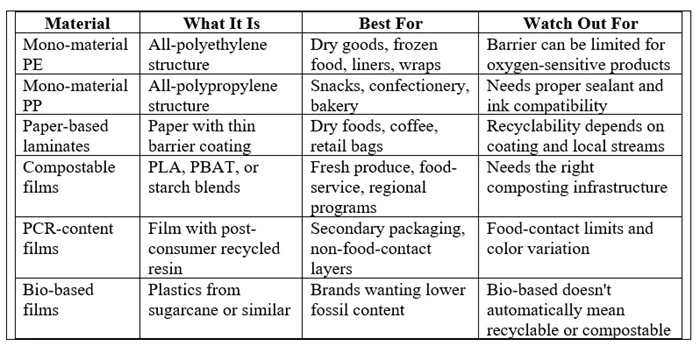
Mono-material flexible packaging deserves special attention. Because every layer is the same polymer family, the whole pouch can enter an existing plastic film recycling stream. That's why it has become the starting point for most serious redesign projects. Modern high-barrier coatings and orientation techniques have narrowed the performance gap with traditional laminates, though not for every application.
3. Recyclable vs Compostable Flexible Packaging
This is the question buyers ask most, and the answer depends on your market, not just the material.
Recyclable packaging is designed to be collected, sorted, and reprocessed into new material. Its real-world benefit depends on whether film collection actually exists where your customers live. Some regions have store drop-off programs, others have almost none.
Compostable packaging is designed to break down in a composting environment. Industrial composting needs controlled heat and moisture, and many households and cities can't offer that. If compostable packaging ends up in regular trash or the recycling bin, it can cause contamination without delivering any benefit.
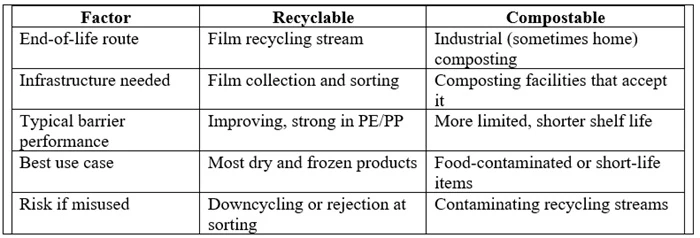
As a rule of thumb, choose recyclable for most consumer products, and compostable only when the packaging is likely to be heavily contaminated with food waste or when a verified composting program exists. Whichever you choose, ask for the certification behind the claim rather than accepting a marketing statement.
Buyer Tip: Ask suppliers to state exactly which standard or test supports their "recyclable" or "compostable" claim, and for which country or region. A claim that's valid in one market can be misleading in another.
4. Key Specifications to Check
Switching materials can quietly change how your packaging behaves on the line and on the shelf. Confirm these in writing:
- Barrier properties: oxygen (OTR), moisture (WVTR), and light protection against your product's shelf-life target
- Seal strength and seal window: especially important when moving from laminates to mono-material, as heat-seal behavior differs
- Thickness and gauge: thinner is not always better; check puncture and drop performance
- PCR content flexible packaging: the percentage of post-consumer recycled content, how it's measured, and whether it's certified (for example by a chain-of-custody scheme)
- Food-contact compliance: PCR and bio-based films may have restrictions depending on the layer and region
- Print quality and ink system: low-migration, solvent-free or water-based inks where possible
- Machine compatibility: run a trial on your filling line before full production
Buyer Tip: Never approve a sustainable switch on lab data alone. A pilot run on your own equipment will reveal sealing, tracking, and jamming problems that spec sheets can't.
5. Cost of Sustainable Flexible Packaging vs Conventional
Let's be honest: sustainable options often cost more per unit, particularly at lower volumes. The size of the premium depends on the material, the complexity of the structure, and how much the supplier has to adjust production.
Where the premium comes from:
- Specialty resins and certified recycled content that cost more than virgin material
- New cylinders, plates, or tooling when artwork or structure changes
- Smaller supplier scale for newer materials
- Testing and certification costs passed through to buyers
Where you can recover value:
- Downgauging: a well-designed mono-material pouch may use less material overall
- Lower fees under EPR schemes: in many programs, recyclable packaging is charged less than hard-to-recycle formats
- Retail and brand access: some retailers now prefer or require recyclable packaging
- Volume commitments: annual contracts typically stabilize pricing
When comparing quotes, look at total cost, not unit price alone: include line efficiency, wastage, freight, compliance fees, and potential shelf-life impact. MOQs for sustainable films can be higher or lead times longer because materials are less standardized, so confirm both early. Custom-printed runs often need several weeks, plus extra time for approvals and trials.
Buyer Tip: Ask for a side-by-side quote that includes your current structure and two sustainable alternatives. It makes the trade-offs visible and strengthens your internal business case.
6. EPR Flexible Packaging Requirements
Extended Producer Responsibility (EPR) rules make brands and producers financially, and sometimes operationally, responsible for the packaging they put on the market. Many regions have introduced or expanded EPR laws, and flexible packaging is often a focus because it's hard to recycle.
Requirements vary by country and, in some places, by state or province, but they commonly include:
- Registering as a producer with the relevant authority or compliance scheme
- Reporting packaging types and weights placed on the market
- Paying fees, often based on material and recyclability
- Meeting recycled-content or recyclability targets over time
- Following labeling rules for recycling instructions
Because rules differ and keep changing, confirm current requirements for every market you sell into, and consult a compliance specialist where needed. A good supplier should be able to provide material declarations and weights that make your reporting easier.
Buyer Tip: Build EPR compliance into supplier conversations from the start. Packaging that qualifies as recyclable today may be assessed differently as local rules tighten.
7. Sustainable Packaging Supplier Evaluation Criteria
A supplier's claims are only as good as their evidence. Use these criteria when comparing candidates:
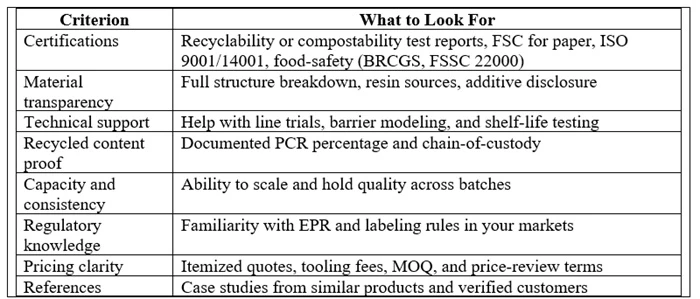
Buyer Tip: Be cautious of vague labels like "eco-friendly" or "green" with nothing behind them. Reliable suppliers will share test data without being pushed.
8. Sustainable Packaging Procurement Checklist
Use this as a working checklist when you choose sustainable flexible packaging:
- Define product requirements: shelf life, barrier, fill temperature, and line speed
- Set sustainability goals: recyclable, compostable, PCR target, or weight reduction
- Identify target markets and the recycling or composting infrastructure in each
- Check applicable EPR and labeling requirements
- Shortlist suppliers and request material specifications and certificates
- Obtain physical samples and run seal, drop, and shelf-life tests
- Trial on your actual filling line before approving
- Compare total cost, including tooling, MOQ, wastage, and compliance fees
- Confirm artwork proofs, print specifications, and color tolerances
- Agree on lead times, quality tolerances, and defect or return terms
- Document claims and keep supporting evidence for audits or retailer requests
- Schedule a review of material and regulatory changes each year
9. Common Mistakes Buyers Make
- Choosing packaging on the "sustainable" label alone without checking real-world recyclability in the target market
- Treating bio-based, biodegradable, and compostable as the same thing
- Skipping line trials, then discovering sealing or jamming problems at scale
- Ignoring barrier needs and cutting shelf life
- Comparing unit prices without counting EPR fees, wastage, and tooling
- Waiting until a retailer or regulator asks for documentation before gathering it
- Making sweeping environmental claims on-pack that the evidence can't support
Buyer Tip: Small pilots are cheaper than recalls and re-prints. Test, document, and scale gradually.
10. Frequently Asked Questions
What is the easiest first step toward sustainable flexible packaging?
For many products, moving to a mono-material PE or PP structure is the most practical first step. It keeps the format familiar, works with existing recycling routes in many regions, and often requires fewer changes than switching to compostable materials.
Is compostable packaging better than recyclable packaging?
Not automatically. Compostable packaging only delivers its benefit if it reaches suitable composting facilities. Recyclable packaging is typically the better choice where film collection exists and where products aren't heavily food-contaminated.
How much PCR content should I ask for?
It depends on the application and your goals. Food-contact layers may be restricted, so PCR is often used in non-contact layers or secondary packaging. Ask the supplier what percentage is achievable, how it's verified, and how it affects appearance and strength.
Will sustainable flexible packaging shorten my product's shelf life?
It can, if the barrier is reduced. That's why shelf-life testing is essential. Many mono-material structures with modern barrier technology can match or come close to conventional performance, but you should verify this for your specific product.
How do I know a supplier's sustainability claims are real?
Request test reports, certifications, material declarations, and customer references. Verify that claims apply to your market, and treat missing documentation as a warning sign.
 Our Services
 Media Pack Download
 Newsletters
 Industrial Events