


Articles
Sustainable Packaging Buying Guide for Marketing and Brand Differentiation

Table of Contents
- What Is Sustainable Packaging?
- Types of Sustainable Packaging Materials
- Key Specifications & Certifications to Check
- How to Choose Sustainable Packaging for Your Business
- MOQ, Lead Time & Pricing Factors
- Custom Branding & Printing Options
- Packaging for Brand Differentiation
- Supplier Verification Checklist
- Common Mistakes Buyers Make
- Frequently Asked Questions
1. What Is Sustainable Packaging?
Sustainable packaging refers to packaging designed to reduce environmental impact across its full lifecycle — sourcing, manufacturing, transport, use, and disposal. This can mean materials that are recyclable, compostable, biodegradable, made from recycled content, reusable, or simply reduced in volume so less material is used per unit shipped.
It's a broad category by design, because "sustainable" isn't a single material or spec — it's an outcome that can be reached through different combinations of material choice, sourcing, and design. This is exactly why businesses need a sustainable packaging buying guide rather than a single product recommendation: the right eco-friendly packaging for a cosmetics brand looks nothing like the right solution for an industrial parts supplier.
For businesses, sustainable packaging now serves two functions simultaneously. Operationally, it meets tightening regulations on single-use plastics and packaging waste across most major markets. Commercially, it functions as a visible signal of brand values at one of the few physical touchpoints a customer has with the company — which is why sustainable packaging for businesses is increasingly evaluated by marketing teams, not just procurement.
Buyer Tip: Before comparing materials, define what "sustainable" needs to mean for your business — recyclable in your customers' region, certified compostable, made from recycled content, or simply reduced in volume. These lead to different sourcing decisions, and vague briefs are the most common cause of mismatched supplier quotes.
2. Types of Sustainable Packaging Materials
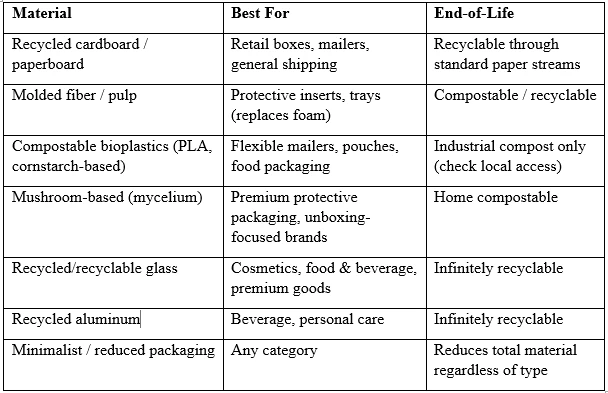
Which Type Should You Choose?
As a general rule: recycled paperboard and molded fiber cover the majority of e-commerce and retail shipping needs and are the easiest entry point into sustainable packaging solutions, since they integrate with existing recycling infrastructure almost everywhere. Compostable bioplastics are worth the added cost when a brand's customer base has genuine access to industrial composting — otherwise the material ends up in landfill despite the claim, which creates a greenwashing risk. Glass and aluminum suit premium and beverage categories where infinite recyclability and perceived quality both matter. Mycelium and other emerging materials are best suited to brands prioritizing a distinctive unboxing experience over lowest-cost sourcing. If you're unsure, ask suppliers to recommend a material based on your product category, shipping distance, and customers' regional recycling or composting infrastructure — get this recommendation in writing before finalizing an order.
3. Key Specifications & Certifications to Check
Before placing an order, confirm the following with your supplier — they determine whether the packaging actually delivers on its sustainability claim, not just its marketing description.
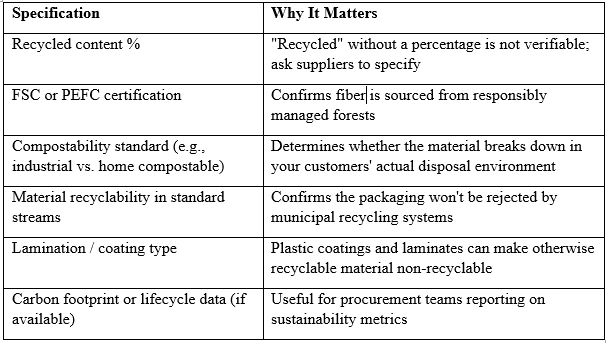
Buyer Tip: Always ask for certifications and percentages in writing — not just "eco-friendly" or "green" as a description. These terms aren't standardized and are one of the most common sources of greenwashing disputes for brands later on.
4. How to Choose Sustainable Packaging for Your Business
Businesses researching how to choose sustainable packaging often start with the material and work backward. It's more effective to work forward from these questions instead.
What does your product need to survive shipping?
Match material strength to real shipping and handling data. Overengineering wastes material and budget; underengineering increases damage and returns, which carries its own environmental and financial cost.
Where will this packaging actually end up?
If customers lack access to industrial composting, compostable material may sound ideal but end up in landfill regardless. Widely recyclable materials are often the more practical sustainable packaging solution.
What can your supplier verify?
Request certifications directly rather than relying on marketing copy — this protects your business from greenwashing exposure down the line.
What's the real cost at your order volume?
Pricing for sustainable packaging materials has narrowed considerably against conventional packaging, but the gap still varies by material and volume — get quotes specific to your business rather than relying on general industry pricing.
Does it support your brand story?
This is where a sustainable packaging procurement guide becomes a marketing decision as much as an operational one — covered further in Section 7.
5. MOQ, Lead Time & Pricing Factors
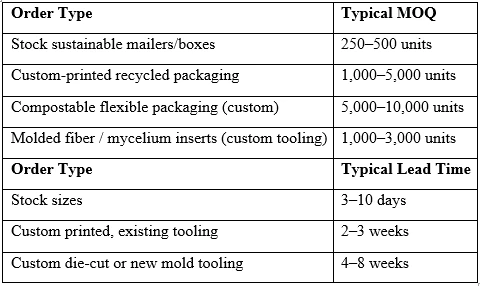
Key cost drivers include material type, certification level, print complexity, order volume, and whether custom tooling or dies are required. Standardizing packaging sizes across SKUs and buying at predictable volumes are the two most effective ways to reduce per-unit cost.
Raw material costs for recycled fiber and bioplastics fluctuate with global pulp and resin markets, so quotes can shift month to month. Non-standard dimensions may require custom tooling, adding a one-time setup fee. Rush orders typically carry a premium of 10–25% over standard turnaround. For predictable volumes, locking in a quarterly or annual rate is usually more cost-effective than repeated spot orders.
6. Custom Branding & Printing Options
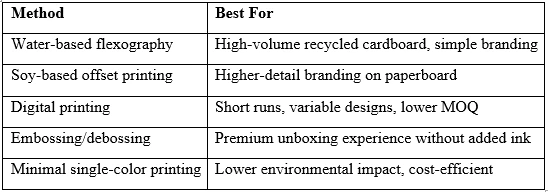
For businesses prioritizing packaging for brand differentiation, printing choice matters as much as material choice. Water-based and soy-based inks maintain recyclability and compostability, while solvent-based inks and heavy foil finishes often compromise it — undermining the sustainability claim the packaging is meant to support.
Buyer Tip: Ask suppliers whether their printing process affects the recyclability or compostability rating of the base material. Some finishes look premium but disqualify the packaging from standard recycling streams.
7. Packaging for Brand Differentiation
This is where sustainable packaging stops being a purely operational decision and becomes a marketing one.
The best sustainable packaging for brand differentiation shares a few consistent traits. It's visually distinctive through texture, color, or material rather than logo alone — customers should be able to recognize the brand from the packaging itself. It tells a specific, verifiable story: which material, why it was chosen, and what happens to it after use, rather than vague sustainability language. And it creates a moment worth sharing, whether that's a memorable unboxing experience or reusable packaging that keeps the brand visible after the sale.
Sustainable packaging trends for brands worth tracking include refill and reuse models expanding into mainstream categories, right-sizing technology that calculates the smallest viable package per order, QR-code transparency tools linking to sourcing and disposal instructions, and regional material sourcing using local agricultural byproducts to shorten supply chains and cut both cost and emissions.
Businesses that treat packaging as a marketing channel — not just a shipping requirement — typically see the differentiation payoff in customer retention, social sharing, and repeat purchase behavior, even when packaging wasn't the primary purchase driver.
8. Supplier Verification Checklist
Before committing to a supplier, verify the following to reduce sourcing and brand risk:
- Request physical samples before placing a bulk order
- Confirm material specifications and recycled/compostable content in writing
- Check relevant certifications (FSC, PEFC, compostability standards, ISO 14001)
- Ask for references or verified transaction history
- Clarify MOQ, lead time, and payment terms upfront
- Confirm whether printing or coating processes affect recyclability
- Request end-of-life guidance you can pass on to customers
9. Common Mistakes Buyers Make
- Choosing a material based on marketing appeal alone, without verifying certification
- Marketing packaging as "compostable" without confirming customer access to composting infrastructure
- Not requesting a sample before a bulk production run
- Overlooking how printing or lamination affects recyclability
- Underestimating cost differences between stock and fully custom sustainable packaging
- Treating sustainability as a one-time material swap instead of an ongoing procurement process
Buyer Tip: A small investment in sampling and certification verification upfront is far cheaper than a bulk order that draws greenwashing criticism after launch.
10. Frequently Asked Questions
What is the most cost-effective sustainable packaging option for small businesses?
Minimalist or right-sized packaging using recycled paperboard is usually the fastest and most affordable entry point, since it lowers material and shipping costs without requiring new tooling or certification investment.
Is sustainable packaging more expensive than conventional packaging?
The price gap has narrowed considerably as demand and supply have scaled, though it still varies by material and order volume. Requesting quotes at your actual business volume is the only reliable way to know the real difference.
How do I avoid greenwashing when marketing sustainable packaging?
Use verifiable third-party certifications, specify exact material and recycled content, and give customers clear, accurate disposal instructions rather than vague terms like "eco-friendly."
Can sustainable packaging really improve brand differentiation?
Yes, when paired with honest communication and a distinctive design or unboxing experience. Sustainability alone isn't a differentiator — sustainability made tangible and verifiable is.
How do I know if a sustainable material is strong enough for my product?
Request the material's protective performance data and compare it against your product's weight and typical shipping conditions. Reputable suppliers can recommend a specification based on these details, and a test sample should always precede a full production run.
 Our Services
 Media Pack Download
 Newsletters
 Industrial Events