

Automated Strapping vs Manual Solutions: Uptime, Cost and Throughput
Quick answer: which is better, manual or automatic strapping?
For most operations strapping more than a few hundred bundles or pallets per shift, an automatic strapping machine beats manual strapping on throughput, uptime and long-run cost per strap. Manual strapping still makes sense for low-volume, irregular loads. The real break-even shows up when you price in labor, rework and downtime, not just the purchase price.
Here is the short version:
- Throughput: A manual operator typically finishes a few straps a minute. An automatic strapping system can run many times faster, without slowing down at hour six.
- Uptime: Automatic machines need planned maintenance, but they remove the biggest source of line stoppages: people-dependent variation.
- Cost: Manual wins on day one. Automatic usually wins by year one or two, once labor and waste are counted.
All figures in this article are typical ranges or illustrative models. Confirm specifics with your equipment supplier before you build a business case.
Manual vs automatic strapping at a glance
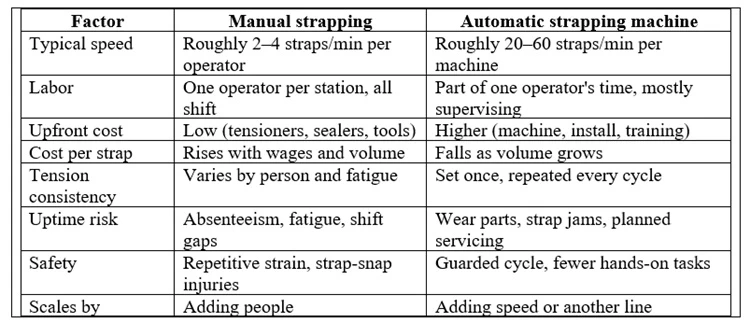
Ranges are typical industry figures for comparison, not quotes. Your numbers will depend on strap type, load size and machine class.
Throughput: where the gap really opens up
Throughput is the first-place automatic strapping vs manual strapping separates. A skilled operator can be quick, but a manual cycle still means positioning the strap, tensioning, sealing and cutting by hand. Every step depends on one person staying sharp for eight hours.
An automatic strapping machine runs that cycle mechanically. The strap feeds, tensions and seals in seconds, and the tenth thousand strap of the shift looks like the first. That is what matters for automatic strapping machine throughput: not the peak speed on a brochure, but the sustained rate across the shift.
Three things tend to surprise teams:
1. The bottleneck moves. Once strapping speeds up, the constraint shifts upstream or downstream, to the packer or the stretch wrapper. Plan the whole line, not one station.
2. Peaks stop being painful. Manual stations need extra heads at peak. A machine just keeps going.
3. Variable loads need the right machine class. A pallet strapping system sized for uniform pallets will struggle with mixed bundles. Match the machine to your actual product mix.
If your strapping station is where trucks wait, throughput is usually the strongest argument for automation.
Uptime: reliability is not the same as having no machine
It is tempting to assume manual strapping has better uptime because there is nothing to break. In practice, manual stations fail in quieter ways: a sick day, a rushed seal, a skipped strap that comes back as a damaged-goods claim.
Strapping machine uptime is a different kind of risk. Machines can jam, wear out sealing heads, or stop because of a bad coil of strap. The difference is that those failures are predictable and, mostly, preventable.
What keeps automatic uptime high:
- Planned maintenance. Replace sealing and feed wear parts on a schedule, not after a failure.
- Strap quality. Cheap or inconsistent strap is behind a large share of jams. Standardize on one spec.
- Spare parts on the shelf. Keep the few parts that stop the line within reach.
- Operator training. Teach clearing a jam in minutes, not calling for help.
- Condition monitoring. Cycle counters and fault logs turn guesswork into a maintenance calendar.
A well-maintained automatic strapping system can run for long stretches with little intervention. Track availability as a number, then compare it to your manual station's real output after breaks, absences and rework. That comparison, not the spec sheet, tells you which option has better uptime in your plant.
Cost: manual vs automatic strapping cost over time
If you only compare purchase prices, manual strapping wins every time. A hand tool is a small spend. An automatic strapping machine is a capital project, and the automatic strapping machine cost depends on machine class, integration with your conveyors, and options such as pallet or bundle handling.
But manual vs automatic strapping cost should be measured per strap, over several years. Four buckets matter:
1. Capital. Machine, installation, commissioning and operator training.
2. Labor. Usually the largest line item. Manual strapping is people-hours; automation turns those into a fraction of one supervisor's time.
3. Consumables. Automatic machines tend to use strap more consistently. Manual strapping often over-straps "to be safe," which quietly burns material.
4. Hidden costs. Product damage, load shifts in transit, injury claims, overtime and missed dispatch windows.
The hidden bucket is where many business cases are won or lost. One damaged pallet that reaches a key customer can cost more than a month of strap.
As a rule of thumb, the more consistent and higher your volume, the faster automation pays back. The next section puts numbers on that.
Strapping machine ROI: a worked example
Take a two-shift plant with six manual strapping operators. Here is an illustrative model. Swap in your own wages, volumes and quotes.
With an installed machine cost of $90,000, the payback is:
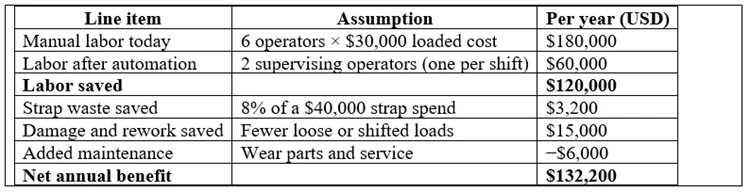
Payback = 90,000
_______ ≈ 0.68 years ≈ 8 months
1,32,000
That is the strapping machine ROI in a high-volume, labor-heavy case. In a one-shift plant with two operators, the same machine could take several years to pay back, and manual might be the smarter call. The lesson: ROI follows volume and labor, not the machine itself.
One caution. Savings from "fewer operators" only count if you redeploy or reduce those hours. Be honest about that in the business case.
When manual strapping still makes sense
Automation is not always the answer. Manual strapping is a reasonable choice when:
- Volumes are low or highly seasonal.
- Loads are oversized, irregular or one-off, and no machine fits them.
- Capital is tight and labor is cheap and stable.
- You are piloting a new product line and the packaging may change.
Many teams land in the middle with a semi-automatic strapping machine: an operator still positions the load, but the machine handles tensioning and sealing. It is a sensible step when you are not ready for a full automatic strapping system.
How to choose a pallet strapping system: a quick checklist
Before you request quotes, gather these answers:
- Straps per shift today, and expected in 3 years
- Load types: pallets, bundles, coils, mixed
- Strap material (PP or PET) and required tension
- Line speed and where the next bottleneck sits
- Floor space, power and conveyor interfaces
- Local service support and spare parts lead time
- Fully loaded labor cost per strapping operator
- Current damage and rework rate attributable to strapping
With those numbers, a supplier can size the machine, and you can build a payback case your finance team will trust.
FAQ: automatic vs manual strapping
What is the main difference between manual and automatic strapping?
Manual strapping relies on an operator to place, tension and seal each strap. An automatic strapping machine does the full cycle mechanically, giving higher speed and more consistent tension.
Is an automatic strapping machine worth it?
It usually is for high-volume, labor-intensive operations. If your strapping station is a bottleneck or runs multiple shifts, payback can come within one or two years. For low volumes, manual may remain cheaper.
How much does an automatic strapping machine cost?
Prices vary widely by machine class, options and integration needs. Ask for a quote based on your load types and speed, and compare it with your annual strapping labor, strap waste and damage costs.
Which has better uptime, manual or automatic?
Automatic machines are more predictable when maintained on schedule. Manual stations lose output through absences, fatigue and rework, which rarely appear in a spec sheet.
What is a semi-automatic strapping machine?
It is a middle option where the operator positions the load and the machine tensions and seals the strap. It suits mid-volume operations or phased automation.
Conclusion: choose by volume, not by price tag
The automated strapping vs manual debate comes down to volume, labor cost and how much a bad strap costs you downstream. Manual keeps the entry price low. Automation lowers the cost per strap, steadies output and gives you uptime you can plan around.
Start with your own numbers: straps per shift, labor per station, and damage rate. Run them through the ROI model above, then ask two or three suppliers to quote against the same brief.
Ready to size a system? Share your load types, daily volumes and shift pattern with your strapping equipment partner and ask for a payback estimate based on your plant, not a generic brochure.
 Our Services
 Media Pack Download
 Newsletters
 Industrial Events