

Biodegradable vs Recyclable Packaging: Which Delivers Better ROI and Brand Value in 2026?
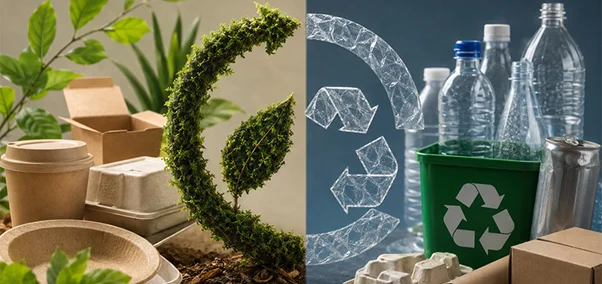
Every packaging decision a business makes today gets scrutinized from three directions at once: the finance team wants to know what it costs, the marketing team wants to know what it signals, and the customer wants to know what happens to it after the box is opened. That's the real backdrop to the biodegradable vs recyclable packaging debate heading into 2026. It's no longer a niche sustainability question tucked into a CSR report — it's a procurement decision with measurable financial consequences.
If you're a brand owner, packaging manager, or supply chain lead trying to figure out which direction to take, this isn't a question with a universal right answer. It depends on your product, your supply chain, your customer base, and how your local waste infrastructure actually works. But there is a structured way to think about it — and that's what this article walks through.
Why This Decision Matters More in 2026
A few things have converged to push sustainable packaging from "nice to have" to "board-level priority."
First, regulation has caught up. Extended Producer Responsibility (EPR) laws are now active or expanding across multiple markets, meaning companies pay fees based on the packaging they put into circulation — and the fee structures increasingly reward recyclability and penalize hard-to-process materials. Second, retailers and marketplaces are tightening their own packaging requirements for suppliers, which means your packaging choice can now affect whether you get shelf space at all. Third, consumers — especially B2B buyers making purchasing decisions on behalf of their own companies — are treating packaging as a proxy for how seriously a vendor takes operational responsibility.
Put simply: packaging is no longer just a cost center. It's a lever for packaging ROI, risk management, and brand positioning, all at once.
Biodegradable Packaging: The Basics and the Business Case
Biodegradable packaging is designed to break down naturally through microbial action, typically returning to organic matter within a defined timeframe under the right conditions — industrial composting, home composting, or in some cases soil or marine environments, depending on the material.
Where it wins:
- Product fit for organics and food. Compostable pouches, trays, and wraps are a natural fit for food service, agriculture, and perishable goods, where contamination with traditional plastic makes recycling difficult anyway.
- End-of-life simplicity for the customer. When infrastructure exists, biodegradable packaging removes the "wash and sort" burden from the consumer — it just breaks down.
- Strong storytelling value. "Returns to the earth" is an intuitive, emotionally resonant narrative that's easy to put on a label and easy for a customer to understand without a lecture on plastic resin codes.
Where it struggles:
- Composting infrastructure is inconsistent. Many regions still lack industrial composting facilities at scale, meaning biodegradable packaging often ends up in a landfill anyway, where it may not break down as intended and can even generate methane.
- Cost premium. Compostable substrates — PLA, bagasse, mycelium-based materials — generally carry a higher per-unit cost than conventional plastics or standard recyclable materials, though this gap has been narrowing as production scales.
- Certification complexity. "Biodegradable" is not a strictly regulated term everywhere, which opens brands up to greenwashing accusations if claims aren't backed by recognized certifications like BPI or TÜV Austria's OK Compost.
Recyclable Packaging: The Basics and the Business Case
Recyclable packaging is built to be reprocessed into new material through existing collection and recycling systems — think cardboard, glass, aluminum, and increasingly, mono-material plastics designed for easier sorting.
Where it wins:
- Mature infrastructure. Recycling systems — however imperfect — already exist at scale in most developed markets. That means a recyclable package has a real, tested pathway to being processed, not just a theoretical one.
- Cost efficiency at scale. Materials like corrugated cardboard, PET, and aluminum are widely available, price-stable, and often cheaper than emerging biodegradable alternatives, particularly for high-volume manufacturers.
- Fits circular economy models. Recyclable materials feed directly into a circular economy packaging system, where materials are recovered and reused rather than treated as single-use, which is increasingly the framework regulators and large retailers are building policy around.
Where it struggles:
- Actual recycling rates lag. Just because something is technically recyclable doesn't mean it gets recycled. Contamination, inconsistent municipal programs, and consumer confusion around what's accepted all reduce real-world recovery rates.
- Complex materials are the exception. Multi-layer packaging (common in snack foods, personal care, and electronics) is often labeled recyclable but is functionally very difficult to process.
- Consumer follow-through required. Unlike biodegradable materials, recyclable packaging depends entirely on the end user sorting and disposing of it correctly — a step that isn't guaranteed.
Biodegradable vs Recyclable Packaging for Businesses: A Side-by-Side Look
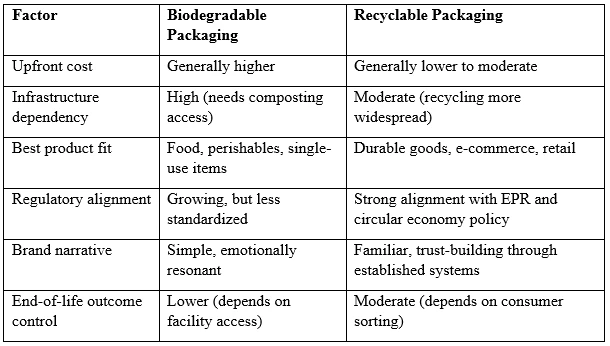
This table underscores the central point: which packaging offers better ROI in 2026 isn't a fixed answer — it's a function of your product category, your customers' geography, and the waste systems available to them.
So, Which Packaging Offers Better ROI in 2026?
Here's where most companies get the analysis wrong: they treat this as a materials question when it's really a systems question. ROI isn't just unit cost versus disposal outcome — it's the full picture of:
- Regulatory cost avoidance. In markets with EPR fees tied to recyclability, choosing genuinely recyclable materials can directly reduce compliance costs.
- Supply chain resilience. Recyclable materials like cardboard and aluminum tend to have more diversified, stable supply chains than emerging biodegradable substrates, which can still face sourcing bottlenecks.
- Customer retention and brand equity. Packaging that customers perceive as genuinely responsible — not performatively so — contributes to repeat purchase behavior and can support premium pricing.
- Waste-handling costs on your end. If you're a manufacturer generating packaging waste internally (trim, rejects, returns), the material's end-of-life pathway affects your own operational costs, not just the customer's.
For many manufacturers, the highest-ROI answer in 2026 isn't "pick one" — it's a hybrid strategy: recyclable materials for durable, shippable, high-volume packaging, and biodegradable materials for product-contact layers, food packaging, or markets with strong composting infrastructure.
Sustainable Packaging Strategies for Manufacturers
If you're building or revising a packaging strategy this year, a few practical moves consistently pay off:
- Map your actual end-of-life infrastructure by market. Don't assume composting or recycling access — verify it region by region before committing to a material.
- Reduce before you substitute. Lightweighting and right-sizing packaging often delivers faster ROI than swapping materials, and it compounds well with either biodegradable or recyclable strategies.
- Standardize on mono-materials where possible. Whether biodegradable or recyclable, mixed-material packaging is the biggest driver of processing failure.
- Invest in verified certifications, not vague claims. Third-party certification protects against regulatory risk and greenwashing scrutiny, which is intensifying globally.
- Pilot before scaling. Test new sustainable packaging solutions in a single product line or region before a full rollout, and track cost, damage rates, and customer feedback closely.
How Sustainable Packaging Improves Brand Value
Beyond the balance sheet, packaging is one of the most tangible touchpoints a business has with its customers — B2B or otherwise. It's physical, it's unavoidable, and it shapes perception before a product is even used.
Businesses that visibly commit to sustainable packaging for businesses — whether biodegradable, recyclable, or a thoughtful mix — tend to see this reflected in:
- Stronger positioning in RFPs and vendor evaluations, where sustainability criteria are increasingly weighted
- Improved standing with institutional and retail buyers who have their own downstream sustainability commitments
- Differentiation in commoditized categories, where packaging becomes a meaningful point of distinction
- Reduced reputational risk, since packaging missteps — real or perceived — travel fast on social channels
The brand value isn't abstract. It shows up in contract renewals, in retailer negotiations, and in how easily your sales team can answer a prospect's sustainability questionnaire.
The Bottom Line
There's no universal winner in the biodegradable vs recyclable packaging debate — and any vendor or consultant telling you otherwise is oversimplifying a genuinely complex decision. What matters is matching the material to your product, your customers' waste infrastructure, and your regulatory exposure, then measuring the results honestly.
The businesses that will come out ahead in 2026 aren't necessarily the ones that pick the "greenest-sounding" option. They're the ones that treat packaging as a strategic, data-driven decision — one that protects margins, satisfies regulators, and builds the kind of trust that keeps customers coming back.
 Our Services
 Media Pack Download
 Newsletters
 Industrial Events