



Industry Leadership Interview
Insights on sustainable packaging, circular economy, material innovation, regulatory compliance, consumer education, and the role of packaging design in balancing environmental impact with product protection and functionality.

About the Expert: Nerida Kelton - Vice President – Sustainability & Save Food
Nerida Kelton is Vice President – Sustainability & Save Food at the World Packaging Organisation (WPO) and Executive Director of the Australasian Institute of Packaging (AIP). With more than 27 years of experience in the packaging industry, including 25 years with the AIP, she has played a key role in advancing packaging education, professional development, sustainability and save-food initiatives across Australasia. The AIP is the peak professional body for packaging training and education in the region.
.webp)
World Packaging Organisation (WPO)
1. The packaging industry is being shaped by sustainability, technological innovation and changing consumer expectations. What do you see as the most significant forces that will define the future of packaging?
There are many different views on what will drive packaging in the future. Sustainability and regulatory compliance such as Extended Producer Responsibility will be key drivers for what types of materials and packaging is selected across the globe. EPR and eco-modulation will drive decisions being made when choosing and designing packaging in the future.
Packaging will need to be designed to offer the lowest environmental impact which could come in the choice of materials, a move to mono materials, a shift of packaging substrate to alternatives, recycled content, reuse and refillable solutions, the elimination of no added PFAS, reduction or ban of chemicals of concern, the true recyclability in existing materials recovery facilities in the country that the product is sold in and more. Packaging design will need to transform to meet regulatory and compliance in the countries that the product are sold in.
Intelligent Packaging will also change the future of how brands communicate to their consumers. QR codes and 2D codes will hopefully be included on more packaging in the future and should be seen as an invaluable way to communicate to consumers. Real estate of packaging can be limited so utilising the value of codes should not be underestimated.
Artificial Intelligence is also coming into the packaging space and should be seen as an enabler. A qualified packaging technologist can use AI in a practical way.
I would also like to see the AIP Save Food Packaging design guidelines embedded into all packaging to minimise food loss and waste across the value chain and Accessible & Inclusive packaging design guidelines also need to be utilised by brands. Simply by using both design principles packaging can become more intuitive, user-friendly, and thoughtful and can make a difference to everyone.
2. Sustainability has moved from being a competitive differentiator to an industry priority. What does genuinely sustainable packaging look like today, and where does the industry still have work to do?
Sustainability and sustainable packaging design looks different across every corner of the globe. This can be based on regulatory frameworks, solid waste management systems, recycling facilities, access to affordable packaging materials and more. It is difficult to provide a silver bullet as every country has a different lens. Developed countries and developing countries also have a different lens and this must not be overlooked when making decisions about packaging choices.
What is sustainable packaging?
The primary function of packaging is to contain and protect products from the point of manufacture, through the supply chain to the retail store or end user, to attract people to buy a product to achieve more sales, and to provide product information. 'Sustainable packaging' is packaging that performs this primary function, but also has lower environmental impact compared to existing or conventional packaging. Sometimes achieving the lowest possible environmental impact can be challenging, particularly when balancing various environmental criteria with other functional and commercial considerations.
A simpler definition: Sustainable packaging minimises environmental impact whilst maintaining its functional requirement. It can take the form of recyclable or reusable packs or involve reducing material and resource use. All forms of packaging - used to present, protect, ship, or store products - can be sustainable if designed correctly.
There are 11 guiding Sustainable Design Principles that can be used in most countries across the world.
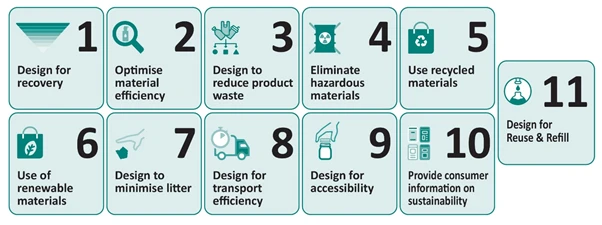
- Design for Recovery
- Optimise Material efficiency
- Design to reduce product waste
- Eliminate Hazardous Materials
- Use Recycled Materials
- Use Renewable Materials
- Design to minimise litter
- Design for Transport Efficiency
- Design for Accessibility
- Provide Consumer information on sustainability
- Design for Reuse and refill
Each country is on a different step in their Sustainability Journey and much can be done now without waiting for regulation. Such as using the Sustainable Packaging design principles in all sized businesses. They also apply to primary, secondary and tertiary packaging.
3. How can packaging manufacturers balance environmental performance with essential requirements such as product protection, shelf life, safety, functionality and cost?
First and foremost, the true role of packaging is its functionality. Packaging needs to be designed to ensure that a product is protected, preserved, contained and transported all the way through the value chain from production until it is used in the household.
Packaging also plays a vital role in ensuring the health and safety of the products and consumers that product waste is kept to a minimum and the efficiency of the packaging can withstand the rigors of transport.
When re-designing packaging to meet global and local packaging waste and sustainability targets the functionality simply cannot be ignored. ‘Sustainable Packaging’, in the simplest of terms, is packaging that performs the primary role of functionality but is also designed with the lowest possible environmental impact when compared to an existing or conventional pack. Finding the balance between functionality, commercial reality, consumer demands, and environmental criteria is the real challenge for packaging technologists and engineers across the globe.
With so much focus right now on plastic and packaging waste, we must not lose sight of the key role packaging plays in the protection of a product. Inadequate packaging that results in wasted food defeats the whole purpose and is a much bigger waste of resources and environmental impacts.
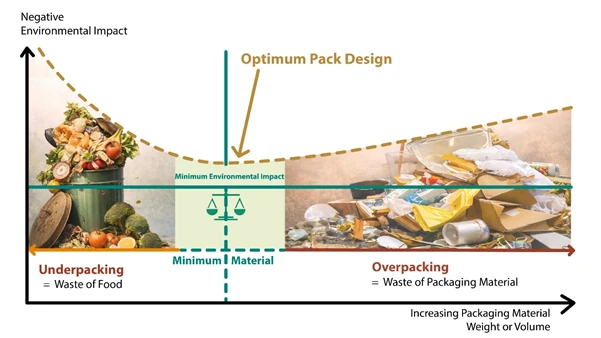
The challenge for packaging technologists & engineers is to be able to design optimum packaging with the lowest environmental impact at the start. It is about finding the balance between meeting food waste targets, at the same time as achieving packaging waste targets.
If the balance is tipped either way it will create unintended consequences which could see overpacking (wasting packaging materials) or underpacking (wasting food). Finding the perfect balance can be challenging and requires technical knowledge and understanding of packaging design.
Lifecycle Assessment
To optimise circular and sustainable design packaging technologists need to look at the potential environmental impacts of the product across its lifetime.
Environmental impact categories can include carbon/greenhouse gas emissions, water depletion, mineral consumption, land transformation, eutrophication, toxicity, and many more and can be undertaken through a Life Cycle Assessment (LCA). This assessment can look holistically at environmental impacts of products, and associated packaging, from raw materials, to production, through to household, and then at end-of-life.
Now more than ever science-driven information that is derived from LCA is such an important step in ensuring that your product and packaging have the lowest environmental impact wherever possible across the entire value chain. LCA can eliminate second-guessing and assumptions about ‘Sustainable Packaging’ choices and can provide concrete information that crosses all areas of the supply chain.
Save Food Packaging
Whilst the primary function of packaging has always been to protect, contain, preserve and transport a product from paddock to plate, the function of intuitive Save Food Packaging Design to minimise food loss and waste is only now being discussed across the globe.
Save Food Packaging is designed to minimise or prevent food waste from paddock to plate using innovative and intuitive design features that can contain & protect, preserve, extend shelf life, easily open and reseal, provide consumer convenience and portion control; all the while meeting global sustainable packaging targets.
Opportunities for packaging design to minimise food waste can include better facilitation or communication around portion control, date labelling, extension of shelf life, protection, resealability, easy to open, grip, dose and empty, contains the correct quantity and serving size food safety/freshness information, information on storage options and improved communication on packs.
The packaging should also highlight a wide range of design factors that help to prevent food waste including mechanical protection, physical-chemical protection, expiry date and best before date. The packaging should also facilitate sorting of household waste – easy to clean, separate, recycle or reuse.
Without adequate design features and packaging that is fit-for-purpose, food can potentially be wasted all the way through the value chain to the household. The costs of such waste can be significant for a business and leaves an indelible footprint on the environment. By modifying packaging design at the start and ensuring that Save Food Packaging design guidelines are followed in the New Product Development process, food loss and waste can be minimised across a value chain.
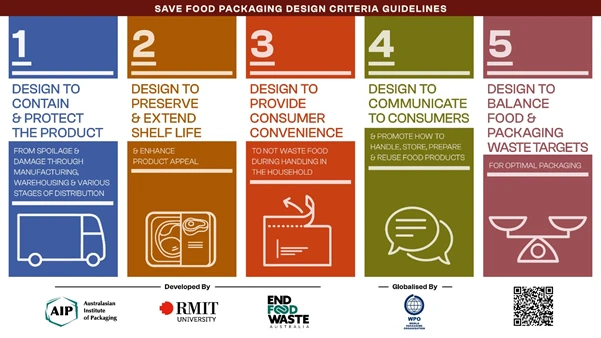
The AIP have developed Save Food Packaging design guidelines that can minimise or prevent food waste from paddock to plate using innovative and intuitive design features that can contain & protect, preserve, extend shelf life, easily open and reseal, provide consumer convenience and portion control; all the while meeting global sustainable packaging targets.
There are 5x Save Food Packaging Guidelines
- Design to contain & protect the product
- Design to preserve & extend shelf life
- Design to provide consumer experience
- Design to communicate to consumers
- Design to balance food & packaging waste targets
4. How important will material innovation be in reducing the environmental impact of packaging? Are there particular material developments that you believe could have a significant impact?
In all corner of the globe we are seeing a shift right now from single use plastics where viable to renewable materials, fibre, cellulose, sugarcane, bagasse, hemp, moulded pulp and more. It is always recommended to undertake a lifecycle assessment before moving to an alternate material to ensure that the alternative can maintain protection, barrier, shelf life, functionality etc. We are seeing a lot of movement to renewable materials in the fresh produce aisles of supermarkets where consumers are demanding to see less single use plastic.
5. Regulations around packaging waste, recyclability, extended producer responsibility and sustainable materials are evolving rapidly across different regions. How should the industry navigate an increasingly complex regulatory landscape?
You need to keep on top of the changes that are happening on a weekly basis; especially if you are selling into multiple countries across the globe. Every country has different regulations and many are evolving at a very fast-pace right now, so it is critical to have someone in the team keeping an eye on what is happening in all of the markets that you sell into.
6. How can collaboration between packaging manufacturers, brand owners, recyclers, policymakers and consumers help address challenges that individual stakeholders cannot solve alone?
Collaboration is critical to the success of a circular economy for packaging. No one stakeholder in the value chain can succeed alone; we all need to work together from resin suppliers to packaging manufacturers, researchers, brands, retailers, recycling and reprocessing facilities and government. Working together also aids in knowledge sharing across different parts of the value chain and helps each other to better understand the different lenses. A great example is encouraging packaging technologist to visit materials recovery facilities and landfill sites to better understand the other end of the value chain. You can’t design for recyclability and recovery if you have never seen how the facilities work, nor understand which materials are higher and lower value for collectors and recyclers.
7. Consumer understanding and behaviour can significantly influence packaging outcomes. What role should education and communication play in encouraging more responsible packaging choices and disposal practices?
Government and council consumer education is critical for container deposit schemes, recycling, waste collection, niche materials that require special drop off points such as blister packs, aseptic cartons and soft plastics, and the overarching sustainability messaging. There is limited consumer education in most countries and this is a shame. We need to help guide them on which bins they should use and this starts with the on-pack communication for recycling. The Australasian Recycling Label (ARL) in Australia and New Zealand, the How 2 Recycle logo in the USA and the On Pack Recycling Label (OPRL) in the United Kingdom are great examples of how to intuitively communicate to consumers about the recyclability of each packaging type and component.
8. Looking ahead to the next five to ten years, which packaging trends do you believe will have the greatest impact on the industry?
Mono Material packaging, building in recycled content into existing packaging, a move away from single use plastics and more towards renewable materials, more refillable and reusable solutions. I would very much like to see more Save Food packaging designed and more Accessible & Inclusive packaging as well in the future.
9. Finally, what should packaging industry leaders prioritise today to build a packaging ecosystem that is more sustainable, resilient and fit for the future?
Collaboration is key and working together for a more circular economy for packaging in all corner of the globe.