

Child-Resistant vs Senior-Friendly Packaging: Compliance, Usability, and Market Access
Quick answer: Child-resistant packaging is designed so most young children cannot open it. Senior-friendly packaging is designed so most older adults can. The best pharmaceutical packaging does both. It has to pass a child test and an adult usability test, and the two pull in opposite directions. The sweet spot is easy-open child-resistant packaging: hard for a four-year-old, easy for a 70-year-old with sore hands.
Key Takeaways
- Child-resistant (CR) packaging protects kids from accidental poisoning. Senior-friendly packaging protects adults from being locked out of their own medicine.
- Most regulations require BOTH: a child-resistance test and a senior-adult usability test.
- Poor usability is not just an annoyance. It leads to non-compliance, medication errors and unsafe workarounds (like leaving caps off).
- Brands that design for both groups get faster approvals, fewer complaints and wider market access.
What Is the Difference Between Child-Resistant and Senior-Friendly Packaging?
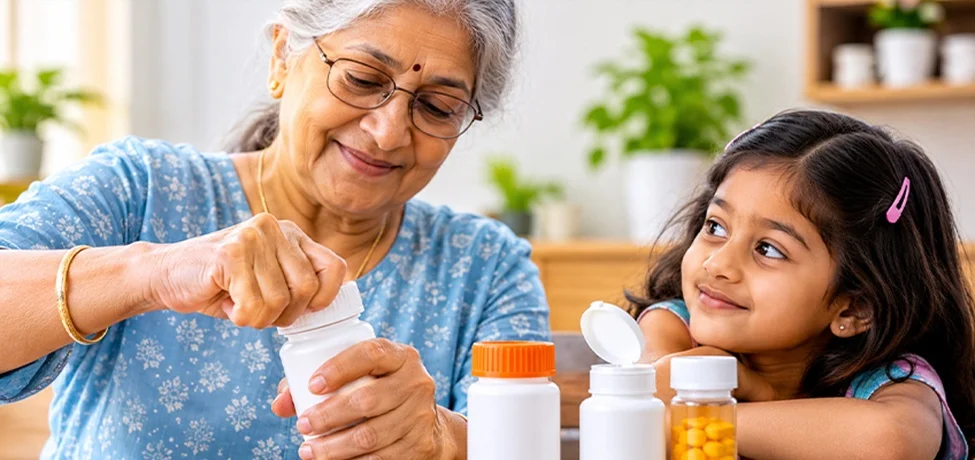
Picture a grandmother with arthritis standing in her kitchen, wrestling with a pill bottle. Now picture her grandson, age four, watching her from the doorway. One package has to satisfy both of them. That is the whole challenge in a single scene.
Child-resistant packaging uses a mechanical barrier, such as push-and-turn, squeeze-and-turn or a locking tab, that requires a sequence of actions or a level of strength and coordination young children don't yet have.
Senior-friendly packaging aims at the opposite goal: opening and reclosing with minimal force, dexterity and instruction reading. It accounts for reduced grip strength, tremors, arthritis, poorer eyesight and cognitive load.
Here is how they compare side by side:
|
Factor |
Child-Resistant Packaging |
Senior-Friendly Packaging |
|
Primary goal |
Prevent child access |
Enable easy adult access |
|
Test population |
Children, roughly 42 to 51 months old |
Adults, roughly 50 to 70 years old |
|
Main risk if it fails |
Accidental poisoning |
Non-compliance, medication errors |
|
Typical design lever |
Added opening steps, force, coordination |
Lower torque, larger grip areas, clear cues |
|
Regulatory focus |
Safety and poison prevention |
Usability and accessibility |
Child-Resistant Packaging Requirements and Regulations
In the United States, child-resistant packaging requirements stem from the Poison Prevention Packaging Act (PPPA), enforced by the Consumer Product Safety Commission (CPSC). It covers most oral prescription drugs and many over-the-counter products, along with certain household chemicals and supplements.
Other markets have their own frameworks. Europe commonly references EN and ISO standards, and many other countries follow ISO-based requirements. If you sell globally, don't assume one approval covers everything. Always confirm the current rules with the relevant authority or a qualified regulatory consultant.
Child-Resistant Packaging Testing Requirements
The testing logic is fairly consistent across major standards:
1. Child panel test. A group of young children (the US protocol uses 200 children aged 42 to 51 months) tries to open the package, first on their own and then after a demonstration. A high percentage must fail.
2. Senior adult test. A separate panel of adults (commonly 50 to 70 years old) must be able to open and properly close the package within set limits.
3. Reclosability. For reclosable packs, the closure must still work after repeated openings.
Standards you will see referenced often include 16 CFR 1700.20 (US protocol), ISO 8317 (reclosable packaging), ISO 14375 and EN 14375 (non-reclosable packaging) and ASTM D3475 (classification).
Pass rates and procedures differ by standard and package type. Treat the numbers above as a guide and check the current text of the standard before you finalize a design.
Child-Resistant Packaging Compliance Standards: A Practical Checklist
- Identify whether your product legally needs CR packaging in each target market.
- Choose the right standard for your pack type (reclosable vs non-reclosable).
- Use an accredited lab for protocol testing.
- Keep the test reports, drawings and supplier specs in your technical file.
- Re-test after any change to the closure, container material or liner.
That last point trips up a lot of teams. A "tiny" change in resin or cap tolerance can change opening force enough to affect your results.
Why Senior-Friendly Packaging Matters More Than Ever
Populations are aging, and older adults take more medications. The same people who most need their medicine are often the ones struggling to open it.
When packaging is too hard, people do things that quietly defeat the safety design:
- Transferring pills to an unmarked container
- Leaving the cap loose or off
- Skipping doses
- Asking a child to open it for them (yes, this happens)
So senior-friendly packaging is a compliance topic, a safety topic and a patient adherence topic all at once. Pharmacies, payers and patient groups increasingly care about it too.
Senior-Friendly Packaging Design: What Actually Works
Good senior-friendly packaging design is mostly about reducing friction without removing protection:
- Larger, textured grip surfaces that work with weak hands
- Lower opening torque where the standard allows
- Clear visual cues, with arrows, alignment marks and high-contrast text
- Tactile and audible feedback, like a click that confirms the cap is closed
- Simple one-handed operation where possible
- Readable labels, with a legible font size and contrast, and plain language
If you can test with real older users early, even five to ten people in an informal session, you will catch problems no spec sheet predicts.
Easy-Open Child-Resistant Packaging: Can You Have Both?
Yes, and this is where the best innovation is happening. Easy-open child-resistant packaging uses clever mechanics instead of brute force. The goal is a task that is cognitively or coordination hard for small children but physically easy for adults.
Common approaches include:
- Push-down-and-turn caps with optimized torque
- Squeeze-and-turn and pinch-and-slide designs
- Align-the-arrows systems, which a small child struggles to figure out
- Blister packs with peel-push or tear-notch designs
- Child-resistant pouches with zipper locks for non-reclosable or semi-reclosable formats
The trick is balance. If you push too far toward child resistance, seniors fail the test. Push too far toward ease of use and children get in. Expect a few design-test-adjust rounds.
Child-Resistant Plastic Packaging, Caps and Closures: Choosing the Right System
Most pharmaceutical products rely on child-resistant plastic packaging, typically polypropylene or HDPE bottles paired with a CR closure. Here are the main pharmaceutical packaging closure systems and how they fit:
1. Two-piece child-resistant caps. An outer shell spins freely until pressed down. Sturdy and common, but the pressing motion can be tough for people with arthritis.
2. Single-piece snap and squeeze caps. Lower cost and simpler. Usability varies a lot by design.
3. Dispensing closures (flip-top, pump, dropper). Common for liquids and ophthalmic products. These need CR features built in without making dosing difficult.
4. Blister and strip packs. Great for unit-dose products and adherence tracking. Look at peel force carefully for seniors.
5. Reusable CR containers and pouches. Popular for supplements, cannabis and certain OTC products, with a growing emphasis on sustainability.
When selecting caps and closures, weigh these factors:
- Opening torque and force range
- Material compatibility with your formulation
- Barrier properties, such as moisture and oxygen
- Cost at your volume
- Supplier quality systems and regulatory track record
- Sustainability goals, including recyclability and mono-material options
Market Access: How Packaging Choices Affect Where You Can Sell
Packaging can open or close doors.
- Regulatory approval. Missing or incomplete CR documentation can delay product launch.
- Retailer and pharmacy acceptance. Many chains prefer, or require, packaging with proven usability.
- Tender and payer decisions. In some health systems, patient-friendly packaging is a scoring factor.
- Brand reputation. Complaints about "impossible" bottles spread quickly in reviews and pharmacy feedback.
- Global expansion. A design tested to one standard may need additional testing to enter another market.
A smart approach is to plan for the strictest market first. If you design and test to a rigorous standard from the beginning, expanding later is far easier than redesigning mid-launch.
Common Mistakes to Avoid
1. Treating testing as the last step. Build it into the design phase.
2. Ignoring the senior test. Passing the child test alone isn't enough.
3. Switching suppliers without re-testing.
4. Assuming one standard fits every market.
5. Overlooking labeling. Instructions that older adults can't read undermine even the best closure.
Frequently Asked Questions
What is child-resistant packaging?
It is packaging designed so that most young children cannot open it within a set time, while adults can use it normally. It is a core tool for preventing accidental poisonings.
What is senior-friendly packaging?
Packaging designed to be opened and closed easily by older adults, including those with limited strength, dexterity or vision, while still meeting safety requirements.
Can packaging be both child-resistant and senior-friendly?
Yes. Many regulations require both. Easy-open child-resistant designs rely on coordination or multi-step actions rather than high force.
What are the testing requirements for child-resistant packaging?
Typically, a child panel test and a senior adult test, run by an accredited lab according to standards such as 16 CFR 1700.20 or ISO 8317. Requirements depend on pack type and market.
Do all medicines need child-resistant packaging?
No. Requirements depend on the product, dose, and local regulations. In the US, many prescription drugs and certain OTC products are covered, but exemptions exist. Always check current rules for your market.
How often should child-resistant packaging be re-tested?
Whenever you change the closure, container, liner, material or supplier, or if regulations change.
Final Thoughts
Child-resistant and senior-friendly packaging are not rivals. They are two halves of the same safety promise: protect the youngest and serve the oldest. Brands that treat usability as seriously as compliance end up with smoother approvals, happier patients and fewer returns.
If you are developing or upgrading a product, start with your target markets, shortlist closure systems early, and put real users in front of your prototypes. Your package should work for the grandmother and stay shut for her grandson.
Disclaimer: Regulations and standards change. Verify requirements with the relevant authority or a qualified regulatory expert before finalizing packaging.
 Our Services
 Media Pack Download
 Newsletters
 Industrial Events