

In-Line vs Off-Line Inspection Systems: Reducing Waste, Downtime, and Compliance Risks
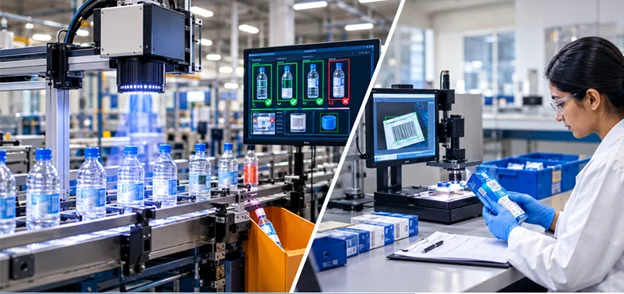
A single mislabeled carton doesn't look like much. But by the time someone catches it, there may be thousands more just like it, already packed, palletized, and headed for a customer. That's how a small inspection gap turns into scrap, rework, a delayed shipment, or a compliance headache.
It's why the inline vs offline inspection systems question matters so much on modern packaging lines. The answer isn't always "inline is better." But how and when you inspect decides how much product you waste, how often your line stops, and how well you hold up in an audit.
Quick Answer: Inline vs Offline Inspection
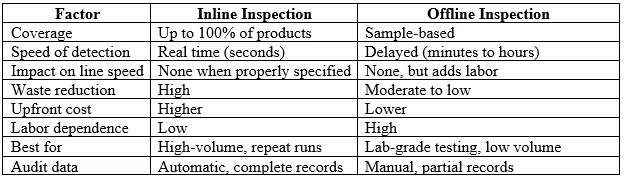
Inline inspection checks every product on the production line, in real time, without stopping it. Offline inspection pulls samples from the line and checks them separately, in a lab or at a quality station.
Inline systems catch defects in seconds and sharply reduce waste. Offline systems suit detailed measurements, low volumes, and tight budgets. Most high-volume packaging operations get the best results from a hybrid: inline for 100% screening, offline for deep verification.
What Are Inline Inspection Systems for Packaging?
Inline inspection systems for packaging sit directly on the conveyor or filling line. Cameras, sensors, and software examine each pack as it passes, checking for things like:
- Missing, skewed, or wrong labels
- Seal and closure defects
- Fill level errors
- Print quality, barcodes, and lot or expiry codes
- Damaged cartons, foreign objects, or missing components
When something fails, the system flags it and rejects the pack automatically, or alerts an operator. This is inline quality inspection for packaging at its simplest: problems are caught at the source, not at the loading dock.
Most of this runs on machine vision inspection for packaging: high-speed cameras and AI-assisted software that compare each product against a "golden" standard thousands of times per hour. That's well beyond what a human eye can sustain over a long shift.
What Are Offline Inspection Systems for Packaging?
Offline inspection systems for packaging work away from the line. An operator pulls samples at set intervals, say every 30 minutes or every 500 units, and inspects them with a bench-top vision system, a measurement device, or manual checks.
Offline is useful when you need:
- Precise dimensional or material testing
- Destructive tests like seal strength or burst pressure
- Inspection of low-volume or highly varied runs
- A lower upfront investment
The tradeoff is coverage. If you sample 2% of your output, 98% went uninspected. A defect that starts right after a check can run for half an hour before anyone sees it.
Side-by-Side Comparison
How Inline Inspection Reduces Waste
Waste in packaging is rarely one big failure. It's a hundred small ones. Inline inspection waste reduction works for three reasons.
1. Defects are caught early. When a vision system spots a misprint on pack #12 instead of pack #1,200, you've lost one pack instead of a pallet. That gap between detection and correction is where most scrap is born.
2. Rework drops. Opening finished cases to fix a labeling error costs labor, materials, and time. Catching the same error at the line costs almost nothing.
3. Root causes become visible. Inline systems log every rejection with a timestamp, image, and defect type. Patterns appear quickly: rejects spike after changeovers, or a particular filler head keeps drifting. Fixing causes beats sorting symptoms.
Plants that move from sampling to automated packaging inspection often see rejects and customer complaints fall, because the problem finally has data behind it.
How Inspection Systems Reduce Downtime
This one surprises people. Adding an inspection system sounds like adding something that can stop the line. Done well, it does the opposite. Inspection system downtime reduction comes from:
- Fewer unplanned stops. Early alerts on drift (a failing capper, a misaligned labeler) let you fix issues during planned breaks rather than after a jam.
- Faster changeovers. Modern systems store recipes, so switching products means selecting a job, not recalibrating by hand.
- Fewer line-clearing events. When a bad batch is caught late, the whole line may have to be cleared and restarted. Catching it early avoids that.
- Less manual checking. Operators spend less time pulling samples and more time running the line.
The caveat is that a poorly chosen system can create downtime through false rejects, slow recalibration, or awkward cleaning. That's why selection matters.
Compliance Risk: Where Inspection Really Pays Off
For food, pharma, cosmetics, and medical products, packaging errors aren't just costly, they're regulatory problems. A wrong allergen declaration, an illegible lot number, or a missing expiry date can trigger recalls, fines, and lost retailer trust.
Automated inspection for packaging compliance helps in several ways:
- Verification of codes and labels. Every pack is checked for correct text, barcode grade, and date/lot information.
- Traceability. Images and results are stored against batch records, so you can prove what was inspected and when.
- Audit readiness. Instead of explaining your sampling plan, you hand over complete data.
- Fewer human errors. Fatigue and distraction don't affect a camera on the night shift.
Offline checks still matter here. Many standards expect periodic lab verification, and sample-based audits are part of good practice. The strongest compliance posture pairs the two: inline for coverage, offline for confirmation.
Which Should You Choose? A Simple Decision Framework
Use this as a starting point for packaging inspection system selection.
Choose inline if:
- You run high volumes or fast lines
- A single defect is costly (recalls, regulated products)
- You want complete traceability data
- Your products and formats are fairly consistent
Choose offline if:
- Volumes are low or runs are short and varied
- You need destructive or highly precise measurement
- Budget is tight and defect risk is moderate
Choose a hybrid if:
- You're in a regulated industry
- You want to prove the inline system's accuracy against lab results
- You're scaling up and expect needs to grow
Industrial Inspection System Buying Guide: 8 Questions to Ask
If you're evaluating vendors, this industrial inspection system buying guide checklist will save you headaches.
- What defects do we actually need to catch? List them by cost and frequency. Don't buy for problems you don't have.
- What's our line speed and product variety? The system must keep up at peak speed and handle your full range of formats.
- How accurate is it in real conditions? Ask for a trial on your own products, with your lighting, glare, and variation. Demo-room results can mislead.
- What's the false reject rate? Too many false rejects waste good product and frustrate operators, and they quietly erode trust in the system.
- How easy is changeover and retraining? Look for recipe management and interfaces your operators can use without calling the vendor.
- How does it integrate? Check compatibility with your PLC, MES, ERP, and reject mechanisms.
- What compliance support is built in? Look for audit trails, user access controls, and data export that fit your regulatory needs.
- What does total cost look like? Include installation, training, maintenance, spare parts, and software updates, not just the sticker price.
Common Mistakes to Avoid
- Buying on price alone. A cheap system with high false rejects costs more in the long run.
- Skipping a pilot. Always test with real production samples.
- Ignoring the people. If operators don't trust or understand the system, they'll work around it.
- Treating inspection as a gate, not a feedback loop. The real value is using the data to fix upstream processes.
- Over-specifying. Not every line needs the most advanced setup. Start with your biggest risk and expand.
Frequently Asked Questions
What is the difference between inline and offline inspection?
Inline inspection checks products on the production line in real time, often covering every unit. Offline inspection checks samples away from the line, usually with a delay.
Is inline inspection more expensive than offline?
Upfront, usually yes. But reduced waste, rework, recalls, and labor often offset the cost over time on high-volume lines.
Can inline systems slow down the production line?
Not when correctly specified. Modern vision systems inspect at full production speed. Slowdowns usually come from poor integration or the wrong system size.
What defects can machine vision detect in packaging?
Label errors, print and barcode defects, seal and cap issues, fill levels, missing items, and surface or carton damage, among others.
Do I still need offline testing if I have inline inspection?
In most cases, yes. Offline testing covers destructive tests, fine measurements, and periodic verification of inline accuracy.
How do I choose a packaging inspection system?
Start with your defect risks, line speed, and compliance needs. Then trial shortlisted systems on your own products and compare false reject rates, integration, and total cost.
Final Thoughts
Inline and offline inspection aren't rivals. They solve different problems. Inline inspection protects your line from small errors turning into big losses. Offline inspection gives you the depth and verification that regulators and customers expect.
If you're scrap-heavy, drowning in rework, or nervous about audits, start by mapping where defects enter your process and what each one costs. That exercise alone will tell you whether to go inline, stay offline, or blend both.
 Our Services
 Media Pack Download
 Newsletters
 Industrial Events