

Compostable vs Bio-Based Materials: A Procurement Guide for Cost-Effective Sustainability
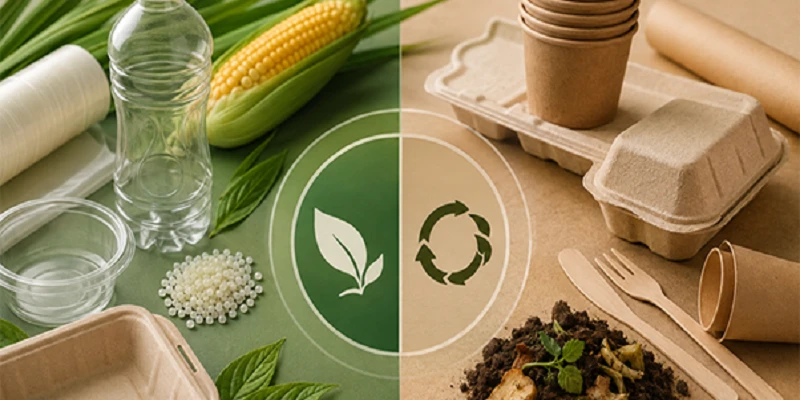
If you've spent any time sourcing packaging in the last few years, you've probably noticed that "sustainable" has become one of the most overused — and most misunderstood — words on a spec sheet. Suppliers throw around terms like biodegradable, compostable, and bio-based as if they're interchangeable. They aren't. And for procurement teams, confusing them can mean overpaying for the wrong material, failing an audit, or making a sustainability claim that doesn't hold up to scrutiny.
This guide breaks down compostable vs bio-based materials in plain language, walks through what each actually costs, and gives you a practical framework for choosing suppliers and calculating ROI — without the greenwashing.
Compostable vs Bio-Based Packaging: What's the Actual Difference?
This is the question that trips up most buyers, so let's settle it first.
Bio-based describes what a material is made from. A bio-based plastic is derived partly or wholly from renewable biological sources — corn starch, sugarcane, cellulose — instead of petroleum. That's it. Bio-based says nothing about what happens to the material after use. Some bio-based plastics (like certain types of bio-PE) behave exactly like conventional plastic in a landfill: they don't break down any faster.
Compostable describes what happens to a material at end of life. A compostable product breaks down into water, carbon dioxide, and biomass within a defined timeframe, under specific conditions (usually industrial composting facilities, though some materials qualify as home compostable). Compostable materials can be bio-based, petroleum-based, or a blend — the origin doesn't matter for this classification, only the disintegration outcome does.
So when people ask about bio-based vs compostable packaging, the honest answer is that they're measuring two different things entirely — source versus disposal outcome. A product can be:
- Bio-based and compostable (e.g., PLA cups made from corn starch)
- Bio-based and NOT compostable (e.g., bio-PE bottles)
- Petroleum-based and compostable (e.g., some PBAT-based films)
Understanding this distinction is the single most important thing a procurement team can do before writing an RFP, because it determines which certifications, disposal infrastructure, and marketing claims are actually valid for your product.
Why This Distinction Matters for Procurement Decisions
Getting this wrong isn't just an academic mistake — it has real financial and legal consequences. Regulators in the US, EU, and elsewhere have tightened rules around environmental marketing claims. Labeling a bio-based product as "compostable" without certification can trigger FTC Green Guides violations or EU Green Claims Directive issues. On the flip side, buying certified compostable packaging for a market with no industrial composting infrastructure means the product ends up in a landfill anyway, where it may not break down meaningfully faster than conventional plastic.
This is why sustainable packaging procurement has to start with an honest assessment of your end-of-life infrastructure, not just the material's origin story.
Compostable Packaging Procurement: What to Look For
When your team is evaluating compostable packaging procurement options, a few non-negotiables should guide the process:
1. Certification, not claims. Look for third-party certification, not a supplier's self-declared "compostable" label. In North America, that means BPI (Biodegradable Products Institute) certification against ASTM D6400 (for plastics) or ASTM D6868 (for coated paper). In Europe, EN 13432 is the benchmark, often carried by the Seedling or OK Compost logos.
2. Composting infrastructure alignment. Confirm whether your target market has access to industrial composting facilities. If it doesn't, compostable packaging may offer limited real-world environmental benefit and could actually contaminate recycling streams if consumers dispose of it incorrectly.
3. Disintegration timeframe. Industrial compostable standards typically require 90% disintegration within 12 weeks and full biodegradation within 6 months under controlled conditions. Ask suppliers for the actual test data, not just a pass/fail certificate number.
4. Barrier performance. Compostable materials, especially in food packaging, often need to match the grease, moisture, or oxygen barrier properties of the conventional material they're replacing. Request performance data specific to your product category, not generic material specs.
Bio-Based Packaging Procurement: Key Evaluation Criteria
Bio-based packaging procurement runs on a different set of questions:
1. Bio-based content percentage. Ask for the actual verified percentage (via ASTM D6866 radiocarbon testing), since "bio-based" products range from 20% to 100% renewable content, and the difference matters both for cost and for any sustainability claims you plan to make downstream.
2. Feedstock sourcing. Understand where the biomass comes from. Sugarcane and corn-based feedstocks raise different land-use and food-security questions than agricultural waste or algae-based alternatives. Buyers increasingly need to answer these questions for ESG reporting.
3. Recyclability. Many bio-based plastics (bio-PE, bio-PET) are chemically identical to their petroleum counterparts and can go through existing recycling streams — a genuine advantage if your market has strong recycling infrastructure but weak composting infrastructure.
4. Supply chain stability. Bio-based feedstocks are subject to agricultural volatility — weather, crop yields, and commodity pricing swings can affect availability and cost far more than petroleum-based inputs.
Compostable Packaging Cost Comparison
Let's talk numbers, because this is usually where sustainability initiatives stall out.
A rough compostable packaging cost comparison against conventional plastic packaging typically shows:
- Compostable films and rigid containers run 20–40% higher per unit than conventional plastic equivalents, though this gap has been narrowing as production scales.
- PLA-based rigid packaging (cups, clamshells) tends to sit at the higher end of that range, often 30–50% more expensive than PET or PP equivalents, particularly at lower order volumes.
- Compostable mailers and flexible films have seen the steepest cost declines, now often within 15–25% of conventional poly mailers for mid-to-large volume orders.
- Minimum order quantities (MOQs) for compostable materials are frequently higher than for conventional plastics, since production runs are less standardized — this can offset unit-price advantages for smaller buyers.
The cost gap narrows significantly with volume commitments, multi-year supplier agreements, and by choosing compostable formats that don't require specialized converting equipment.
Bio-Based Packaging Cost Comparison
A bio-based packaging cost comparison tells a somewhat different story:
- Bio-based plastics with high recycled or renewable content but no compostability requirement (like bio-PE) often carry a smaller premium — typically 10–20% over conventional plastic — because they can use existing manufacturing and recycling infrastructure.
- 100% bio-based, high-performance materials (used in rigid bottles or structural packaging) can still command a 25%+ premium depending on feedstock costs that year.
- Paper-based bio-materials with bio-coatings tend to be the most cost-competitive category, sometimes reaching price parity with conventional coated paper at scale.
The practical takeaway: if cost is the primary constraint, bio-based materials that mimic existing plastic supply chains (rather than requiring new composting-compatible formulations) tend to close the price gap faster.
Compostable Packaging Supplier Selection: A Practical Checklist
Compostable packaging supplier selection should go well beyond a spec sheet comparison. Ask every shortlisted supplier for:
- Valid, current third-party certification documentation (not expired or pending)
- Traceable supply chain data for feedstock origin
- Batch-level disintegration test results, not just category-level certification
- References from clients in your specific product category (food-contact requirements differ substantially from e-commerce mailers, for instance)
- Capacity commitments that match your growth projections, since compostable material producers are still scaling and can face capacity constraints during peak seasons
Sustainable Packaging Supplier Evaluation: Building a Scorecard
For a broader sustainable packaging supplier evaluation, build a weighted scorecard across these dimensions:
- Certification integrity (are claims third-party verified?)
- Price stability (historical volatility, hedging practices for feedstock costs)
- Lead times and MOQs relative to your order patterns
- Geographic proximity (shipping emissions can offset material sustainability gains)
- End-of-life alignment with your customers' actual disposal access
- Transparency in reporting and willingness to share raw test data, not just marketing summaries
Weighting these based on your company's specific priorities — cost, compliance, brand positioning — turns a vague "go green" mandate into a defensible, auditable procurement decision.
Compostable Packaging Certification Requirements: Quick Reference
Because this comes up in nearly every RFP, here's a condensed reference for compostable packaging certification requirements:
- ASTM D6400 (US) — Industrial compostable plastics
- ASTM D6868 (US) — Compostable coated paper and fiber products
- EN 13432 (EU) — Packaging recoverable through composting and biodegradation
- BPI Certification — Third-party verification mark for North American compostable products, based on ASTM standards
- OK Compost / Seedling logo (TÜV Austria / European Bioplastics) — European compostability certification marks
- AS 4736 / AS 5810 (Australia) — Industrial and home compostable standards respectively
Always confirm certification is current and product-specific, since certifications are typically granted per formulation and can lapse or change with reformulation.
Calculating Sustainable Packaging ROI
Here's where many procurement teams get stuck: sustainable materials often cost more upfront, so how do you justify the switch?
A realistic sustainable packaging ROI model should account for more than unit cost:
- Regulatory risk avoidance — Extended Producer Responsibility (EPR) fees are expanding across US states and the EU, and several EPR frameworks now offer reduced fee rates for certified compostable or high-recycled-content packaging.
- Brand and retention value — Sustainability-linked packaging changes can measurably affect customer retention and willingness to pay a premium, particularly in food, beauty, and DTC categories.
- Waste stream cost reduction — Businesses generating significant packaging waste may see reduced disposal costs where composting programs are cheaper than landfill tipping fees.
- Investor and B2B procurement requirements — Increasingly, enterprise buyers require sustainability documentation from vendors as part of their own ESG commitments, making compliant packaging a condition of doing business, not just a marketing choice.
The most accurate ROI models run a 3-year total cost of ownership comparison, incorporating unit price premiums against these offsetting factors, rather than comparing sticker price alone.
Making the Final Call
There's no universal right answer between compostable and bio-based materials — the right choice depends on your product category, your customers' access to composting infrastructure, your volume, and your regulatory exposure. What matters is that the decision is made deliberately, backed by verified certifications and real cost data, rather than driven by whichever term sounds greenest on a supplier's homepage.
Start by mapping your actual disposal infrastructure and regulatory environment, then work backward to the material category — and supplier — that fits both your sustainability goals and your budget.
 Our Services
 Media Pack Download
 Newsletters
 Industrial Events