

Digital Printing vs. Flexographic for Packaging: Speed, Customization, and Branding Impact
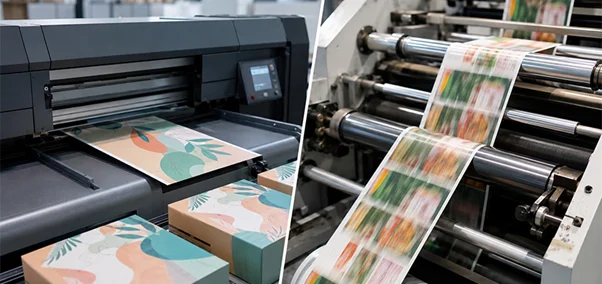
If you've ever stood in front of two print quotes wondering why one costs three times more per unit but somehow makes more sense for your order, you already understand the core tension in packaging printing today. The digital printing vs. flexographic printing for packaging decision isn't really about which technology is "better." It's about which one fits your run size, your timeline, and how much your brand depends on customization.
Both technologies coexist in the packaging world for good reason — each solves a different business problem. This guide breaks down the real differences so you can make a decision based on your actual production needs, not marketing claims.
The Quick Answer
For anyone comparing digital vs. flexographic printing for packaging and wanting a fast takeaway: digital printing wins on speed to market, short-run economics, and personalization. Flexographic printing wins on cost-per-unit at high volumes, color consistency across massive runs, and substrate versatility. Most large brands now use both, depending on the SKU and the campaign.
Now let's get into why.
What Is Flexographic Printing?
Flexography (flexo) is a well-established printing method that uses flexible relief plates wrapped around rotating cylinders. Ink is transferred from the plate onto the packaging substrate — corrugated board, film, labels, or flexible pouches — at high speed. It's the workhorse behind most grocery store shelves, from cereal boxes to snack bags to shipping cartons.
Flexo has been refined over decades. Modern flexo presses run extremely fast, handle a wide range of materials, and produce consistent, vivid color when the press is properly calibrated. The catch is the setup: each job requires custom plates, precise plate mounting, and press calibration before a single good print rolls off the line. That upfront investment is where flexo's economics come from — and where its limitations begin.
What Is Digital Printing?
Digital printing skips the plate-making step entirely. Designs go straight from a computer file to the substrate, using inkjet or toner-based technology. There's no physical plate to create, mount, or store, which means a press can jump from one design to a completely different one in minutes.
This is why digital printing packaging customization has become such a big deal for brands. Want to print 500 boxes with a different QR code or regional promotion on each one? Digital can do that without slowing down. Want to test five different label designs before committing to one? Digital makes that financially realistic.
Speed and Turnaround Time
Packaging print turnaround time is often the deciding factor for brands working on tight launch schedules or unpredictable demand.
- Digital printing has almost no pre-press lag. Files go to press quickly, and jobs can be reordered or adjusted on short notice. For a brand needing packaging in days rather than weeks, digital is usually the practical choice.
- Flexographic printing requires plate creation and press setup, which can take days before printing even begins. Once running, however, flexo presses produce output at very high speeds, making them far more efficient once a job is in full production for a large quantity.
In short: digital is faster to start, flexo is faster to finish — but only at volume.
Customization and Variable Data Printing
This is where the gap between the two technologies is widest.
Variable data printing packaging — where each printed unit can carry unique text, codes, imagery, or serialization — is essentially exclusive to digital printing. Flexo plates are static; every impression from a given plate looks identical. Digital, by contrast, can print a different barcode, name, expiration batch, or promotional message on every single unit in a run without ever slowing the press.
This capability has opened up entire marketing strategies that weren't feasible before:
- Personalized packaging for direct-to-consumer brands
- Region-specific labeling without separate print runs
- Anti-counterfeiting serialization
- Limited-edition or influencer-collaboration packaging
- A/B testing different designs within the same production batch
If your brand strategy leans on personalization or frequent design iteration, this single capability often settles the digital vs flexo printing for packaging debate on its own.
Run Length and Volume Economics
Run size is the single biggest factor in the digital vs flexo printing cost comparison, and it flips the advantage depending on quantity.
Digital printing short run packaging makes sense when:
- Order quantities are small to mid-sized (from a few hundred to a few thousand units)
- Designs change frequently, by season, region, or promotion
- You're testing a new product or package design before a full launch
- Inventory needs to stay lean, avoiding large minimum print runs
Flexographic printing high volume packaging makes sense when:
- You're printing tens of thousands to millions of units of the same design
- The design is stable and unlikely to change for a long period
- Cost-per-unit at scale matters more than flexibility
- You need consistent output across an extended production schedule
The break-even point varies by supplier, substrate, and press type, but as a general rule: below roughly 5,000–10,000 units, digital tends to be cheaper once you account for plate costs and setup labor in flexo. Above that threshold, flexo's lower per-unit ink and material costs start to win out.
Branding Impact and Print Consistency
Packaging print brand consistency matters just as much as cost and speed, especially for established brands protecting their shelf identity.
Flexo has a long track record of producing rich, saturated color at scale, and once a press is dialed in, it can replicate that exact look across enormous print runs with minimal variation. For brands whose packaging color is part of their identity — think a specific shade tied directly to brand recognition — that reliability at volume is valuable.
Digital printing has closed much of this gap in recent years. Modern digital presses, particularly those using advanced color management systems, can now match brand colors closely and maintain consistency across shorter runs. Where digital pulls ahead is flexibility without sacrificing brand control — a marketing team can push out a limited seasonal design or regional variant without breaking the visual identity guidelines, and without committing to a six-figure print run to do it.
For brands running frequent promotions, seasonal packaging, or multi-region distribution, digital's ability to stay on-brand while still varying content is often more valuable than flexo's raw color depth at scale.
Substrate and Material Considerations
Flexo remains the more versatile option for unusual or industrial substrates — certain films, foils, and heavier corrugated stock print more reliably on flexo presses that have been optimized for those materials over decades. Digital presses have expanded their substrate compatibility significantly, but flexo still holds an edge for some specialty packaging materials, particularly in high-speed corrugated and flexible film production.
So, Which Should You Choose?
There's no universal winner in the flexo vs. digital printing for packaging conversation — the right choice depends entirely on your specific order profile. Here's a simplified way to think about it:
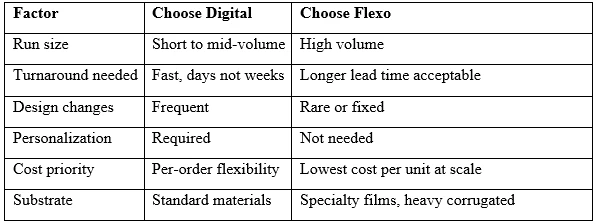
Many mid-size and large brands don't pick one exclusively — they use digital for new product testing, regional variants, and promotional runs, then shift to flexo once a design proves itself and volume justifies the plate investment. That hybrid approach captures the strengths of both technologies without forcing an all-or-nothing bet.
Frequently Asked Questions
Is digital printing cheaper than flexo for packaging?
It depends on volume. Digital is generally cheaper for short runs because it avoids plate-making costs. Flexo becomes cheaper per unit once order quantities scale into the tens of thousands, since its ink and material costs drop significantly at volume.
Which is faster, digital or flexo printing?
Digital printing has a shorter turnaround for getting a job started since there's no plate setup. Flexo, once running, prints at very high speeds and is more efficient for large-volume jobs already in production.
Can flexo printing do variable data or personalization?
No. Flexo plates are fixed, so every printed unit is identical. Variable data printing, including unique codes or personalized text per unit, requires digital printing.
What run size is the break-even point between digital and flexo?
It varies by supplier and substrate, but a common benchmark is around 5,000 to 10,000 units. Below that, digital is usually more economical; above it, flexo tends to be cheaper per unit.
Does digital printing match flexo's color quality?
Modern digital presses with strong color management can closely match flexo's output, though flexo still has an edge for extremely large runs requiring exact color replication across long production stretches.
Final Thoughts
The digital vs. flexo packaging printing decision comes down to matching the technology to your production reality. If your brand needs speed, customization, and the flexibility to change designs often, digital printing is built for that. If you're producing massive volumes of a stable, unchanging design, flexographic printing still delivers the best cost efficiency at scale. Understanding where your orders actually fall on that spectrum — rather than defaulting to whichever method your last supplier used — is what turns a printing decision into a genuine branding advantage.
 Our Services
 Media Pack Download
 Newsletters
 Industrial Events