

QR Code vs. RFID Labelling: Marketing ROI, Traceability, and Supply Chain Efficiency
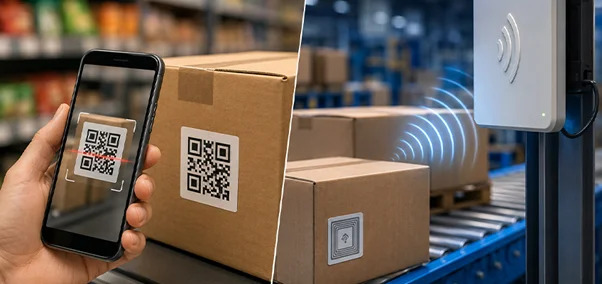
If you run a brand, manage a warehouse, or oversee packaging decisions, you've probably faced this question at least once: should we go with QR codes or RFID tags? It sounds like a small technical choice, but it actually shapes how customers interact with your product, how accurately you track inventory, and how much money you spend keeping your supply chain honest.
The short answer is that there isn't one "winner." QR codes and RFID solve overlapping but different problems, and the smartest brands are increasingly using both together. Let's break down exactly where each technology shines, what it costs, and how to decide which one — or which combination — fits your business.
QR Code or RFID for Product Tracking: What's the Real Difference?
A QR code is a printed, scannable image that requires a camera (usually a smartphone) and a direct line of sight to read. RFID (Radio Frequency Identification) uses a small chip and antenna that communicates via radio waves, meaning it doesn't need line of sight and can be read from a distance, even through packaging.
That single difference — line-of-sight versus radio-wave detection — is the root of almost every decision you'll make between the two.
- QR codes are cheap, easy to generate, and require zero specialized hardware beyond a smartphone.
- RFID tags require chips, antennas, and dedicated readers, but they can be scanned in bulk, automatically, without a human pointing a camera at each item.
If your priority is customer engagement and simple item-level tracking, QR codes usually win. If your priority is high-volume, automated inventory accuracy across a warehouse or retail floor, RFID tends to pull ahead.
QR Code vs. RFID for Inventory Management
Inventory management is where the two technologies diverge the most sharply.
With QR codes, someone (or some device) has to scan each code individually. This works fine for small operations, boutique retailers, or businesses that don't move thousands of units per hour. It's manual, but it's also flexible and nearly free to implement once you already have printers and smartphones.
RFID changes the math entirely for high-volume environments. A single RFID reader can scan hundreds of tagged items per second without anyone touching or aiming at them individually. Warehouses using RFID routinely report inventory counts that used to take hours now taking minutes. This is why large retailers, apparel chains, and logistics companies lean toward RFID for stock counts, loss prevention, and real-time shelf visibility.
The tradeoff is upfront cost and infrastructure. RFID readers, tag encoding, and system integration require real investment. QR codes require almost none. So the inventory management decision really comes down to volume: low-to-mid volume operations often do fine with QR, while high-throughput environments increasingly need RFID to stay competitive.
QR Code Traceability in Packaging
Traceability has become a non-negotiable expectation in industries like food, pharmaceuticals, cosmetics, and increasingly fashion. Regulators and consumers alike want to know where a product came from, how it was handled, and whether it's authentic.
QR codes are a natural fit here because they double as a communication channel. A single QR code on packaging can link to batch numbers, origin data, expiration dates, certifications, and even a full farm-to-shelf story — all while giving the brand a direct line to the end consumer's phone. This is why QR code traceability in packaging has grown so quickly in food and beverage, wine, and supplement industries, where "scan to verify" has become a trust signal as much as a compliance tool.
The limitation is that QR traceability depends on someone actually scanning the code, which means it's better suited for consumer-facing transparency than for automated, internal supply chain checkpoints.
RFID Traceability in Packaging
RFID traceability in packaging operates on a different level — it's built for automation rather than consumer interaction. Because RFID tags can be read in bulk and without line of sight, they're ideal for tracking products as they physically move through checkpoints: from manufacturing lines, through distribution centers, onto trucks, and finally to store shelves.
This makes RFID especially valuable in industries where product authenticity and chain-of-custody matter enormously — pharmaceuticals, luxury goods, and electronics, for example. A tagged pallet can be verified at every checkpoint automatically, creating a tamper-evident digital trail without manual scanning labor.
The catch: RFID tags cost more per unit than a printed QR code, and reading infrastructure needs to be installed at every checkpoint you want visibility into. For internal traceability at scale, that investment often pays for itself; for direct consumer engagement, it usually doesn't.
QR Code Supply Chain Traceability vs. RFID Supply Chain Tracking
Zooming out to the full supply chain, the comparison becomes about speed, labor, and data richness.
QR code supply chain traceability tends to work best in supply chains with moderate volume, budget constraints, or a strong consumer-transparency component. It's low-cost to deploy at scale because printing a QR code costs fractions of a cent, and it integrates easily with existing packaging and labeling processes.
RFID supply chain tracking is built for speed and automation. It eliminates manual scanning bottlenecks, reduces human error, and enables real-time location tracking of goods in transit. Logistics companies moving large volumes of pallets or containers often find that RFID pays for itself through labor savings alone, even before counting the accuracy improvements.
A useful way to think about it: QR codes tell a story to the people who interact with the product. RFID tells a story to the systems that move the product. Many mature supply chains now use both — RFID for internal, high-speed tracking, and QR codes for the final consumer-facing touchpoint.
QR Code Packaging Marketing vs. RFID Packaging Applications
This is where the two technologies serve genuinely different business functions.
QR code packaging marketing turns every product into a potential marketing touchpoint. Brands use QR codes to link to product tutorials, loyalty programs, user-generated content campaigns, personalized offers, and social media pages — all directly from the packaging in someone's hand. Because QR codes are consumer-facing by nature, they've become one of the most cost-effective tools for closing the gap between physical packaging and digital marketing.
RFID packaging applications, on the other hand, are rarely aimed at consumers at all. RFID is used for anti-counterfeiting, smart shelf restocking alerts, automated checkout (as seen in some cashier-less retail formats), and asset tracking. It's operational infrastructure, not a marketing channel — though some luxury brands have started embedding RFID for both authentication and quiet backend inventory benefits simultaneously.
If your goal is customer engagement and brand storytelling, QR codes are the clear choice. If your goal is operational visibility and loss prevention, RFID applications deliver more value.
QR Code vs. RFID Implementation Cost
Cost is often the deciding factor for smaller and mid-sized businesses, so it's worth being direct about the numbers.
QR codes cost almost nothing to implement. Generating and printing a QR code adds negligible expense to existing packaging, and scanning requires no special hardware since customers already carry smartphones.
RFID implementation costs are significantly higher. Passive RFID tags typically cost more per unit than a printed QR code, and that's before accounting for readers, antennas, software integration, and staff training. For large-scale operations, that cost is often justified by labor savings and accuracy gains. For smaller businesses or lower-volume products, the investment can be hard to justify.
QR Code vs. RFID ROI
When comparing QR code ROI for marketing campaigns against RFID ROI for supply chain management, you're really comparing two different types of return.
QR code ROI for marketing campaigns is measured in engagement: scan rates, click-throughs, repeat visits, and the value of first-party customer data collected through scans. Because the cost of entry is so low, even a modest engagement rate can generate a strong return relative to spend.
RFID ROI for supply chain management is measured in operational savings: reduced labor hours, fewer stockouts, lower shrinkage, and faster inventory cycles. These savings tend to compound over time and at scale, which is why RFID ROI often becomes more attractive the larger and more complex the supply chain gets.
Neither ROI model directly competes with the other — they answer different business questions. A brand chasing marketing engagement should evaluate QR performance; an operations team optimizing warehouse throughput should evaluate RFID performance.
Smart Labels: QR Code vs. RFID in Smart Packaging
The most forward-looking trend right now isn't choosing one over the other — it's combining them. Smart labels increasingly include both a printed QR code and an embedded RFID chip on the same package. This hybrid approach lets brands capture the operational automation of RFID and the consumer engagement of QR codes without compromising on either.
QR code and RFID in smart packaging is becoming especially common in pharmaceuticals, high-value electronics, and premium consumer goods, where both anti-counterfeiting and customer interaction matter. As smart packaging technology matures, expect this dual-tag approach to become the default rather than the exception, particularly as tag costs continue to fall.
Making the Right Choice for Your Business
There's no universal winner in the QR code vs. RFID debate — only the right tool for your specific goals. If you're prioritizing low-cost implementation, consumer engagement, and storytelling, QR codes deliver strong ROI with minimal investment. If you're prioritizing automated, high-volume inventory accuracy and supply chain visibility, RFID's higher upfront cost is often justified by long-term operational savings.
For many growing brands, the real answer is a phased approach: start with QR codes for traceability and marketing, then layer in RFID as volume and operational complexity increase. That way, you're not choosing between marketing ROI and supply chain efficiency — you're building toward both.
Frequently Asked Questions
Is QR code or RFID better for product tracking?
QR codes are better for consumer-facing tracking and low-cost deployment, while RFID is better for automated, high-volume tracking across a supply chain.
Which is cheaper to implement, QR codes or RFID?
QR codes are significantly cheaper to implement since they only require printing and a smartphone camera to scan, while RFID requires tags, readers, and system integration.
Can QR codes and RFID be used together?
Yes. Many smart packaging solutions now combine both — RFID for automated backend tracking and QR codes for consumer engagement — on the same label.
Which technology offers better ROI, QR codes or RFID?
It depends on the goal: QR codes typically offer stronger ROI for marketing and engagement campaigns, while RFID offers stronger ROI for large-scale supply chain and inventory operations.
 Our Services
 Media Pack Download
 Newsletters
 Industrial Events