

Reusable vs. Single-Use Packaging: Long-Term Savings, Regulations, and Consumer Appeal
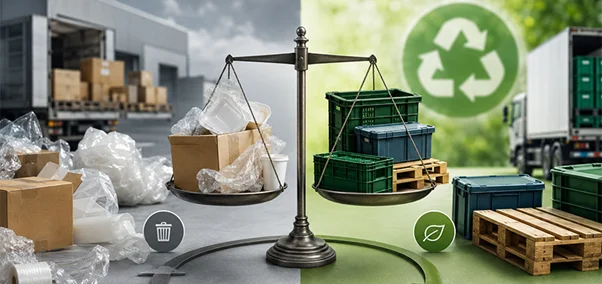
Every business that ships, stores, or sells a physical product eventually runs into the same question: should we keep buying packaging we throw away, or invest in packaging we can use again? A decade ago, this was a niche sustainability debate. In 2026, it's a bottom-line decision shaped by regulation, customer expectations, and hard numbers on cost per use.
This article breaks down the reusable vs. single-use packaging debate from every angle that matters to a business — cost, compliance, supply chain fit, and what customers actually want.
What's the Real Difference Between Reusable and Single-Use Packaging?
Single-use packaging is designed for one trip: a box, a mailer, a plastic tray, or a pallet wrap that gets used once and then recycled, landfilled, or incinerated. It's cheap per unit, requires no reverse logistics, and has dominated packaging design for the last century because it's simple to plan around.
Reusable packaging — sometimes called returnable or circular packaging — is engineered to survive dozens or hundreds of cycles. Think crates, totes, pallets, kegs, IBCs (intermediate bulk containers), and refillable containers that move back through the supply chain instead of out of it. The upfront cost is higher, but each unit is doing the job of ten, fifty, or a hundred single-use items over its lifespan.
The short answer to "which one is better" is: it depends on your volume, your shipping loops, and your regulatory exposure. But for most businesses shipping repeatedly between the same nodes — retailer to distribution center, manufacturer to plant, DC to store — reusable packaging solutions increasingly win on total cost of ownership.
Reusable Packaging Benefits Beyond the Obvious
Most conversations about reusable packaging start and end with "less waste." That's true, but it undersells the case. The real benefits show up in day-to-day operations:
- Lower damage rates. Rigid reusable totes and crates protect products better than corrugated boxes that weaken with each handling, cutting product loss.
- Standardized dimensions. Reusable containers are typically built to modular sizes that stack and nest efficiently, improving truck and warehouse space utilization.
- Faster packing and unpacking. Returnable crates with consistent openings and stacking patterns speed up manual and automated handling on the dock.
- Brand and compliance signaling. Retailers and enterprise buyers increasingly favor suppliers who can demonstrate a lower packaging footprint, especially in food, automotive, and industrial supply chains.
- Traceability. Many reusable systems now include RFID tags or QR codes, giving supply chain teams real-time visibility into container location and cycle count — something single-use packaging can never offer.
Single-Use Packaging Alternatives Worth Evaluating
Not every business can flip to a fully reusable model overnight, and not every use case needs it. If full reuse isn't realistic yet, there are middle-ground single-use packaging alternatives worth testing:
- Recycled-content packaging — corrugate, mailers, and trays made from a higher percentage of post-consumer material, which lowers extended producer responsibility (EPR) fees in many states.
- Mono-material packaging — replacing multi-layer plastic laminates with single-polymer structures that are actually recyclable in curbside systems, not just labeled as such.
- Compostable packaging — for food service and perishable goods, where reuse isn't hygienic or practical.
- Right-sized packaging — reducing material volume and void fill per shipment, which cuts both cost and dimensional weight shipping fees.
- Hybrid programs — reusable packaging for the controlled legs of a supply chain (DC to store) paired with recyclable single-use packaging for last-mile delivery to consumers.
These alternatives matter because they buy time and reduce risk while a company builds toward a longer-term circular packaging solution.
Sustainable Packaging Comparison: Cost, Waste, and Performance
A fair sustainable packaging comparison has to look past the sticker price of a single box or crate. Here's how the two models typically compare across the metrics that matter:
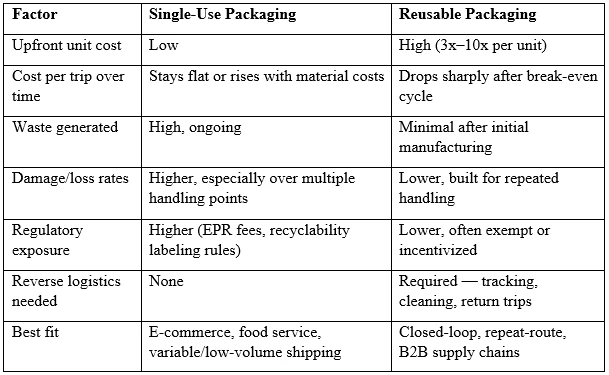
The takeaway: single-use wins on simplicity and low upfront cost, especially for irregular or one-way shipments. Reusable packaging wins on total cost and environmental performance wherever there's a closed loop and enough volume to earn back the initial investment.
Reusable Packaging for Supply Chain Efficiency
The biggest gains from reusable packaging for supply chain operations show up in closed-loop networks — manufacturer to retailer, plant to warehouse, or business-to-business shipping lanes where the same containers travel the same routes repeatedly.
Automotive and industrial manufacturers have used returnable dunnage and racks for parts shipments for years, largely because the cost of damaged components outweighs the cost of managing a reusable fleet. Grocery and retail distribution has followed the same logic with reusable plastic crates that replace waxed cardboard produce boxes — crates that get washed, stacked, and sent right back out.
The efficiency case rests on a few pillars:
- Predictable container inventory reduces last-minute packaging procurement.
- Standardized stacking and nesting improves trailer cube utilization, sometimes by 15–20%.
- Reduced labor for building and taping boxes at each handling point.
- Fewer product returns due to in-transit damage.
The catch is that reusable systems need a working reverse logistics loop. If containers don't come back reliably, the economics collapse. This is why reusable packaging performs best in networks with a limited number of trading partners and predictable shipping frequency, rather than sprawling direct-to-consumer shipping where the "return trip" of a package is unrealistic.
Reusable Packaging Cost Savings: Where the Number Really Breaks Even
Every company asks the same question before switching: how many cycles does it take before reusable packaging cost savings actually show up on the P&L?
The general pattern holds across most reusable formats:
- A reusable tote or crate costs roughly 3–10 times more than a single-use equivalent.
- Break-even is typically reached between 10 and 40 use cycles, depending on the container type, cleaning costs, and loss rate.
- Well-managed reusable programs (low loss, high cycle count) can drive the per-trip cost down to a fraction of single-use packaging — often 60–80% lower once a container has paid off its upfront cost.
The two biggest variables that make or break the ROI are loss rate (containers that never come back) and cycle time (how fast a container completes a round trip and re-enters the pool). A reusable program with a 20% annual loss rate and slow returns can actually cost more than single-use packaging. A tightly managed program with tracking, deposit systems, or contractual return obligations can pay for itself within the first year.
Reusable Packaging ROI for Manufacturers
For manufacturers specifically, reusable packaging for manufacturers delivers value beyond the packaging line item itself. Reduced product damage lowers warranty and replacement claims. Standardized containers simplify line-side material handling and reduce the labor spent assembling shipping cartons. And because many large retail and OEM buyers now require or reward suppliers using reusable or low-waste packaging, adopting it can be a competitive differentiator in supplier scorecards.
Reusable packaging ROI calculations for manufacturers typically factor in:
- Container purchase and depreciation cost
- Washing, inspection, and repair costs
- Reverse logistics and tracking costs
- Labor savings from faster loading/unloading
- Reduction in damaged-goods write-offs
- Avoided single-use material purchases
Manufacturers running high-volume, repeat-route shipments — automotive parts, appliance components, beverage kegs — tend to see the fastest payback, often within 12–24 months.
Returnable Packaging Systems and Reusable Transport Packaging
Returnable packaging systems cover the full operational model: ownership, tracking, cleaning, and return logistics for containers that are meant to make dozens or hundreds of trips. These systems range from simple deposit-based pallet pools to fully managed, RFID-tracked fleets run by third-party pooling companies.
Reusable transport packaging — pallets, crates, IBCs, dunnage, and bulk bins — is where most of the volume and savings potential sits, because transport packaging touches every shipment a company sends. Pooling providers now offer "packaging as a service" models, where companies pay per trip rather than owning the container fleet outright, which lowers the barrier to entry for mid-size businesses that don't want to manage cleaning and repair infrastructure themselves.
Reusable Packaging Regulations and Packaging Sustainability Regulations in 2026
Regulation is now one of the strongest forces pushing companies toward reuse. Reusable packaging regulations and broader packaging sustainability regulations in 2026 are tightening across multiple regions:
- In the United States, Extended Producer Responsibility (EPR) programs are moving from rollout into real enforcement in 2026, with more states activating programs, expanding material coverage, and tightening compliance expectations. States are increasingly charging producers material-specific per-pound fees that fund collection, sorting, recycling infrastructure, and consumer education.
- California's SB 343 adds another layer: packaging manufactured after October 4, 2026 cannot carry a recyclability label unless the material is widely recycled in the state.
- Washington's Recycling Reform Act goes a step further by directly funding reuse: the state's program includes a reuse financial assistance component that will help businesses and organizations develop or expand reusable and refillable packaging systems, funded by producer fees starting in 2029.
- In Europe, the new EU Packaging and Packaging Waste Regulation (PPWR) sets rules covering compostability, packaging minimization, and specific criteria defining reusable packaging, and it will enter into force for all EU member states on August 12, 2026, including reuse targets for transport, e-commerce, and beverage packaging that increase over time.
- Longer-term targets are also emerging: under Maine-style EPR frameworks, producers will eventually need to make 50% of their packaging readily recyclable, reusable, or compostable by 2030, rising to 75% by 2040.
- The regulatory direction is consistent across regions: fees and restrictions on single-use materials are rising, while reuse and refill systems are increasingly treated as a compliance strategy rather than just a sustainability nice-to-have. Companies that get ahead of this shift avoid scrambling when new reporting deadlines and fee structures land.
Consumer Preferences for Sustainable Packaging
Regulation is only half the pressure. Consumer preferences for sustainable packaging have shifted from a niche concern to a mainstream purchase driver. Shoppers increasingly evaluate brands based on how much packaging waste they generate, and a meaningful share have switched to alternative brands specifically because of sustainable packaging choices, such as curbside-recyclable or recycled-content packaging.
This shift shows up in a few consistent patterns:
- Consumers respond well to visible, verifiable claims (refill programs, take-back schemes) over vague "eco-friendly" labeling.
- Refill and reuse programs, once limited to niche beauty and cleaning brands, are expanding into grocery, beverage, and personal care as retailers add in-store refill stations.
- Younger shoppers in particular treat packaging waste as a signal of broader brand values, not just an environmental afterthought.
For consumer-facing brands, this means reusable and refillable packaging isn't just a cost or compliance decision anymore — it's a marketing asset when it's genuine and clearly communicated.
Circular Packaging Solutions: The Direction Everything Is Heading
Whether it's transport packaging between warehouses or refillable containers on a retail shelf, circular packaging solutions are becoming the shared target across regulation, cost management, and consumer demand. A circular model keeps packaging materials in active use — through reuse, refill, or high-quality recycling — rather than treating every package as a one-way trip to disposal.
For most companies, the realistic path isn't an all-or-nothing switch. It's a phased approach:
- Audit current packaging spend and waste volume by product line and shipping lane.
- Identify closed-loop, repeat-route shipments as the first candidates for reusable packaging.
- Pilot a returnable packaging system with a limited set of partners or locations.
- Track loss rate, cycle time, and damage reduction to calculate real ROI.
- Expand to additional lanes once the pilot proves the break-even math.
- Layer in recyclable or compostable alternatives for the shipments that can't realistically go reusable.
Frequently Asked Questions
Is reusable packaging always cheaper than single-use packaging?
Not immediately. Reusable packaging costs more per unit upfront and only becomes cheaper once it has completed enough cycles — usually 10 to 40 trips — to offset that initial cost. For low-volume or one-way shipments, single-use packaging can still be the more economical choice.
What industries benefit most from reusable packaging?
Industries with closed-loop, repeat-route shipping — automotive, industrial manufacturing, grocery distribution, and beverage — see the fastest payback because containers travel predictable routes and return reliably.
Will packaging regulations in 2026 require companies to use reusable packaging?
Not universally, but the direction is clear. EPR fees, recyclability labeling restrictions, and reuse targets in regions like California, Washington, and the EU are all making single-use packaging more expensive and reusable or refillable systems more financially attractive.
Do consumers actually care about packaging sustainability?
Yes. A meaningful and growing share of consumers report switching brands specifically over packaging choices, and this trend is strongest among younger shoppers who treat packaging as a signal of a brand's broader values.
What's the biggest risk in switching to reusable packaging?
Loss rate. If reusable containers don't reliably come back into the system, the cost savings disappear. Successful programs need tracking, clear return agreements with partners, and realistic cycle-time expectations before scaling up.
The choice between reusable and single-use packaging isn't a philosophical one anymore — it's operational. Regulations are raising the cost of single-use materials, consumers are rewarding brands that visibly reduce waste, and the ROI math on reusable systems keeps improving as pooling and tracking technology matures. The businesses coming out ahead aren't necessarily the ones going fully circular overnight. They're the ones running the numbers on their specific shipping lanes, piloting reuse where it fits, and keeping recyclable alternatives in place where it doesn't — yet.
 Our Services
 Media Pack Download
 Newsletters
 Industrial Events