

Smart Labels vs. Traditional Labels: Boosting Consumer Engagement and Sales Conversion
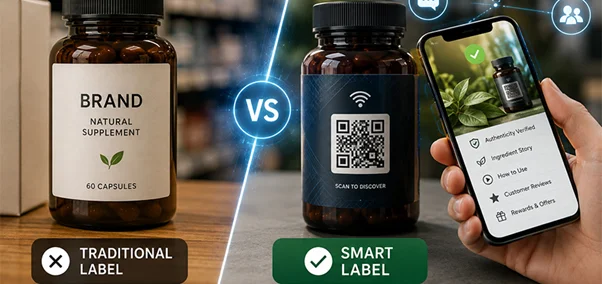
Packaging used to have one job: tell you what's inside. Today, it's expected to do a lot more — prove authenticity, guide usage, and keep talking to the customer long after checkout. That's the shift at the heart of smart labels vs. traditional labels. A QR code now opens a recipe video. A wine label unlocks the story behind the vineyard. A skincare jar reveals its exact production date with a single tap. This isn't a passing design trend — it's changing how brands sell, how consumers decide, and how much trust a product earns before it even leaves the shelf.
If you're a brand owner, packaging manager, or marketer trying to decide whether it's time to upgrade, this guide breaks down the real differences, the numbers behind them, and what actually moves the needle on sales.
What Are Traditional Labels, Really?
Traditional labels are the printed paper or vinyl stickers most of us grew up with. They carry static information: product name, ingredients, barcode, batch number, and maybe a logo. Once printed, that information is fixed. If pricing changes, a recall happens, or a promotion ends, the label itself can't update — the whole batch has to be reprinted or physically covered.
They're inexpensive, familiar, and easy to produce at scale. But in a market where consumers expect instant information and personalized experiences, static labels are starting to feel like a one-way conversation in a world that wants a dialogue.
What Are Smart Labels?
Smart labels embed technology directly into the packaging — QR codes, NFC chips, RFID tags, or even temperature and freshness sensors. Instead of just displaying information, they connect the physical product to a digital experience. Scan or tap, and the consumer is instantly linked to product authentication, usage instructions, loyalty programs, reviews, or exclusive content.
This is the core of the smart labels vs. conventional labels debate: one format informs, the other engages, verifies, and adapts in real time.
Smart Labels versus Traditional Labels: The Core Differences
When comparing smart labels versus traditional labels, the differences show up in four key areas:
1. Information flow. Traditional labels are static — printed once, fixed forever. Smart labels are dynamic; the underlying digital content can be updated anytime without reprinting a single unit.
2. Consumer interaction. A traditional label is read. A smart label is used — scanned, tapped, or tracked, turning a passive glance into an active moment.
3. Data and traceability. Smart labels can log where a product has been, verify authenticity, and feed real-time data back to the brand. Traditional labels offer none of this visibility once the product leaves the factory.
4. Cost and complexity. Traditional labels win on simplicity and upfront cost. Smart labels require more investment in technology and integration but pay that back through engagement, data, and reduced counterfeiting.
Similarly, when you look at digital labels vs. traditional labels, the story is the same: digital labels turn a static surface into a live channel that brands can control long after the product ships.
Smart Packaging vs. Traditional Packaging: The Bigger Picture
Labels don't exist in isolation — they're part of the packaging as a whole. Comparing smart packaging vs. traditional packaging reveals why this shift matters beyond just the label itself.
Traditional packaging protects and informs. Smart packaging protects, informs, and communicates. Sensors can track freshness in real time, alerting retailers before spoiled stock reaches shelves. NFC-embedded caps can confirm a product hasn't been tampered with. Connected packaging can even personalize the unboxing experience based on where and when it's opened.
For categories like pharmaceuticals, premium spirits, and cosmetics — where authenticity and shelf life genuinely matter — this isn't a luxury. It's becoming the baseline expectation.
Interactive Labels vs. Traditional Labels: Where Engagement Actually Happens
This is where the conversation gets interesting for marketers. The comparison of interactive labels vs. traditional labels is really a comparison of two different relationships with the customer.
A traditional label speaks once, at the point of purchase, and then goes silent. An interactive label keeps talking. It can:
- Launch a how-to video the moment someone opens the app-linked scan
- Reveal ingredient sourcing stories that build emotional trust
- Offer a discount code for the next purchase
- Collect first-party data on who's buying, where, and how often
- Turn a single product into a repeatable touchpoint across the entire customer journey
This ongoing dialogue is why smart label consumer engagement consistently outperforms static alternatives — engagement doesn't end at checkout, it starts there.
Interactive Label Consumer Engagement: What the Data Shows
Brands that have adopted connected packaging report measurable lifts in several areas. Interactive label consumer engagement tends to show up in three ways:
Longer attention on-pack. A QR code that promises a recipe, a game, or a discount gives shoppers a reason to linger with the product rather than moving to the next shelf item.
Higher repeat purchase intent. When a label links to a loyalty program or personalized offer, it gives the brand a reason to stay in contact after the sale — something a printed barcode simply cannot do.
Better conversion at the shelf. Reviews, certifications, or "verified authentic" badges accessible through a scan reduce hesitation at the exact moment a purchase decision is being made.
This is the essence of interactive packaging engagement: it doesn't just decorate the product, it actively participates in the sale.
Digital Packaging Engagement and the Modern Consumer
Today's shoppers, especially younger ones, expect to interact with brands the same way they interact with everything else — through their phones. Digital packaging engagement meets that expectation directly. A generation that reads reviews before buying almost anything now expects that same verification layer built into the product itself.
This is also why smart labels benefits extend well beyond aesthetics. They give brands a channel to answer the exact questions a consumer has in that moment — is this authentic, is this fresh, is this right for me — without requiring a separate app download or a Google search.
Smart Label Advantages for Brands
Beyond the consumer-facing benefits, there are strong operational reasons brands are making the switch. Smart label advantages include:
- Real-time updates to pricing, promotions, or compliance information without reprinting stock
- Anti-counterfeiting protection, especially valuable for luxury goods, pharmaceuticals, and electronics
- Supply chain visibility, tracking a product from factory to shelf
- First-party data collection, giving marketing teams insights that used to be guesswork
- Reduced waste, since digital content updates instantly instead of triggering a reprint
Smart Labels Benefits for Brands: The ROI Argument
When it comes to smart labels benefits for brands, the return on investment usually shows up in three places: higher conversion at the point of sale, stronger repeat engagement after the sale, and fewer losses from counterfeit or recalled product. Combined, these often offset the higher upfront cost of the technology within one to two product cycles for mid-to-large brands.
Smart labeling advantages also extend into sustainability reporting — brands can now prove sourcing claims, carbon footprint data, or recycling instructions directly through the label, satisfying both regulators and increasingly conscious consumers.
Traditional Labels vs. Smart Labels: When Does Traditional Still Make Sense?
To be fair, the traditional labels vs. smart labels decision isn't always one-sided. Traditional labels still make sense for:
- Low-cost, high-volume commodity goods where margin doesn't support added technology
- Categories with minimal counterfeiting risk or low consumer research behavior
- Early-stage brands still validating product-market fit before investing in infrastructure
Smart labels make more sense as products move up in price point, complexity, or trust requirements — think supplements, spirits, electronics, and anything where "is this real?" or "how do I use this?" are common buyer questions.
Frequently Asked Questions
What is the main difference between smart labels and traditional labels?
Traditional labels display fixed, printed information that can't change after production. Smart labels connect the physical product to digital content — through QR codes, NFC, or RFID — that can be updated, tracked, and personalized in real time.
Do smart labels actually increase sales?
Yes, primarily by reducing purchase hesitation (through verification and reviews accessible via scan) and by extending engagement beyond the point of sale through loyalty offers and repeat-purchase triggers.
Are smart labels more expensive than traditional labels?
Generally yes, upfront. But the ability to update content without reprinting, combined with reduced counterfeit losses and higher engagement, often makes the total cost of ownership comparable or better over time.
Which industries benefit most from smart packaging?
Pharmaceuticals, premium spirits and wine, cosmetics, electronics, and supplements see the strongest returns, since authenticity, usage guidance, and traceability directly influence buyer trust.
Can small brands afford smart labels?
Yes — QR-code-based smart labels are now affordable even for small and mid-sized brands, since they don't require specialized hardware like NFC or RFID to get started.
The Bottom Line
The debate over smart labels vs. traditional labels isn't really about technology for technology's sake — it's about whether a brand wants its packaging to talk at consumers or talk with them. Traditional labels will always have a place for low-complexity, low-risk products. But for any brand competing on trust, engagement, or repeat purchase behavior, smart and interactive labels aren't just an upgrade — they're becoming the new standard for how packaging sells.
 Our Services
 Media Pack Download
 Newsletters
 Industrial Events