


Top 7 Circular Economy Packaging Strategies for Procurement and Sustainability Specialists
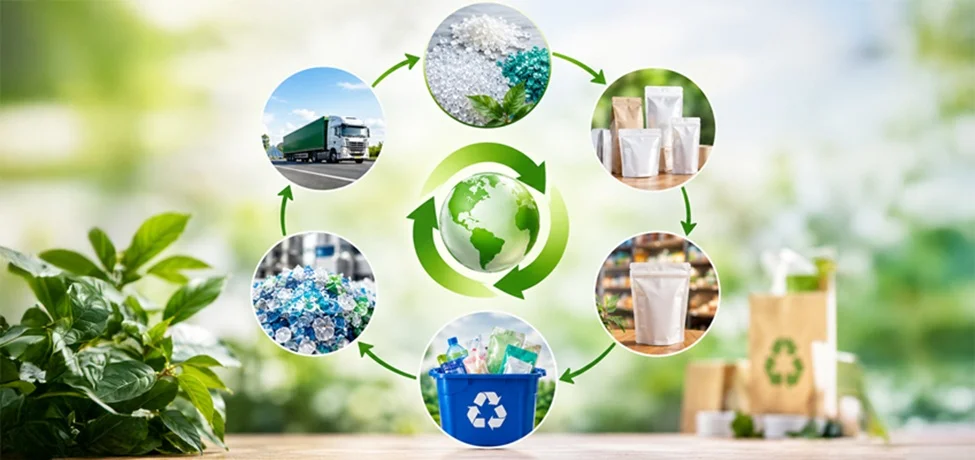
If you work in procurement or sustainability, you've probably sat in a meeting where someone said, "We need to make our packaging greener," and then everyone looked at you.
Fair enough. Packaging touches suppliers, logistics, product safety, brand, cost and now regulation. Swapping plastic for paper isn't a strategy, and it can backfire.
So, what are the best circular economy packaging strategies? The seven that deliver the most are:
1. Design for mono-material recyclability
2. Use post-consumer recycled (PCR) content
3. Right-size packaging
4. Adopt returnable transit packaging (RTP)
5. Build a closed-loop packaging supply chain
6. Test a packaging-as-a-service lease model
7. Ground every decision in packaging LCA and EPR compliance
Below is how each works in practice, where teams get stuck, and what to ask your suppliers.
1. Design for Mono-Material Recyclability
What it is: Making a pack from one polymer family (all PE or all PP, say) instead of laminating several layers together.
Why it matters: Multi-layer films and mixed-material pouches are hard to separate and rarely get recycled. Mono-material plastic packaging design gives recyclers a clean, predictable stream, and recyclable packaging is what most circular economy packaging strategies rest on.
What procurement can do:
- Add "recyclable in practice and at scale" to your RFQs, not just "recyclable in theory."
- Ask suppliers for barrier-performance data. The main hurdle with mono-material is shelf life, so request trials before you commit.
- Check design against recyclability guidelines in your target markets. Labels, inks, adhesives and closures all affect the result.
A common mistake: Declaring a pack "mono-material" while ignoring a PVC sleeve or a metallized label. The weakest component sets the recyclability of the whole pack.
2. Use Post-Consumer Recycled Content (PCR)
What it is: Packaging made partly or wholly from material that has already been used by consumers and collected for recycling.
Why it matters: Recyclability on paper means little if demand for recycled material is weak. Post-consumer recycled content (PCR) creates that demand and keeps virgin material out. It's also increasingly mandated: several jurisdictions now set minimum recycled-content targets for plastic packaging.
What procurement can do:
- Set a PCR target by packaging type, since rigid PET and HDPE are easier to source than flexible films or food-contact applications.
- Ask for chain-of-custody certification. Mass-balance claims and physically traceable PCR are not the same thing.
- Lock in supply early. Food-grade PCR can be tight, and price swings against virgin resin are real. Multi-year contracts or indexed pricing help.
A common mistake: Chasing 100% PCR on every SKU. A phased approach, say 30% on one line and then scaling, usually works better than a headline target you can't meet.
3. Right-Size Your Packaging
What it is: Matching the pack to the product so you cut void fill, oversized boxes and extra layers. In industry terms, right-sizing packaging optimization.
Why it matters: It's the rare strategy that saves money and carbon at the same time. Smaller packs mean less material, more units per pallet and fewer trucks. Less air shipped is the easiest sustainability win most teams overlook.
What procurement can do:
- Audit your top 20 SKUs by volume and measure the empty space in each shipper.
- Consolidate box sizes. Fewer sizes means better supplier pricing and simpler inventory.
- Run drop and compression tests before cutting material. Damage rates can erase the savings fast.
Quick win: Ask your logistics provider for dimensional-weight charges. If you're paying to ship air, you have a business case ready-made.
4. Adopt Returnable Transit Packaging (RTP)
What it is: Durable crates, pallets, totes, drums and containers that are used for dozens or hundreds of trips instead of once. Returnable transit packaging (RTP) is most common in B2B flows: automotive, FMCG, retail distribution and manufacturing.
Why it matters: Single-use corrugate, stretch wrap and wooden crates add up to a huge, recurring waste stream. RTP turns packaging from a consumable into an asset.
What procurement can do:
- Start with closed, predictable routes: plant-to-plant, DC-to-store, supplier-to-line.
- Calculate cost per trip, not unit price. A reusable crate costs more upfront but often wins on total cost of ownership.
- Plan for loss and repair rates, tracking (barcodes, RFID), cleaning and reverse logistics.
A common mistake: Treating RTP as a purchase instead of a system. Without return-flow discipline, pooling or deposits, crates disappear.
5. Build a Closed-Loop Packaging Supply Chain
What it is: A system where packaging material flows back to you (or your partners) and becomes new packaging. A closed loop packaging supply chain connects collection, sorting, reprocessing and re-manufacture.
Why it matters: Individual tactics help, but loops make them durable. If your used film comes back as new film, you reduce exposure to virgin-material price volatility and strengthen your recycled-content claims.
What procurement can do:
- Map where your packaging actually ends up after use. Most teams are surprised.
- Partner with converters and recyclers who can take back production scrap and post-use material.
- Start with what you control: factory offcuts, warehouse stretch film and corrugate from your own DCs. These are clean, high-value streams.
Practical tip: Build take-back clauses into supplier contracts so the loop is written into the commercial relationship, not left to goodwill.
6. Test a Packaging-as-a-Service (Lease) Model
What it is: Instead of buying packaging outright, you pay for its use. The provider owns the assets, handles cleaning, repair and recovery, and charges per trip, per month or per use. This is the packaging as a service lease model.
Why it matters: It shifts capital costs to operating costs and gives the provider a financial reason to design durable, reusable packaging. It also removes the operational headache of running a return system yourself.
What procurement can do:
- Pilot on one lane or one product family before scaling.
- Scrutinize contract terms: minimum volumes, loss liability, data access and exit options.
- Compare against your current total cost, including disposal, damage and handling labor.
A common mistake: Signing a long contract before you understand your own return rates. Pilot first, then negotiate.
7. Ground Everything in LCA and EPR Compliance
This last strategy is what keeps the other six honest.
Packaging lifecycle assessment (LCA): A lifecycle assessment measures environmental impact from raw material to end of life. Without it, you can end up making things worse. A heavier reusable pack, for example, only pays off if it's reused enough times. A lightweight flexible pouch may beat glass on carbon but lose on recyclability. LCA shows you the trade-offs.
Packaging sustainability compliance (EPR): Extended producer responsibility makes producers financially and operationally responsible for the packaging they put on the market. EPR schemes now operate or are being rolled out across the EU, India, the UK, Canada and a growing number of US states. Fees often depend on material, weight and recyclability, so design choices directly change what you pay. Because rules and deadlines vary by market and keep changing, confirm current requirements for each country you sell in.
What procurement can do:
- Require suppliers to provide material composition, recycled-content and recyclability data in a standard format.
- Use LCA results to rank options, not just justify decisions after the fact.
- Build a compliance calendar by market covering registration, reporting and fee deadlines.
Bonus: Good EPR data also helps with sustainability reporting, so one dataset serves several needs.
How to Prioritize: A Simple Starting Order
You don't need to do all seven at once. Here's a sensible sequence:
| Stage | Focus | Why first |
| Quick wins (0–6 months) | Right-sizing, supplier data collection | Low risk, fast savings |
| Build (6–18 months) | Mono-material redesign, PCR targets, LCA | Needs testing and supplier work |
| Scale (18+ months) | RTP, closed loops, packaging as a service | Needs systems and partnerships |
| Always on | EPR compliance tracking | Regulation doesn't wait |
Frequently Asked Questions
What is circular economy packaging?
Packaging designed so materials stay in use through reuse, recycling or recovery, rather than becoming waste after a single use.
What is sustainable packaging procurement?
Buying packaging using environmental criteria such as recyclability, recycled content, reusability and carbon footprint, alongside cost, quality and supply security.
Is reusable packaging always better than recyclable packaging?
Not always. It depends on trip count, transport distance, cleaning requirements and return rates. A lifecycle assessment gives the clearest answer for your case.
How does EPR affect packaging decisions?
EPR fees usually scale with material type and weight, and sometimes with recyclability. Lighter, recyclable, mono-material designs often cost less to place on the market.
Where should a procurement team start?
Audit your current packaging, collect supplier data and tackle right-sizing first. It's the lowest-risk way to show results.
Final Thoughts
Circular packaging isn't a single project. It's a set of connected decisions, and procurement sits at the center of most of them. Start small, measure properly, and bring suppliers in as partners rather than order-takers.
If you do just one thing this quarter, pick your five highest-volume packaging items and ask three questions of each: Can it be right-sized? Can it be mono-material? Can it be reused? The answers will tell you where to go next.
 Our Services
 Media Pack Download
 Newsletters
 Industrial Events