

Hybrid Printing Technology: Combining Digital and Flexographic Printing
Flexographic printing is efficient but slow to change. Digital printing is flexible but costly at scale. For years, packaging printers were forced to pick one weakness over the other. Hybrid printing technology, which combines digital and flexographic printing on a single press, removes that choice.
What Hybrid Printing Technology Actually Is
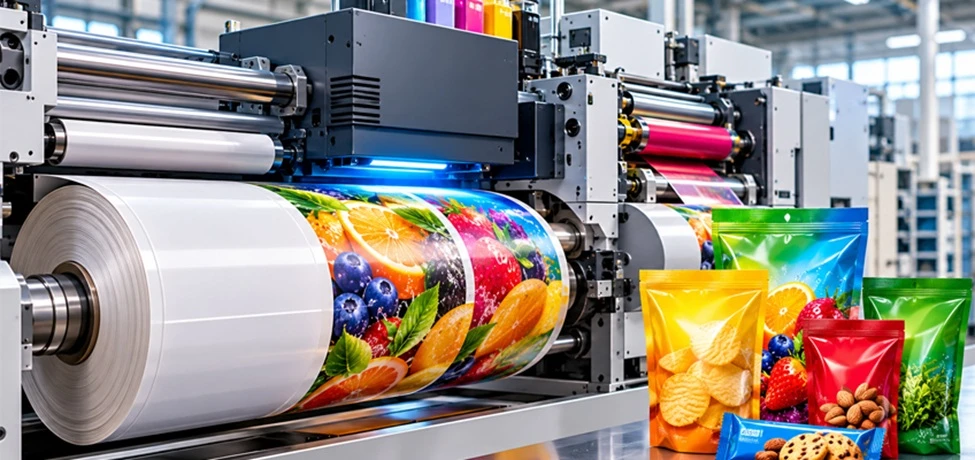
Hybrid printing technology places digital inkjet units and flexographic stations on the same press, so a package can be printed, coated, and finished in one pass. The flexo side handles what it has always done well: opaque white, brand spot colors, primers, varnishes, and coatings. The digital side prints the full-color artwork, including photographic images, gradients, and any element that changes from one pack to the next.
You will also hear the approach called digital flexo printing. The label differs, but the principle is the same. Each technology takes the part of the job it handles best, and the press does not force either one to do everything.
Why the Industry Moved Beyond Choosing Sides
Flexo became the standard for packaging because, once a press is running, almost nothing beats it on cost per meter. The problem sits upstream of the press. Every new design needs plates, every color needs matching, and every changeover burns time and material before saleable output begins. On long runs, that cost is spread thin. On short runs, it dominates the job.
Digital printing arrived with the opposite profile. No plates, almost no setup, and artwork that can change from one repeat to the next. But ink costs climb with volume, and finishes that brands rely on for shelf impact, such as dense whites, metallic effects, and tactile coatings, are harder to achieve digitally.
Meanwhile, the orders reaching converters have been changing. Brands want more SKUs, regional variants, seasonal editions, and faster launches, usually in smaller batches. They still expect the look of a premium long-run pack. Hybrid flexographic printing grew out of that gap. It is less a brand-new invention than a practical merger of two proven technologies, shaped around how packaging is ordered today.
Inside the Hybrid Printing Process
The easiest way to understand the hybrid printing process is to follow a roll of film through the press.
The substrate first passes through surface treatment, such as corona or a primer, to prepare it for ink. It then reaches the flexo stations, which lay down opaque white and any brand-critical spot colors. On transparent films, that white layer is what gives the artwork a clean, bright base. Next, the film moves under the digital heads, where CMYK inks, sometimes extended with orange, violet, or green for a wider color range, print the images and variable content. Finally, flexo returns for varnish, matte or gloss coating, cold foil, or lamination, and many lines finish with inline die-cutting, slitting, and rewinding.
Because this digital and flexographic printing combination runs as a single workflow, the job is handled once, not two or three times across separate machines. That saves time, and it also removes a surprising number of small errors that appear when rolls travel between processes.
Hybrid Printing vs Digital Printing
For anyone evaluating the technology, the comparison that matters most is hybrid printing vs digital printing.
Pure digital is the more flexible option on paper. Setup is minimal, plates are unnecessary, and artwork can change instantly. The trade-off is cost and capability at scale: ink expense rises with volume, and demanding whites, special colors, and heavy finishing are harder to deliver. Hybrid keeps the digital advantage where it counts, on the artwork, and hands the heavy lifting back to flexo, where it is both stronger and cheaper.
One way to think about it is that digital alone is a sprinter and flexo alone is a marathon runner. Hybrid is the athlete who can do both well enough to win the races that actually come up. For the short-to-medium runs that dominate modern packaging orders, that versatility is often worth more than peak speed in either direction.
The Benefits of Hybrid Printing in Practice
The benefits of hybrid printing are easiest to see on the shop floor.
Turnaround is usually the first improvement printers notice. With fewer plates and fewer changeovers, a job can move from approved artwork to finished rolls far more quickly than on a conventional line. Waste drops as well, because the digital sections need very little makeready, which matters a great deal when the film is the most expensive input in the job.
Design freedom grows too. Gradients, photography, and many SKUs can run back to back without stopping the press, while the finish still looks premium. Brand consistency improves quietly in the background, since flexo-printed spot colors keep logo shades stable from job to job. And because digital data can change with every repeat, QR codes, batch codes, regional languages, and campaign graphics stop being a production headache and become routine.
Hybrid Printing for Packaging: Where It Fits Best
Hybrid printing for packaging delivers the most value where variety and speed matter more than sheer volume. Food and beverage brands use it for seasonal flavors, limited editions, and regional labels. Personal care and health companies use it to manage large SKU ranges in modest batches. E-commerce brands rely on it because their designs change often and launch windows are tight.
It also suits private label and contract packers, who serve many customers with many designs and small orders. As a rule of thumb, if your portfolio looks like many designs in moderate quantities, hybrid is likely to fit. If it looks like one design in enormous quantities, a traditional flexo press may still be the better tool.
Hybrid Printing for Flexible Packaging
Flexible packaging is where this technology has earned most of its reputation. Pouches, sachets, wrappers, and laminates need an opaque base, solid barrier properties, and reliable sealing, yet brands want vivid imagery and frequent artwork updates. Pure digital makes that combination difficult, and pure flexo makes frequent changes expensive.
Hybrid printing for flexible packaging handles it cleanly. Flexo prints the white, digital prints the imagery on top, and a varnish or lamination protects the result. Because inks and primers are matched to the film, the print survives converting, filling, and sealing without cracking or scuffing. Coffee roasters, spice brands, pet food makers, and snack companies, all of whom juggle many variants at once, tend to gain the most. Moving from one pouch design to the next becomes a matter of loading a file instead of rebuilding a plate set.
Hybrid Printing for Plastic Packaging
Plastics add a technical wrinkle. Films such as PE and PP, shrink sleeves, and in-mold labels have non-porous surfaces, so ink adhesion, surface treatment, and curing all need careful attention.
Hybrid printing for plastic packaging works well because the flexo side can apply primers and white layers that give the digital inks a stable foundation. Combined with the right surface treatment and curing method, usually UV or LED-UV depending on the system, the result is sharp graphics that hold up in real use. One piece of practical advice: do not assume a result on one film will carry over to another. Run adhesion, rub, and chemical-resistance tests on your actual substrate, especially for products exposed to moisture, oil, or refrigeration.
Production Efficiency on the Shop Floor
Hybrid printing production efficiency comes mostly from removing steps, not from speeding up a single one. When printing, coating, and converting happen inline, a job travels through the plant once, which cuts handling, waiting, and storage.
Setups become shorter because fewer plates and color matches are involved. Job changes are smoother because digital artwork can switch with little or no stoppage. Scheduling gets easier, since short runs can be grouped without the heavy penalty they carry on a conventional press. Inventory shrinks as well, because you can print closer to real demand instead of stocking thousands of meters of pre-printed film that may be obsolete after the next design update.
The size of the gain depends on your job mix. A plant running a handful of designs in very long runs will see a smaller benefit than one switching between dozens of SKUs every week.
The Cost Question
Cost is where most buying conversations become serious, so it deserves a balanced view. Hybrid printing cost efficiency typically comes from four places: lower plate and tooling spend on digitally printed elements, less makeready waste, fewer press stops, and less capital tied up in obsolete stock. For short and medium runs, and for jobs with frequent design changes, those savings often outweigh the higher price of digital ink.
The other side of the ledger matters just as much. The press is a significant investment, operators need proper training, and digital ink still costs more per square meter than flexo ink. A very long run of a single design may remain cheaper on a pure flexo press.
The practical way to decide is a break-even calculation. Take your typical order sizes and compare the full cost per job, including plates, setup, waste, ink, labor, and delays, across flexo, digital, and hybrid. For most converters, the numbers make the answer clear.
Before You Invest
If you are considering a hybrid line, begin with your own data, not the vendor’s brochure. Look at how many SKUs you run, your average run length, and how often orders repeat. Check which substrates dominate your work, because ink and primer compatibility will decide how smoothly everything performs.
Pay close attention to prepress and color management. The digital and flexo sections must match visually, and a weak workflow shows up immediately. Then consider people and support. Operators need to understand both technologies, and training, spare parts, and service response time matter as much as the machine itself. The common challenges, including color differences between sections, film adhesion, and over-promising to customers, are all manageable when planned for early.
Final Thoughts
Hybrid printing is not about replacing flexo or digital. It is about ending the either-or decision. By pairing flexo’s finishing strength with digital’s agility, printers can serve brands that want variety, speed, and quality without being locked into long-run economics.
If your customers keep asking for shorter runs, more versions, and faster delivery, that is a strong signal. Hybrid printing technology is worth a serious look.
Quick Answers
What is hybrid printing technology?
It combines digital inkjet and flexographic printing on one press, allowing printing, coating, and finishing in a single pass.
Is hybrid printing cheaper than digital printing?
Often, yes, for medium runs and jobs that need white ink, spot colors, or coatings. Very short, simple jobs may still cost less on pure digital.
Which run lengths suit hybrid printing best?
Short to medium runs, especially across many SKUs. Very long single-design runs usually stay more economical on pure flexo.
 Our Services
 Media Pack Download
 Newsletters
 Industrial Events