

Interactive QR Code Packaging: A Powerful Tool for Marketing and Traceability
QR codes were once a problem that had no solution. Brands would print them on their packaging; consumers would sometimes scan them, and the websites would often be boring, with nothing to come back for.
Things have changed today.
Now-a-days, individuals have come to accept scanning codes without hesitation. They leverage them to pay, visit menus, download their tickets, check their information and communicate with the brands. The behavior is not uncommon. It's a part of life. Though this may be a small shift, it's a significant one when it comes to how packaging is viewed in manufacturing companies.
Today, packaging teams are expected to have to solve issues that they did not have 10 years ago. Customer engagement is a need for marketing departments. There is a demand for improved visibility in the supply chain. Regulatory teams need reliable traceability. Consumers are scrutinising product claims more closely than ever before and brand owners want to build consumer trust in the market.
Interestingly, QR technology is in the middle all those conversations.
The original goal was often simple. Provide consumers with an easy-to-access, additional resource. What many companies found, however, was that the same code could be used to achieve a lot more objectives. The package may be a portal to sources of records, authentication systems, loyalty programs, instruction programs, information on sustainability and feedback from customers.
That is, the package ceased to be the final end of the discussion.
Why Packaging Teams Are Paying Attention
Talk to packaging professionals for a while and a common theme comes up. The conversation is not confined to materials, looks, or transportation capabilities.
Sure those topics are still relevant. No company wants damaged products or ineffective packaging designs. However, it is now understood that the package can have a significant part in the customer's experience.
It's just take one expensive chocolate bar, for instance. The consumer who is in front of a retail shelf might have some questions that can't be answered by traditional packaging. From where did the cocoa beans come? Does the company interact with the farmers directly? Are sustainability claims independently verified?
There is rarely enough room on a package to provide detailed answers.
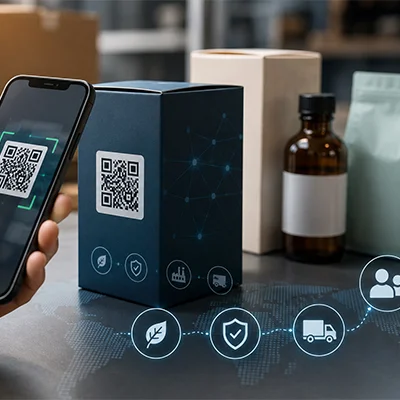
This challenge has helped fuel interest in Interactive QR Code Packaging and Smart QR Code Packaging initiatives. Instead of cramming a lot of information on a label, companies are offering access to digital content that can be updated, expanded and customized over time.
The end product is a package that remains clean and functional, and, at the same time, provides access to a much larger reservoir of information.
The Conversation Usually Starts Somewhere Else
One misconception about QR-enabled packaging is that it begins as a marketing initiative.
Sometimes it does. Just as often, it doesn't.
Food manufacturers frequently begin with traceability requirements. Pharmaceutical companies tend to focus on compliance and authentication. Luxury goods brands are often motivated by concerns about counterfeiting. Consumer electronics companies may be looking for better ways to provide product support after purchase.
Marketing opportunities often emerge later.
That pattern appears repeatedly across industries. A company implements a QR code system to address one challenge and then discovers additional applications. The same infrastructure supporting Product Traceability Solutions may eventually support loyalty programs, educational content, or QR Code Marketing Campaigns.
From a business perspective, that flexibility is difficult to ignore.
There is a marketing tool that was created to solve other problems.
The goal of marketers who first adopted QR codes was simple. Get consumers to engage with the brand by scanning.
Some campaigns succeeded. Others generated little interest.
The difference usually came down to one question: what happened after the scan?
Consumers rarely scan codes simply because they exist. They scan because they expect value. That value may take different forms depending on the product and the customer.
A consumer who buys specialty coffee might wish to learn more about sourcing. Parent may want to know more about the ingredients and quality of baby foods. Patients on medication might wish to check for authenticity and confirm usage information.
The most effective examples of Digital Packaging for Brand Engagement recognize these motivations. Instead of the technology, they are concerned with useful information at the time consumers are interested in the information.
That is why some programs do well and others don't.
Not Every Consumer Scans for the Same Reason
One of the more interesting lessons that has been learned from the connected packaging projects is the flagrant diversity of customers' motivations.
Promotions or rewards are not the primary focus for consumers at all times. In reality, many scans occur because people are searching for answers.
Food shoppers often look for sourcing information. Any concerns customers may have about the ingredients in cosmetics should be addressed. When consumers buy a high dollar product, they may want to be assured that the information they read on the label is supported.
The journey towards transparency has been on the rise in various industries, and it has driven the popularity of Connected Packaging Technology.
Consumers are "getting used to doing their own research instead of just taking it on faith in print. QR codes for packaging makes that easier.
Sometimes the scan is just a way for them to build trust with you, but not a marketing exchange.
The distinction is noteworthy as trust has become a factor in buying decisions.
When Traceability Moves Into the Spotlight
When you ask the professionals in the supply chain what keeps them awake at night, the chances are that traceability will be near the top of their list.
Supply chains are extremely complicated these days. Products can contain raw materials sourced from various countries, be produced in various facilities and be distributed over continents.
Accurate information is very important when problems occur, and it can be a matter of quickness.
This is why Product Traceability Solutions have been gaining momentum. Companies can link physical products to digital records directly, rather than using internal systems.
From the consumer point of view, it's transparency. It's visibility for manufacturers.
The two goals mentioned above are usually not mentioned in the same breath, but are growing more intertwined.
The Real Opportunity
A lot of the talk about ‘QR-enabled packaging' is centered on technology. However, the most successful projects seldom are successful because of the technology.
They are successful because they are solving actual problems.
The aim is to make information more accessible, no matter the objective is Digital Product Authentication, better traceability, Consumer Engagement through Packaging, or better QR Code Marketing Campaigns.
Simplicity can be effective in a world where trust and transparency are still key drivers in making purchases and where customer experience is still paramount.
That's why QR codes are playing a huge part in the discussion.
They do not replace packaging. They simply allow packaging to do more than it could before.
 Our Services
 Media Pack Download
 Newsletters
 Industrial Events