

Sustainable Anti-Corrosive Packaging: Eco-Friendly VCI Films, Papers, and Recyclable Barrier Solutions
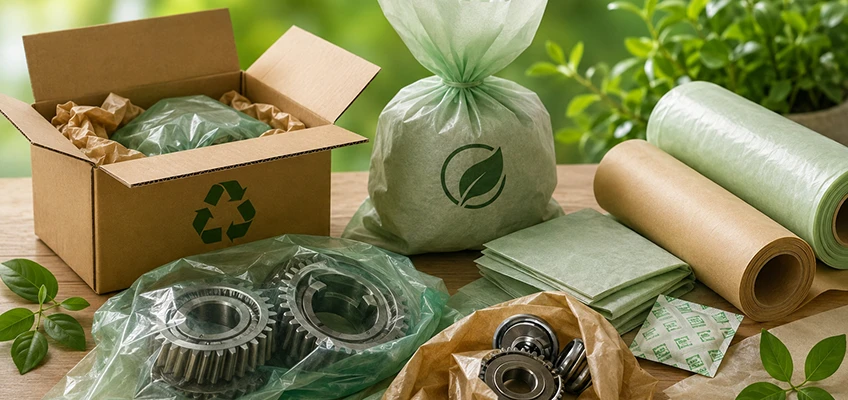
Corrosion has always been the quiet enemy of metal manufacturing, shipping, and storage. For decades, industries fought it with heavy oils, plastic-laden wraps, and chemical coatings that did the job but left a mess behind — both literally and environmentally. Today, that trade-off is disappearing. Sustainable anti-corrosive packaging has moved from a niche request to a mainstream requirement, as manufacturers, logistics teams, and procurement managers look for ways to protect metal parts without piling up landfill waste or violating tightening environmental regulations.
This shift isn't just about good intentions. It's driven by real pressure: stricter packaging waste laws in the EU and Asia, corporate ESG targets, and customers who simply won't accept single-use plastic anymore. The result is a new generation of eco-friendly VCI packaging — vapor corrosion inhibitor films and papers engineered to protect steel, aluminum, copper, and other metals while staying true to circular economy principles.
| Also Read: Next-Generation Anti-Corrosive Packaging for Automotive, Aerospace, and Global Supply Chains |
What Is VCI Packaging, and Why Does It Matter?
Vapor Corrosion Inhibitor (VCI) technology works by releasing a fine, invisible layer of protective molecules into the air inside a sealed package. These molecules settle on metal surfaces and form a microscopic barrier that blocks moisture, oxygen, and corrosive salts from triggering rust or oxidation. Unlike oils or greases, there's no residue to wipe off before use — the part comes out ready to go.
VCI paper & VCI film are the two primary formats used across industries like automotive, aerospace, electronics, machinery, and heavy equipment manufacturing. VCI paper is typically used for wrapping smaller components or interleaving stacked metal sheets, while VCI film is favored for shrink-wrapping, bagging, or covering larger equipment during shipping and long-term storage.
The problem with traditional versions of these products was their reliance on non-recyclable plastic resins and, in some cases, coatings containing PFAS ("forever chemicals") for added moisture resistance. That's exactly what the sustainable packaging movement is now correcting.
The Rise of Recyclable Barrier Packaging
Recyclable barrier packaging refers to materials engineered to block moisture, gases, and contaminants — the core job of any protective wrap — while remaining compatible with standard recycling streams. This is a genuine engineering challenge. Barrier performance and recyclability have historically pulled in opposite directions: multi-layer laminates that stop moisture cold are usually impossible to recycle because their layers can't be separated.
Newer mono-material structures solve this by using a single polymer family (often polyethylene-based) engineered at the molecular level to deliver barrier performance without laminating in incompatible layers. The result is recyclable VCI films that offer the same corrosion protection as older multi-layer products but can go straight into existing PE recycling streams.
For companies trying to hit zero-waste-to-landfill targets, this single change can have an outsized impact, since packaging waste is often the most visible and easiest-to-fix part of a manufacturing operation's environmental footprint.
Biodegradable Corrosion Protection: A Complementary Path
Recyclability isn't the only route to sustainability. Biodegradable corrosion protection materials — often made from plant-based polymers or specially formulated paper substrates — are designed to break down naturally after disposal, rather than depending on the recycling infrastructure being available at the point of use.
This matters because recycling access varies enormously by region. A facility in a country with limited recycling infrastructure may find biodegradable VCI paper more practical than a recyclable film that requires specific collection systems. Biodegradable options are especially popular for one-time-use applications like export crating, where the packaging is unlikely to be returned or recycled after the shipment reaches its destination.
Sustainable Barrier Films and the PFAS-Free Shift
Sustainable barrier films are built to perform two jobs at once: block moisture and corrosive vapors, and do so without long-term environmental liability. The most significant recent development here is the move toward PFAS-free barrier coatings.
PFAS compounds were once common in high-performance moisture and grease-resistant coatings because they're extraordinarily effective — and extraordinarily persistent. They don't break down, which means they accumulate in soil, water, and eventually the human body. Regulatory bodies in the EU, US, and elsewhere have begun restricting or banning PFAS in packaging applications, and manufacturers of anti-corrosive materials have responded with silicone-based, wax-based, and bio-polymer coating alternatives that match barrier performance without the chemical baggage.
Choosing PFAS-free options isn't just a compliance checkbox anymore — it's increasingly a condition of doing business with large OEMs and government contractors who screen suppliers for exactly this kind of chemical exposure risk.
Bio-Based VCI Packaging: Sourcing Matters Too
Beyond what happens after use, sustainability also depends on what a material is made from in the first place. Bio-based VCI packaging uses renewable feedstocks — such as plant starches, cellulose, or other agricultural byproducts — instead of petroleum-derived plastics as the base material.
This reduces the carbon footprint at the sourcing stage, not just the disposal stage, and it appeals strongly to companies reporting under frameworks like the GHG Protocol or CDP, where upstream material sourcing counts directly against emissions targets. Bio-based films can be engineered with the same VCI additive technology as conventional plastic films, meaning the corrosion protection performance doesn't have to be sacrificed for the sake of sourcing.
Recyclable Industrial Packaging: Thinking Beyond a Single Product
It's worth zooming out from VCI-specific materials to the broader category of recyclable industrial packaging. Corrosion protection is rarely the only packaging need in a shipment — there's often outer cartons, pallet wrap, dunnage, and desiccant packets involved too. A genuinely sustainable packaging strategy looks at the entire shipment system, not just the anti-corrosive layer.
Leading manufacturers now offer full packaging audits that assess every material touching a shipped part, replacing non-recyclable foam, mixed-material tape, and laminated boxes alongside the VCI wrap itself. This systems-level approach tends to deliver bigger sustainability wins than swapping out a single component in isolation.
Moisture Barrier Films: Where Function Meets Sustainability
Moisture barrier films remain the technical backbone of anti-corrosive packaging, regardless of the sustainability angle. Moisture is the primary trigger for oxidation, so any barrier film — recyclable, biodegradable, or conventional — has to first prove it can hold up against humidity, condensation, and temperature swings during transit and storage.
Modern corrosion-resistant packaging materials are tested against standards like ASTM D1748 and NACE TM0208 to verify VCI effectiveness across different metal types and storage durations. The good news for buyers is that today's eco-friendly options routinely meet or exceed these benchmarks — sustainability no longer means compromising on protection.
Circular Economy Packaging: Closing the Loop
Circular economy packaging principles ask a simple but demanding question: what happens to this material after its first use? For anti-corrosive packaging, the answer increasingly involves take-back programs, closed-loop recycling partnerships between suppliers and manufacturers, and design choices that make disassembly and material recovery easier from the start.
Some VCI film producers now operate collection programs where used film is returned, reprocessed, and remanufactured into new packaging — a genuine closed loop rather than a one-way trip to a recycling bin that may or may not process it correctly. This kind of program is becoming a competitive differentiator among industrial packaging suppliers.
Low-Carbon Packaging Materials: The Bigger Picture
Every choice discussed above — recyclability, biodegradability, PFAS-free formulation, bio-based sourcing — ultimately feeds into one overarching goal: low-carbon packaging materials that reduce the total emissions footprint of getting a product from factory to customer safely. Lighter-weight films reduce transportation emissions. Renewable feedstocks cut sourcing emissions. Recyclable structures cut end-of-life emissions. Together, they represent a meaningfully smaller footprint than the anti-corrosive packaging of even five years ago.
Frequently Asked Questions
Is eco-friendly VCI packaging as effective as traditional VCI packaging?
Yes. When properly formulated and tested against industry standards, sustainable VCI films and papers deliver the same level of corrosion protection as conventional petroleum-based products.
Can recyclable VCI film go into standard curbside recycling?
Mono-material, PE-based recyclable VCI films are generally compatible with standard polyethylene recycling streams, though local facility capabilities vary and should be confirmed.
What's the difference between biodegradable and recyclable anti-corrosive packaging?
Recyclable materials are processed and remanufactured into new products, while biodegradable materials break down naturally in the environment. The right choice depends on regional waste infrastructure and the intended use case.
Why are companies moving away from PFAS in barrier coatings?
PFAS compounds persist indefinitely in the environment and are increasingly restricted by regulation. PFAS-free alternatives now match performance without that long-term liability.
Final Thoughts
Sustainable anti-corrosive packaging is no longer a compromise between protection and environmental responsibility — it's a demonstration that both can be engineered together. Whether a business chooses recyclable VCI films, biodegradable VCI paper, bio-based materials, or PFAS-free barrier coatings, the technology has matured to the point where corrosion protection and environmental accountability are simply two sides of the same specification sheet.
 Our Services
 Media Pack Download
 Newsletters
 Industrial Events