


Smart Flexible Packaging: AI, Digital Printing, and Connected Packaging Technologies
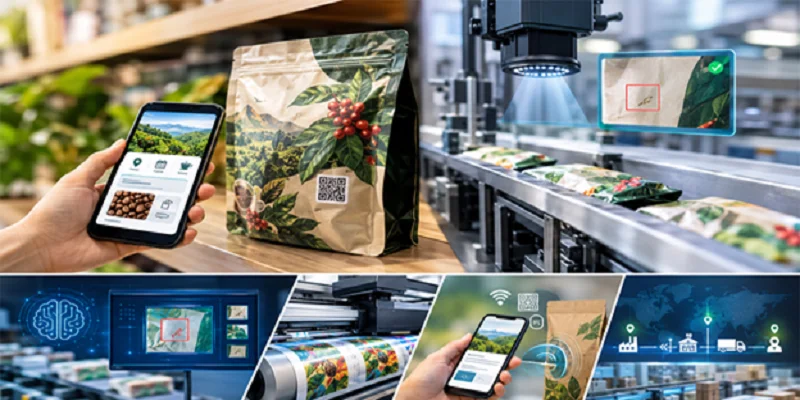
Picture a coffee pouch on a store shelf. A shopper taps their phone on it and sees the farm where the beans were grown, the roast date, and a brew guide. Meanwhile, at the factory, a camera caught a tiny printing flaw on that same pouch before it left the line.
That is smart flexible packaging at work. It is already happening in food, beverage, pet care, and personal care.
This guide explains how it works and what to consider before you invest.
What Is Smart Flexible Packaging?
Smart flexible packaging is packaging in the form of pouches, films, sachets, and wraps that carries digital intelligence. It combines printed codes, sensors, or chips with data systems, so the pack can be tracked, verified, and used to talk to consumers.
Three technologies drive it:
- AI, which checks quality and predicts problems
- Digital printing, which makes short runs and personalization possible
- Connectivity, such as QR codes and NFC, which links the physical pack to digital content
Each is useful alone. Together, they turn packaging from a passive container into a data channel.
Why Smart Packaging Technology Is Growing Now
Three pressures are pushing brands in the same direction.
Consumers want proof. People scan labels for sourcing, ingredients, and recyclability, and vague claims no longer satisfy them.
Supply chains are under stress. Brands need to know where products are, where they came from, and whether they are genuine.
Product cycles are shorter. Seasonal flavors, regional editions, and limited drops mean traditional long-run printing often produces waste.
Smart packaging technology answers all three. That is why "smart" is moving from a novelty to a practical requirement.
Digital Printing for Flexible Packaging: The Foundation
Digital printing is the technology that makes the rest possible.
Traditional flexographic and gravure printing rely on plates or cylinders. They are excellent for very long runs, but every design change costs time and money. Digital printing for flexible packaging skips the plates and prints straight from a file.
What that means in practice:
- Short runs become affordable. You can test a new design with a few thousand pouches instead of hundreds of thousands.
- Lead times shrink. A design change is a file update, not a new set of plates.
- Less waste. You print what you need, not what a minimum order forces you to.
- Every pack can be different. This is where the real opportunity sits.
Variable Data Printing Packaging: Every Pouch Gets Its Own Identity
Variable data printing packaging means each pack can carry unique information, such as a serial number, a batch code, or a personalized message, within the same print run.
Here is why that matters:
- Unique QR codes let you trace one pouch instead of one pallet.
- Regional or language versions can be produced in the same run.
- Campaign mechanics like a "scan to win" code or a personalized name pack become simple to run.
- Anti-counterfeiting improves, because unique codes are harder to fake at scale.
Traditional printing can't do this economically. Digital printing does it as a normal part of production.
AI in Flexible Packaging: From Design to Delivery
"AI" gets overused, so here is where it does concrete work.
Design and prepress. AI tools can speed up artwork checks, catch layout errors, and help with color matching across materials.
Predictive maintenance. Machine data can flag that a press or laminator is drifting toward a fault, so you can fix it before it wastes material.
Demand forecasting. Better forecasts mean better print planning and less obsolete stock.
Process optimization. AI can suggest settings that reduce waste on the line.
Before adopting any of these, ask a plain question: which specific problem is this solving? AI that doesn't address a real problem is just an expensive dashboard.
AI Packaging Quality Inspection: The Highest-Return Use Case
If you only try one AI application, this is often the one.
Flexible packaging is hard to inspect. Films are shiny, transparent, or stretchy, and defects can be tiny: a streak, a misregistration, a pinhole, a smudged barcode. Human inspectors get tired, and fixed-rule vision systems can struggle with natural variation.
AI packaging quality inspection uses cameras plus machine learning models trained on examples of good and bad output. The system learns what a real defect looks like versus harmless variation.
Typical benefits:
- Faster detection of print defects, registration errors, and missing elements
- Fewer false rejects than rigid rule-based systems
- Verification that variable data and codes are printed and scannable
- A defect record that helps you trace problems back to their source
The last point ties directly to variable printing. If every pouch has a unique code, you need to be certain that code actually scans. Inspection and connectivity depend on each other.
QR Codes on Flexible Packaging: The Easiest Way In
QR codes on flexible packaging are the most accessible entry point into connected flexible packaging. There is no special hardware or chip, and every modern smartphone camera reads them.
What you can do with them:
- Link to product stories, usage guides, and recipes
- Share recycling and disposal instructions
- Show sourcing and certification details
- Enable authentication and product registration
- Run promotions and loyalty programs
Practical tips so your codes actually work:
- Leave enough quiet space around the code so it scans reliably.
- Mind the surface. Wrinkles, gloss, and curved pouch areas can make codes harder to read, so test on real filled packs.
- Keep contrast high between the code and its background.
- Add a clear call to action. "Scan for a brew guide" beats a bare square.
- Send people to a mobile-friendly page that loads fast.
A QR code that leads to a slow or irrelevant page is worse than no code at all.
NFC Flexible Packaging: Tap Instead of Scan
NFC flexible packaging embeds a small near-field communication tag in or on the pack. The shopper simply taps a phone against it, with no camera needed.
NFC is more expensive than a printed code, but it offers things QR can't easily match: a smoother tap experience, stronger authentication options, and tamper-evidence features. It tends to suit premium products, high-value goods, and brands where counterfeiting is a serious concern.
QR vs NFC at a Glance

Many brands use both: QR for broad reach, NFC for premium lines.
Smart Packaging in the Supply Chain
The consumer experience gets the attention, but the smart packaging supply chain benefits may matter even more.
When each pack carries a unique identifier, you can:
- Trace products from production to shelf
- Narrow recalls to specific batches or units instead of pulling everything
- Spot diversion and counterfeits by checking where a code is scanned
- Improve inventory visibility across warehouses and retailers
- Collect real usage data about where and when packs are scanned
For food and pharma-adjacent products, better traceability can reduce the cost and reputational damage of a recall.
The Challenges Nobody Should Skip
Smart packaging isn't magic, and it's worth being honest about the hurdles.
- Data privacy. Scanning creates data. Be transparent and comply with the privacy rules where you sell.
- Recyclability. Adding chips or metallized elements can complicate recycling. Check design against recyclability guidelines.
- Cost. NFC and advanced inspection systems require investment. Start where the return is clearest.
- Integration. Codes, printing, inspection, and databases must talk to each other, and that takes planning.
- Consumer follow-through. If the scan experience is dull, people won't come back.
How to Start: A Simple 5-Step Approach
- Pick one problem. Waste, counterfeits, recalls, or engagement? Choose one.
- Start with QR. It's the cheapest way to learn.
- Pilot digital printing on a limited product line or seasonal edition.
- Add inspection where defects cost you the most.
- Measure and expand. Track scans, waste reduction, and defect rates, then scale what works.
Frequently Asked Questions
What is smart flexible packaging?
It is flexible packaging, such as pouches and films, enhanced with technologies like QR codes, NFC tags, digital printing, and AI-based inspection to improve traceability, quality, and consumer engagement.
How does AI improve flexible packaging quality?
AI-powered vision systems learn to distinguish real defects from normal variation, catching print errors and code failures faster and with fewer false rejects.
What is variable data printing in packaging?
It is printing that lets each pack carry unique information, such as serial numbers or personalized codes, within a single run.
Is QR or NFC better for flexible packaging?
QR codes are cheaper and work for most products. NFC costs more but offers a smoother tap experience and stronger authentication, making it better for premium or high-risk goods.
Is smart packaging recyclable?
It depends on the design. Printed QR codes generally have little effect, while embedded tags may. Always check against current recycling guidelines.
Final Thoughts
Smart flexible packaging isn't about adding gadgets to a pouch. It's about making packaging do more work: protect the product, prove its story, catch problems early, and connect a brand to the people who buy it.
Start small, solve one real problem, and let the data guide what comes next.
 Our Services
 Media Pack Download
 Newsletters
 Industrial Events