


Why Is Print Durability Critical for Maintaining GHS Hazard Compliance?
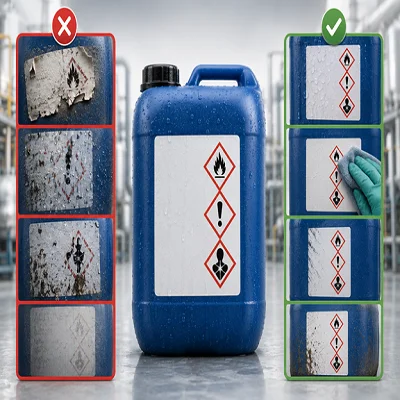
The Occupational Safety and Health Administration’s (OSHA) Globally Harmonized System (GHS) labeling requirements are strict. Hazard compliance is only as strong as its labels. When it comes to chemical safety labels, print durability is one of the most important considerations. To navigate achieving this, we’ve tapped into the nearly 50 years of industry experience at Label-Aid Systems Inc. to help break down what’s essential to maintain GHS compliance.
The Importance of Print Durability for Hazard Compliance
In industrial settings, print durability is critical for keeping things safe and compliant. GHS labels need to be readable for as long as they’re in use. If they aren’t, workers are left in an unsafe spot because they can't clearly see vital safety information.
Additionally, companies could face regulatory trouble for safety violations.
Faded text and peeling edges prevent workers from accessing critical safety information during emergencies. This creates risks for improper chemical handling, workplace accidents and safety violations. The right combination of substrate, adhesive and ink helps prevent such failures.
Looking Beyond the Required Elements of a GHS Label
OSHA determines which information must be on a GHS warning label. There are six GHS label requirements for hazard communication under 29 CFR 1910.1200, including specific information about the chemical and its hazard type.
These OSHA GHS labeling requirements include:
- Product identifier: The name or number used for the hazardous chemical
- Signal word: Words like "Danger" or "Warning" that indicate severity level
- Hazard statement: A phrase describing the nature and degree of the hazard
- Pictogram: Standardized symbols that communicate specific hazard types
- Precautionary statement: Instructions for handling, storage and emergency response
- Supplier information: The details of the chemical manufacturer or distributor
Facilities need custom identification with application-specific chemical names, safety information and pictograms designed for their unique conditions. Labels must contain each element to satisfy the baseline compliance requirement. Achieving full compliance is much more in-depth, involving material selection, layout design and choice of printing method.
Customized label printing allows businesses to select unique designs, materials and processes to achieve application-specific performance and appearance. Label-Aid Systems Inc. explains, “Each label is created around your organization’s color, logo and usage requirements using close-tolerance printing, cutting and assembly techniques.” While many options exist, this company utilizes digital, screen and flexographic printing methods.
Custom design and printing processes can produce labels certified to Underwriters Laboratories (UL) and American National Standards Institute (ANSI) standards. This is ideal for those who need durable, high-quality labels for OSHA warnings. For example, they can create a fully compliant GHS label that contains a product identifier, hazard statement, signal words, precautionary statement, pictogram and supplier information.
GHS Labeling Considerations for Industrial Operations
Careful analysis is needed to choose the right combination of substrate and printing method. Professionals must evaluate chemical type, regulatory needs, environmental exposure, operational demands and product lifespan. They all contribute to the long-term legibility of a label.
Custom safety and certification labels warn employees about site-specific hazards and demonstrate that products meet stringent standards. They help companies increase site safety when dangerous materials are present, thereby preventing safety violations and increasing efficiency. Label printers offer clear, permanent identification with various symbols and colors.
Label-Aid Systems Inc. clarifies that, “Safety certification labels use high-contrast printing, fade-resistant inks and durable materials that maintain visibility throughout the product’s life cycle.” It selects materials based on the hazards present. For example, it uses chemical-resistant substrates for corrosive conditions, like those found near chemical hazards. This way, the labels can clearly communicate risks for years to come.
How to Ensure Warning Labels Meet GHS Standards
Understanding compliance requirements is one thing. Executing them properly is another. The six mandatory elements may seem straightforward, but design and production are complex.
Common problems include:
- Increased rework: Physical degradation occurs when inferior or unsuitable label materials are exposed to harsh environments.
- Inconsistent layout: Poor design may violate formatting rules or confuse workers, causing safety issues during storage and handling.
- Slow production: Slow manufacturing processes can delay chemical handling and shipment timelines considerably.
- Regulatory risks: Incorrect or missing elements trigger failed audits and financial penalties.
This complexity underscores why partner selection matters. According to Label-Aid Systems Inc., “There is no substitute for experience.” Since every label printing process is different, there is no one-size-fits-all solution. Packaging and labeling professionals must choose between flexographic, digital and screen printing based on their intended application and operational conditions.
In this field, proven expertise is priceless. The longer label printers produce custom labels in-house, the better equipped they are to handle unique material, printing and design challenges. Their experience also lends to superior guidance on printing methods and materials. Label-Aid Systems was founded in 1976, giving it half a century of expertise. Many of its employees have been with the company for at least two decades.
Frequently Asked Questions About GHS Hazard Compliance
Here are the answers to frequently asked questions about GHS hazard compliance.
What information has to be on a GHS warning label?
Per 29 CFR 1910.1200, the information that has to be on a GHS warning label includes the product identifier, signal word, hazard statement, pictogram, precautionary statement and chemical manufacturer details. Each element communicates application-specific hazard information to workers handling chemicals.
Do GHS labels have to be in color?
GHS labels must follow a specific color scheme, unless they appear on safety data sheets. Only then can they be in black and white. Color coding lets workers quickly identify hazard levels and take appropriate precautions.
How do companies verify their chemical labels comply with OSHA HazCom?
Professionals can verify their chemical labels comply with OSHA HazCom in two ways. For an at-a-glance verification, professionals should check that the label contains all six OSHA GHS labeling requirements. To ensure the label is fully compliant, they must cross-reference this information with the safety data sheet.
How long do GHS labels need to last?
To stay compliant, GHS labels need to remain legible for the entire time a product is being used or stored. That’s why durability and material choice are so important—if a label fades or peels early, you’re looking at serious safety and compliance issues.
Future-Proofing Hazard Communication Strategies
Material choice and printing method directly affect the label’s durability and longevity. That’s why custom labels represent an investment in safety, compliance and operational stability. The right partner makes it possible to ensure warning labels meet GHS standards while withstanding industrial environments and satisfying all OSHA GHS labeling requirements.

About: Megan Vitanza - Marketing strategist
Megan Vitanza is a marketing strategist, loving mother, wife, bookworm and gamer. As Senior Digital Media Consultant at WebFX, she spends her days researching and producing content for her manufacturing clients. In her off hours she enjoys baby snuggles and cozying up with a good book.
 Our Services
 Media Pack Download
 Newsletters
 Industrial Events