
Articles
Food & Beverage Packaging Buying Guide for Sales and Marketing Leaders
Table of Contents
1. Why Packaging Is a Sales and Marketing Decision
2. Food Packaging Materials Comparison
3. Food Contact Packaging Requirements
4. Factors to Consider When Buying Food Packaging
5. Total Cost of Ownership
6. Sustainable and Eco-Friendly Options
7. Food Packaging Supplier Evaluation
8. Packaging Procurement Checklist
9. Common Mistakes Buyers Make
10. Frequently Asked Questions
1. Why Packaging Is a Sales and Marketing Decision
Packaging is often treated as an operations problem: something procurement handles once the product is ready. That view costs brands money. Your package is the last thing a customer touches before they decide, and the first thing they judge on a shelf or a delivery doorstep.
A food and beverage packaging buying guide matters for sales and marketing leaders because packaging shapes outcomes you are measured on: shelf impact, perceived quality, repeat purchase, retailer listings, and even return rates. A leaking pouch or a dented can does more damage to your brand than a weak ad campaign ever could.
If you are wondering how to choose food packaging that works for both the product and the brand, start with three questions. What does the product need to survive (heat, moisture, oxygen, transit)? What does the customer expect to see and feel? And what can the business afford over the full life of the pack, not just the unit price?
Buyer Tip: Bring procurement, operations, and marketing into the same room before you brief a supplier. Most expensive packaging mistakes start with a brief written by only one of them.
2. Food Packaging Materials Comparison
There is no single best material, only the right one for your product. This food packaging selection guide starts with how the main options compare.
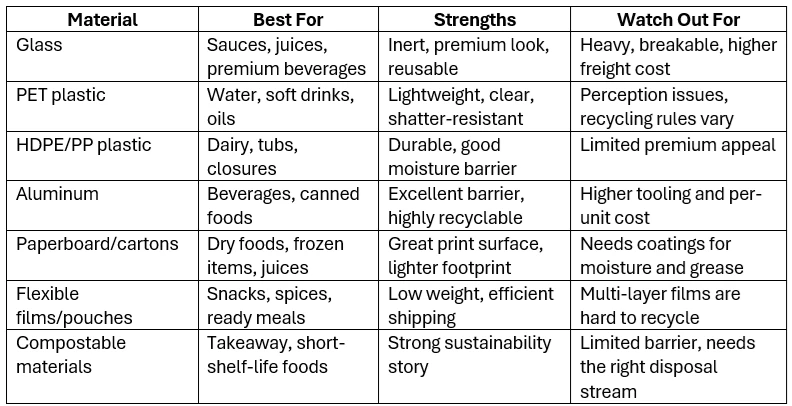
When people ask how to choose the right packaging for food products, the honest answer is to match the material to shelf life first and appearance second. A beautiful pack that shortens shelf life by two weeks is a bad trade.
3. Food Contact Packaging Requirements
This is the part buyers most often skip, and the one that can stop a launch overnight. Food contact packaging requirements exist to make sure nothing from the package migrates into the food at harmful levels.
The main frameworks depend on where you sell:
- India: FSSAI packaging regulations
- United States: FDA rules for food contact substances (21 CFR)
- European Union: Framework Regulation (EC) 1935/2004, plus material-specific rules
- Export markets: Often a mix of these, plus retailer-specific standards
Whatever the market, ask suppliers for these documents:
- A declaration of compliance for the specific material and market
- Migration test reports where relevant
- Food-safety certifications such as BRCGS Packaging Materials, FSSC 22000, or ISO 22000
- Traceability records, so you can trace a batch if something goes wrong
Buyer Tip: A supplier saying “it’s food grade” is not documentation. Ask for the paperwork before you approve samples, not after.
4. Factors to Consider When Buying Food Packaging
Once the material shortlist is clear, these are the factors to consider when buying food packaging. Run every option against all of them.
Product protection. Check barrier properties against oxygen, moisture, light, and grease. A snack needs a different barrier than a carbonated drink.
Shelf life and storage. Ambient, chilled, and frozen products demand different performance. Ask for shelf-life testing, not assumptions.
Processing compatibility. Hot-fill, retort, aseptic, and modified atmosphere packaging each need materials that survive the process. Confirm the pack works on your filling line.
Branding and print. Look at print quality, finishes, and how the pack looks on a crowded shelf, in a delivery box, and in a thumbnail on a marketplace.
Consumer experience. Reseal, easy-open, portion control, and pour spouts all affect repeat purchase more than most teams expect.
Logistics. Weight, stackability, and pallet efficiency drive freight cost.
Regulatory labeling. Make sure there is physical space for mandatory information, such as nutrition, allergens, and batch details.
5. Total Cost of Ownership
The cheapest quote is rarely the cheapest pack. Total cost of ownership for packaging means everything you pay across the pack’s life, not just what is on the invoice.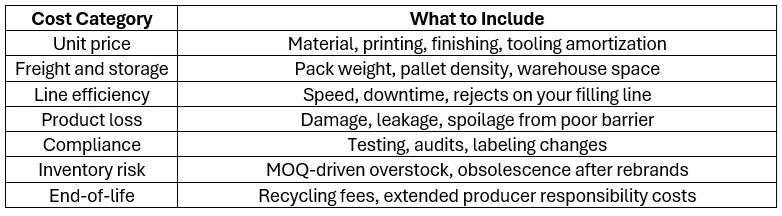 A pack that costs 8% more but cuts damage claims and speeds up the line can easily win on total cost. Ask your finance team to model two or three options this way before you commit.
Buyer Tip: Track returns and complaints by packaging type. This data turns a gut-feel debate into a business case.
6. Sustainable and Eco-Friendly Options
Retailers, investors, and customers increasingly expect progress here, and regulations on recyclability and recycled content are tightening in many markets. This eco-friendly food packaging guide covers the practical options.
- Mono-material packs: Single-polymer pouches and tubs are far easier to recycle than multi-layer laminates.
- Recycled content: Post-consumer recycled (PCR) PET and recycled paperboard cut virgin material use. Confirm food-contact approval for any recycled plastic.
- Lightweighting: Using less material per pack lowers both cost and carbon.
- Responsibly sourced fiber: Look for FSC or PEFC certification on paper and board.
- Compostable packaging: Useful for specific formats, but only if your customers have access to the right composting facilities.
- Refill and reuse: Promising for B2B and premium segments, though it needs logistics support.
Be careful with claims. Terms like “eco-friendly,” “green,” or “biodegradable” without proof invite regulatory and reputational trouble. If you cannot back a claim with certification or data, do not print it.
Among sustainable food packaging options, the best choice is usually the one that actually gets recycled in your customers’ region, which is not always the most exotic material.
7. Food Packaging Supplier Evaluation
A good supplier protects your brand as much as your product. Use this framework for food packaging supplier evaluation:
- Certifications: BRCGS, FSSC 22000, ISO 9001, and relevant food contact compliance
- Quality systems: Batch traceability, in-line inspection, and a clear complaint process
- Capacity and reliability: On-time delivery history and ability to scale during peak season
- Technical support: Willingness to run trials on your line and troubleshoot
- Financial stability: A supplier that disappears mid-contract creates serious supply risk
- Sustainability credentials: Verifiable data, not just a brochure
- Communication: How fast and clearly they answer. This predicts how they behave when something goes wrong.
Visit the plant if you can, or at least request a video audit. Facilities tell you things certificates cannot.
8. Packaging Procurement Checklist
Use this packaging procurement checklist before signing off on any new pack:[ ] Define product requirements: shelf life, temperature, fill process
- [ ] Confirm target markets and their food contact regulations
- [ ] Shortlist two or three materials and formats
- [ ] Request samples and run line trials
- [ ] Conduct shelf-life and transit (drop and vibration) testing
- [ ] Obtain compliance documents and certifications
- [ ] Approve artwork, die-lines, and printed proofs
- [ ] Compare quotes on total cost of ownership
- [ ] Clarify MOQ, lead time, price validity, and payment terms
- [ ] Agree on quality specifications and a rejection process in writing
- [ ] Plan a backup supplier for critical SKUs
Buyer Tip: Never launch with a single supplier on a hero product if you can avoid it. Qualify a second source early, even if it only takes a small share.
9. Common Mistakes Buyers Make
- Choosing on unit price alone and ignoring total cost
- Skipping line trials, then discovering the pack jams the filler
- Assuming “food grade” covers every market
- Making sustainability claims without proof
- Designing for the shelf and forgetting the shipping box
- Approving artwork without checking mandatory label space
- Ordering large MOQs, then rebranding six months later
- Relying on one supplier with no contingency plan
Most of these are cheap to prevent and expensive to fix after the fact.
10. Frequently Asked Questions
What is the best material for food packaging?
There is no universal winner. Glass suits premium and inert needs, PET and aluminum work well for beverages, and flexible films are efficient for snacks. Choose based on shelf life, processing method, cost, and market regulations.
How do I make sure packaging is safe for food contact?
Ask for declarations of compliance and migration test reports for your target market, and choose suppliers with recognized food-safety certifications. Confirm that the documents refer to the exact material you are buying.
Is eco-friendly packaging more expensive?
Sometimes upfront, but not always over its full life. Lightweighting and mono-materials can reduce material and freight costs. Compare options on total cost of ownership rather than unit price.
How long does a custom packaging order take?
It varies by format. Stock items may ship in days, while custom printed or tooled packaging often takes several weeks once artwork, proofing, and production scheduling are included. Build in extra time for a first order with a new supplier.
What should I ask a new packaging supplier first?
Start with certifications, compliance documents for your market, minimum order quantities, lead times, and whether they will support line trials. Request samples before discussing volume pricing.
Who should be involved in the packaging decision?
At minimum, marketing, operations, procurement, and quality or regulatory. Including sales early helps too, since retailer requirements often shape pack size and format.
 Our Services
 Media Pack Download
 Newsletters
 Industrial Events