
Top 8 Packaging Strategies That Help Sales Teams Close More Deals
Quick answer: The best packaging strategies for sales teams combine three things: an offer that is easy to understand, proof the buyer can see and touch, and a clear financial case. Tiered options, total cost of ownership (TCO) math, well-built samples, and tailored custom packaging all help a rep move a deal from “interesting” to “signed.”
Introduction:
Most sales conversations don’t stall because the product is bad. They stall because the buyer can’t picture it, can’t justify the price, or can’t explain it to the three other people who have to approve it.
That’s where packaging comes in, in both senses of the word: the physical box, pouch, or crate, and the way you wrap your offer into something a buyer can say yes to. When both are handled well, packaging that helps close deals becomes a quiet advantage that reps can lean on in every meeting.
Here are eight packaging strategies for sales teams that work, with practical notes on how to use each one.
1. Package the offer, not just the product
Buyers rarely purchase a single item. They purchase an outcome: fewer damaged shipments, faster line changeovers, a shelf presence that moves units.
Value-based packaging selling strategies start by bundling what you sell around that outcome. Instead of quoting a price per unit, a rep presents a “solution”: the packaging format, the supply schedule, the design support, and the service behind it. A buyer comparing three line-item quotes will pick the cheapest. A buyer comparing three solutions will pick the one that solves their problem.
A simple test: can your rep describe the offer in one sentence that doesn’t include a unit price? If not, the offer isn’t packaged yet.
2. Offer good, better, best options
Too many choices freeze buyers, but a single option feels like a take-it-or-leave-it ultimatum. Three tiers hit the sweet spot.
In practice, this might be a standard stock format, an enhanced version with better protection or branding, and a premium custom build. The middle option often wins, and it gives the buyer a sense of control. It also gives your rep something valuable: a natural way to discuss budget without awkwardness. “Which of these three feels closest to what you need?” is a far better question than “What’s your budget?”
Keep the differences between tiers obvious. If the buyer has to decode a spec sheet to tell them apart, the tiers are doing the opposite of their job.
3. Lead with total cost of ownership
Price is the easiest thing to compare, which is why it dominates negotiations. Total cost of ownership shifts the conversation to what the packaging really costs once it’s in use.
Packaging total cost of ownership sales strategies look beyond the invoice. They account for:
- Product damage and returns
- Labor and speed on the packing line
- Warehousing space and freight (dimensional weight matters)
- Waste, rework, and disposal
- Brand impact from a poor unboxing or damaged delivery
A slightly pricier carton that cuts damage claims by a few percent, or packs 20 percent faster, can be the cheaper option by year-end. Reps who bring a simple TCO estimate, even a rough one built on the buyer’s own numbers, change the tone of the meeting. They stop defending a price and start showing a return.
A word of caution: use the buyer’s data wherever possible. Generic savings claims feel like marketing. A calculation built on their volumes feels like analysis.
4. Make packaging samples for sales teams count
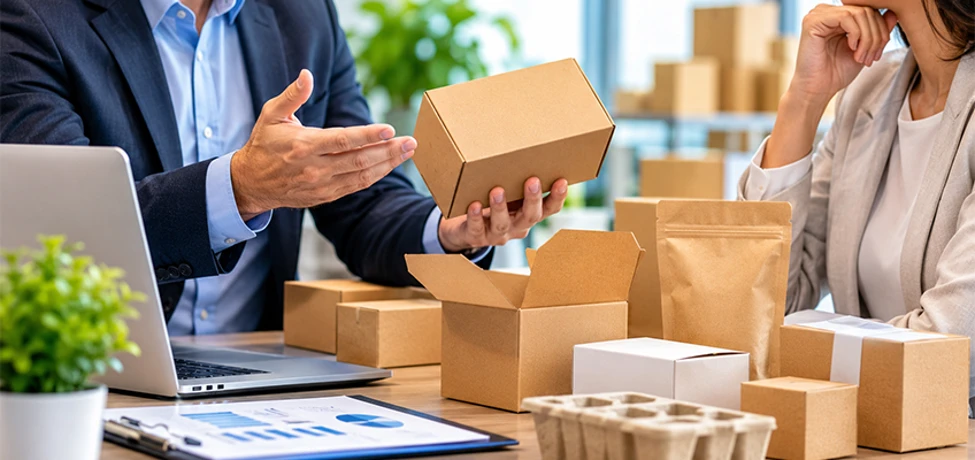
Nothing sells packaging like holding it. A good sample does what a slide deck can’t: it lets the buyer feel the board stiffness, test the closure, and imagine their product inside.
But samples are often an afterthought: a generic box tossed into a rep’s trunk. Smarter packaging samples for sales teams follow a few rules:
- Fit the sample to the prospect. A sample sized for their actual product beats a stock one every time.
- Show the range. Carry examples of each tier so the conversation about options is physical, not abstract.
- Include a story. A short card explaining what problem the sample solved for a real customer gives the buyer something to repeat internally.
- Track what you send. Know who received what, and follow up within a week while it’s still on their desk.
Samples also travel. The box you leave behind gets shown to the operations manager, the finance lead, and the CEO. It works for you when your rep isn’t in the room.
5. Tailor custom packaging strategies to the buyer’s world
Custom doesn’t have to mean expensive or slow. It means showing the buyer you understand their product, their customers, and their constraints.
Effective custom packaging strategies for sales often begin with a short discovery step: How is the product shipped? Who opens the package, a consumer or a warehouse worker? What’s the biggest packaging complaint today? A rep who asks these questions can come back with a mockup, even a rough one, that reflects the answers.
That mockup is powerful. It turns a vague “we can customize” into a concrete idea the buyer can react to, edit, and eventually approve. Buyers are far more likely to buy something they helped shape.
6. Use packaging design to strengthen the product’s story
Design isn’t decoration. Good packaging design strategies to boost sales support what the product claims to be. Premium goods should feel premium on the shelf and in the hand. Sustainable brands should look and feel sustainable. Practical industrial products should communicate reliability.
For sales teams, the lesson is to connect design choices to commercial results. Rather than saying “this looks great,” a rep might say “this structure makes the product easier to spot on a crowded shelf” or “this opening style cuts return rates because customers aren’t forced to rip the box apart.”
Material choice is part of this story, too. Recycled content, right-sized boxes, and reduced plastic aren’t just good for the planet; many buyers now have sustainability targets to hit, and packaging is one of the easiest places to make visible progress. A rep who can speak to that confidently gives procurement teams an internal win to point to.
7. Speak the language of manufacturing buyers
Packaging strategies for manufacturing sales teams need an extra layer of rigor. Manufacturers care about compatibility with existing lines, lead times, minimum order quantities, compliance standards, and supply reliability. A beautiful design means little if it jams the packing machine.
Reps selling to manufacturers should come prepared with:
- Clear technical specifications and tolerances
- Evidence of line compatibility or trial results
- Realistic lead times and contingency plans
- Documentation for any relevant standards
Trust is the real currency here. A manufacturing buyer who believes you’ll deliver on time, every time, will often accept a higher unit price. Show reliability through references, case studies, and honest conversations about risk. Admitting what you can’t do is often more persuasive than overpromising.
8. Give reps a playbook, then let them be human
Even the best B2B packaging strategies for sales fall flat if only one rep knows how to use them. The final strategy is operational: turn what works into something repeatable.
That might mean a shared library of case studies, a simple TCO calculator, a standard sample kit, and a few discovery questions every rep asks. Short internal training sessions, where top performers explain how they present tiers or handle price objections, spread good habits quickly.
But don’t script reps into robots. Buyers can tell when they’re hearing a pitch on autopilot. A playbook should provide structure and proof points; the conversation itself should still sound like one person helping another solve a problem.
Putting it all together
If this feels like a lot, start small. Pick two strategies and test them for a month. Many teams see quick gains from better samples and a simple TCO conversation, since both change how buyers experience the sale almost immediately.
Then measure what matters: How many sample requests turn into quotes? How many quotes become orders? How long do deals take? Those numbers will show where packaging is helping and where it still needs work.
The underlying idea is simple. How packaging helps sales teams close deals comes down to reducing uncertainty. A clear offer, a tangible sample, a credible cost story, and a design that fits the buyer’s world all answer the same silent question: “Will this work for me?” When your team can answer that confidently, the deal tends to follow.
Frequently Asked Questions
What are packaging strategies for sales teams?
They are the ways a sales team presents, structures, and supports its packaging offer to win deals. This includes tiered options, samples, custom mockups, and cost-of-ownership arguments.
How does packaging help sales teams close deals?
It makes the offer easier to understand, lets buyers physically evaluate quality, and gives them a financial and practical reason to choose one supplier over another.
What is value-based packaging selling?
It is selling based on the outcome packaging delivers, such as less damage, faster packing, or stronger shelf appeal, rather than on unit price alone.
Why do samples matter in packaging sales?
Samples make an abstract proposal tangible. A relevant, well-made sample gets shared inside the buyer’s company and keeps your offer visible after the meeting ends.
What is total cost of ownership in packaging?
It is the full cost of using a packaging solution, including damage, labor, storage, freight, and waste, not just the purchase price.
 Our Services
 Media Pack Download
 Newsletters
 Industrial Events