


Articles
Packaging Machinery Buying Guide for Procurement Engineers and Operations Heads
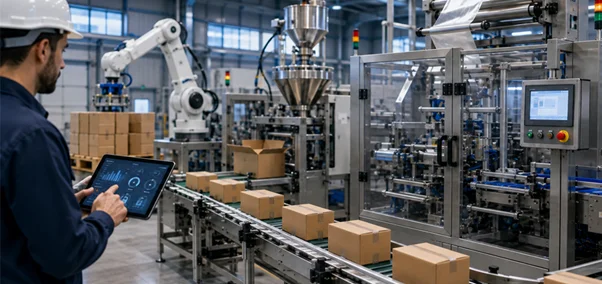
Table of Contents
- What Is Packaging Machinery?
- Types of Packaging Machinery
- Packaging Equipment Selection Criteria
- How to Choose Packaging Machinery for Your Line
- Packaging Machinery Throughput & Capacity Planning
- Packaging Machinery Integration with Existing Lines
- Packaging Machinery Reliability & Predictive Maintenance
- Energy Efficient & Modular Packaging Machinery
- Packaging Machinery Supplier Evaluation
- Packaging Machine RFQ Checklist
- Common Mistakes Buyers Make
- Frequently Asked Questions
1. What Is Packaging Machinery?
Packaging machinery covers the equipment used to fill, wrap, seal, label, cartons, palletize, and inspect products before they leave a facility. It sits at the intersection of production and logistics — the last set of machines a product touches before it becomes a shippable unit.
For procurement engineers and operations heads, packaging machinery decisions carry weight far beyond the purchase order. A poorly matched machine slows the entire line, drives up scrap and labor cost, and can bottleneck output for years until the next capital cycle. A well-matched machine, on the other hand, becomes largely invisible — it runs, it doesn't jam, and nobody thinks about it.
This packaging machinery buying guide is built for exactly that decision: how to choose packaging machinery that fits your product, your volume, your plant, and your budget — without over-buying capability you'll never use or under-buying capacity you'll outgrow in eighteen months.
Buyer Tip: Before requesting a single quote, document your product's dimensions, weight range, fragility, and your target units-per-minute. These four data points drive nearly every other specification in this guide.
2. Types of Packaging Machinery
Packaging machinery is generally grouped by the function it performs on the line.
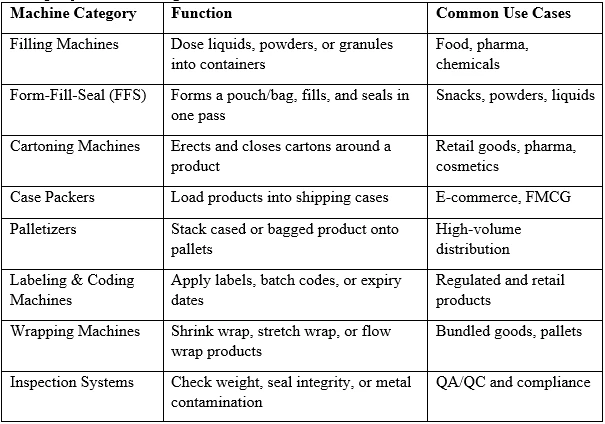
Most production lines combine several of these into a single packaging system, connected by conveyors and controlled through a shared PLC or line controller.
3. Packaging Equipment Selection Criteria
Once you know the category of machine you need, the real work starts: matching a specific machine to your actual production reality. The core packaging equipment selection criteria procurement teams should evaluate are:
- Product characteristics — shape, weight, fragility, viscosity (for liquids), and temperature sensitivity
- Required throughput — units per minute at both current and forecasted volumes
- Changeover frequency — how often the line switches between SKUs or pack formats
- Footprint and plant layout — available floor space, ceiling height, and utility access
- Automation level — manual, semi-automatic, or fully automatic operation
- Compliance requirements — food-grade, pharma-grade, or export packaging standards
- Total cost of ownership — not just machine price, but energy use, spare parts, and downtime cost
Weighing these against each other — rather than optimizing for price or speed alone — is what separates a packaging machinery selection guide that works on paper from one that works on the floor.
4. How to Choose Packaging Machinery for Your Line
Knowing how to choose packaging machinery starts with translating your production data into hard packaging machinery requirements, then matching those requirements against what suppliers actually offer.
A practical sequence procurement engineers can follow:
- Map your current bottleneck. Identify whether the constraint is filling speed, sealing consistency, labeling accuracy, or manual case packing.
- Define non-negotiable specs. Set minimum throughput, product compatibility, and compliance requirements you will not compromise on.
- Shortlist machine types, not brands. Decide whether you need FFS, a cartoner, or a case packer before comparing specific suppliers.
- Request live trials or video runs with your actual product — not a generic sample — before finalizing.
- Model total cost of ownership across a 5–7 year horizon, including energy, consumables, and expected maintenance.
Buyer Tip: Ask suppliers to run your product on their demo line, on camera, at your target speed. A machine that performs well on a standard test product can behave very differently on yours.
5. Packaging Machinery Throughput & Capacity Planning
Packaging machinery throughput is usually the single most quoted — and most misunderstood — spec on a machine's datasheet. Rated throughput figures (e.g., "120 units/min") are typically measured under ideal lab conditions: consistent product, no changeovers, and a trained operator.
Real-world throughput is almost always lower once you factor in:
- Changeover and cleaning downtime between SKUs
- Operator-dependent tasks (loading, adjustments)
- Product variability (weight, fill level, moisture)
- Planned maintenance windows
A useful rule of thumb: plan capacity around 70–80% of a machine's rated maximum, not the number on the spec sheet. If your forecasted demand sits close to a machine's true sustained output, you're buying a bottleneck, not a solution.
Buyer Tip: Always ask suppliers for OEE (Overall Equipment Effectiveness) benchmarks from existing installations similar to your product — not just theoretical rated speed.
6. Packaging Machinery Integration with Existing Lines
Packaging machinery integration is where many capital projects run into unplanned cost and delay. A machine that performs perfectly as a standalone unit can still fail to deliver value if it doesn't communicate with your upstream and downstream equipment.
Key integration factors to confirm before purchase:
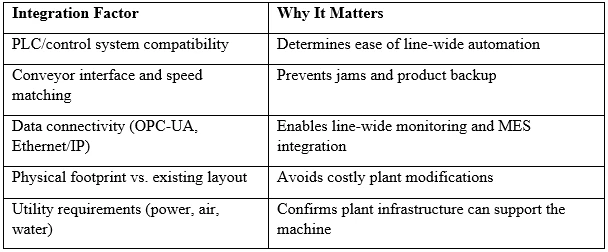
Involving your automation or controls team early — not just after the machine arrives — significantly reduces commissioning delays.
7. Packaging Machinery Reliability & Predictive Maintenance
Packaging machinery reliability directly determines unplanned downtime, and downtime on a packaging line has a way of cascading backward into production and forward into shipping delays.
When evaluating reliability, look beyond MTBF (Mean Time Between Failures) figures on a spec sheet and ask about:
- Build quality of wear components (seals, blades, sensors)
- Availability and lead time of spare parts
- Access to local or regional service technicians
- Historical performance data from existing customers in your industry
Packaging machinery predictive maintenance has become a standard expectation on modern equipment rather than a premium add-on. Machines equipped with IoT sensors can track vibration, temperature, and cycle counts to flag component wear before failure occurs — shifting maintenance from reactive (fix after breakdown) to predictive (fix before breakdown). For operations heads managing multiple lines, this capability alone can materially reduce unplanned stoppages and extend equipment life.
Buyer Tip: Ask whether predictive maintenance is built into the machine's control software or requires a separate subscription/sensor package — this affects both upfront and ongoing cost.
8. Energy Efficient & Modular Packaging Machinery
Two trends are reshaping capital equipment decisions across most plants: energy cost and flexibility.
Energy efficient packaging machinery reduces operating cost through variable-frequency drives, servo motors instead of pneumatic actuators, and standby modes during idle periods. Over a machine's operating life, energy consumption can rival or exceed the original purchase price — making efficiency ratings a legitimate line item in your ROI calculation, not just a sustainability checkbox.
Modular packaging machinery allows a line to be reconfigured — adding a labeling module, swapping a filling head, or scaling capacity — without replacing the entire system. For operations facing frequent SKU changes or uncertain future volume, modular designs reduce the risk of the machine becoming obsolete before it's fully depreciated.
Buyer Tip: If your product mix is likely to change in the next 3–5 years, weight modularity heavily in your evaluation — even at a higher upfront cost. Retrofitting a fixed-configuration machine later is almost always more expensive than paying for flexibility upfront.
9. Packaging Machinery Supplier Evaluation
A thorough packaging machinery supplier evaluation reduces sourcing risk far more effectively than comparing quotes on price alone. Before signing off, verify:
- Manufacturing track record with your specific product category
- Reference sites you can contact or, ideally, visit
- Local service and support infrastructure, including spare parts stocking
- Installation, training, and commissioning support included in the quote
- Warranty terms and what they actually cover
- Compliance certifications relevant to your industry (CE, UL, GMP, food-grade)
Buyer Tip: Request at least two customer references running a similar product and volume — not just any reference the supplier chooses to share.
10. Packaging Machine RFQ Checklist
A clear, complete RFQ shortens your sourcing timeline and gets you comparable quotes instead of apples-to-oranges proposals. A solid packaging machine RFQ checklist includes:
- Product specifications (dimensions, weight, fragility, batch/lot requirements)
- Target throughput and required OEE
- Available floor space and utility specifications
- Automation level required (manual, semi, or full auto)
- Integration requirements with existing line equipment
- Compliance and certification requirements
- Requested warranty, service, and spare parts terms
- Delivery, installation, and commissioning timeline
- Total cost of ownership breakdown, not just machine price
Buyer Tip: Send the same RFQ document, with identical specifications, to every shortlisted supplier. This is the single easiest way to get quotes you can actually compare line by line.
11. Common Mistakes Buyers Make
- Buying based on rated throughput instead of realistic sustained output
- Overlooking integration and controls compatibility until after purchase
- Treating price as the primary decision factor over total cost of ownership
- Skipping live trials with actual product before finalizing
- Underestimating future volume or SKU changes, leading to premature obsolescence
- Not confirming spare parts availability and service response times upfront
Buyer Tip: A capital equipment mistake is expensive to reverse. The few extra weeks spent on trials, reference checks, and RFQ comparisons are almost always cheaper than a machine that underperforms for the next decade.
12. Frequently Asked Questions
What is the most important factor in a packaging machinery buying guide?
Matching realistic sustained throughput — not rated maximum speed — to your actual production volume is the single factor most likely to make or break the investment. Every other criterion, from integration to reliability, builds on getting this number right.
How do I choose packaging machinery for a small or growing operation?
Prioritize modular packaging machinery that can scale or be reconfigured as volume grows, rather than a fixed-configuration machine sized for today's output. This avoids replacing equipment prematurely as demand increases.
What packaging machinery requirements should I define before requesting quotes?
At minimum: product dimensions and weight, required throughput, automation level, floor space, utility availability, and any regulatory compliance standards (food-grade, pharma-grade, export packaging). These form the backbone of any RFQ.
How is packaging machinery reliability measured?
Reliability is typically assessed through MTBF (Mean Time Between Failures), spare parts availability, service response times, and increasingly, predictive maintenance data from IoT-enabled sensors that flag wear before failure occurs.
Is energy efficient packaging machinery worth the higher upfront cost?
In most cases, yes. Energy costs accumulate over a machine's operating life and can exceed the original purchase price, so evaluating efficiency as part of total cost of ownership — not just sustainability — usually justifies the added upfront investment.
What should be included in a packaging machine RFQ checklist?
Product specs, target throughput, automation level, integration requirements, compliance needs, warranty and service terms, and a full total-cost-of-ownership breakdown. Sending an identical, complete RFQ to every supplier is what makes quotes genuinely comparable.
How do I evaluate a packaging machinery supplier before purchase?
Check their track record with similar products, request verifiable customer references, confirm local service and spare parts availability, and review what's actually included in installation, training, and warranty terms — not just the machine's price.
 Our Services
 Media Pack Download
 Newsletters
 Industrial Events