


Articles
Protective & Industrial Packaging Buying Guide for Procurement Directors

Table of Contents
- What Are Protective & Industrial Packaging?
- Types of Packaging Materials
- Key Specifications to Check
- How to Choose the Right Packaging Solution
- MOQ, Lead Time & Pricing Factors
- Total Cost of Ownership & Cost Comparison
- Sustainability & Compliance
- Supplier Selection & RFQ Checklist
- Common Mistakes Buyers Make
- Frequently Asked Questions
1. What Are Protective & Industrial Packaging?
This industrial packaging buying guide and protective packaging buying guide covers two related categories that are often bought the same way, which is a mistake.
Industrial packaging contains, stacks, and moves goods in bulk. Examples are pallets, drums, crates, stretch film, strapping, bulk bags, and heavy-duty corrugated. Its job is load stability and storage efficiency.
Protective packaging shields individual items from shock, vibration, abrasion, moisture, and static. Examples are foam, air cushions, molded pulp, VCI film, edge protectors, and void fill. Its job is damage prevention.
Most operations need both. Effective industrial packaging procurement and protective packaging procurement start from this split, because the failure modes differ: industrial packaging fails when loads shift or collapse, and protective packaging fails when a fragile item meets a hard drop.
Buyer Tip: Before requesting any quote, pull your last 12 months of damage claims and returns. The best industrial packaging solutions and protective packaging solutions are built around your damage data, not a supplier's catalog.
2. Types of Packaging Materials
Choosing among industrial packaging materials and protective packaging materials comes down to the job each one does.
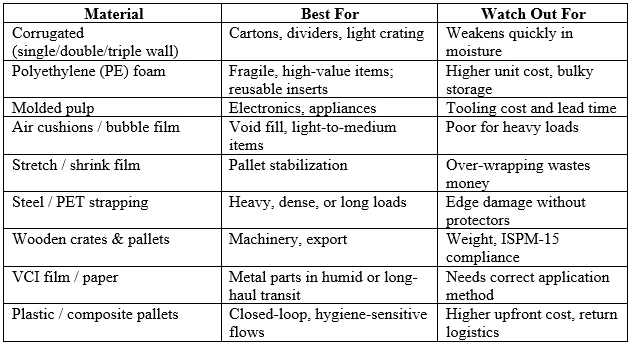
Which should you choose? As a rule of thumb, corrugated and air cushions cover most lightweight parcel needs. Foam or molded pulp suits fragile, high-value items. Strapping, stretch film, and crates handle heavy or palletized freight, and VCI is for anything that can corrode.
3. Key Specifications to Check
Confirm these with every supplier. They decide whether packaging performs under your real conditions.
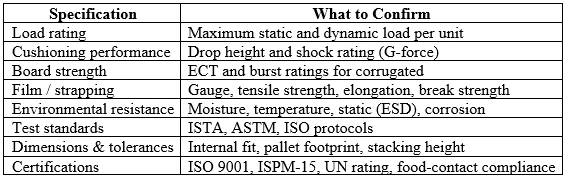
Buyer Tip: Ask for specs and test reports in writing. Terms like "heavy duty" or "export quality" are not standardized and often lead to under-specified packaging.
4. How to Choose the Right Packaging Solution
Document four things first:
- Product profile: weight, dimensions, fragility, sharp edges, sensitivity to moisture, static, or corrosion
- Distribution journey: parcel, LTL, or ocean freight, and the number of handling touchpoints
- Storage conditions: humidity, stacking height, duration
- Compliance needs: wood treatment, hazardous goods, customer-specific specs
Then match the solution to the risk:
- Shock-sensitive items: custom foam or molded pulp
- Heavy machinery: crates, strapping, and VCI protection
- Palletized bulk goods: correctly specified stretch film plus edge protectors
- Mixed-SKU parcel shipments: right-sized corrugated with air cushions
Keep void space low (roughly under 10-15%) to reduce filler spend and in-transit movement.
5. MOQ, Lead Time & Pricing Factors

(Ranges vary by supplier and region. Always confirm in your quote.)
Key cost drivers are material grade, dimensions, tooling, print or branding, and volume. Raw material prices, such as paper, resin, and steel, also shift quotes month to month, so predictable volumes are better locked into quarterly or annual pricing than bought on the spot market.
Industrial packaging cost reduction tactics that work:
- Right-size packaging to cut dimensional weight charges and void fill
- Standardize SKUs (fewer box sizes and film specs means better volume pricing)
- Downgauge intelligently: high-performance stretch film can use less material per pallet, but test before rollout
- Consolidate suppliers while keeping a qualified backup for critical items
- Use returnable packaging for closed-loop flows
- Track damage by root cause: fixing the top two causes often saves more than any negotiation
6. Total Cost of Ownership & Cost Comparison
Packaging total cost of ownership (TCO) is the full cost of a packaging decision across its lifecycle:
TCO per unit = (materials + labor + freight + damage cost + storage + disposal) ÷ units shipped
A proper protective packaging cost comparison looks at the full pack-out. Here is an illustrative example for a 15 kg industrial sensor shipped by parcel:
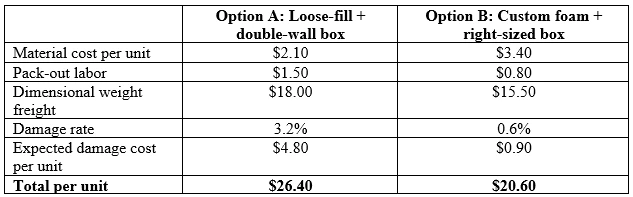
(Illustrative figures. Replace with your own data.)
Option B costs more in materials and is still about 22% cheaper overall.
Buyer Tip: Run this calculation on your top five SKUs. A packaging option that is $0.20 cheaper but adds 30 seconds of pack-out labor is not actually cheaper.
7. Sustainability & Compliance
Sustainability is now a sourcing requirement for many buyers, especially those supplying retail chains or export markets. Ask suppliers for:
- Recycled content percentage, specified by material
- FSC certification for paper-based packaging
- Recyclability documentation, since mixed-material packaging is harder to recycle
- EPR and regional compliance details for your markets
- Heat-treatment (ISPM-15) marks on wood packaging for export
One honest point: the greenest packaging is often the one that prevents a damaged shipment. A recycled-content box that fails and triggers a reshipment has a worse footprint than a sturdier option that arrives intact.
Buyer Tip: Request sustainability documentation upfront. Retrofitting compliance after an order is placed is far harder than screening for it during sourcing.
8. Supplier Selection & RFQ Checklist
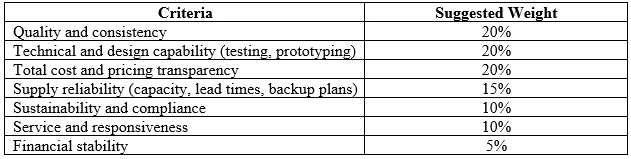
Industrial packaging supplier selection and protective packaging supplier selection should go beyond price. Use a weighted scorecard:
Supplier verification checklist
- Request physical samples before bulk orders
- Ask for drop, vibration, and compression test reports
- Confirm specs and tolerances in writing
- Check certifications (ISO 9001, ISPM-15, FSC, food-grade if applicable)
- Get customer references from your industry
- Ask how they handled their last supply disruption
- Clarify MOQ, lead time, payment terms, and defect/return policy
Industrial packaging RFQ checklist (also works for protective packaging)
Product and application
- Dimensions, weight, and fragility rating
- Shipping modes and distribution environment
- Storage duration and conditions
- Current specs and known failure points
Commercial terms
- Annual volume and release schedule
- Target pricing tiers by volume
- MOQ and lead times
- Payment terms, price-hold period, and raw material escalation clauses
- Tooling and sample costs (who pays, who owns)
Quality and compliance
- Required standards (ISTA, ASTM, ISPM-15, UN)
- Incoming inspection and acceptance criteria
- Sustainability requirements
- Traceability and documentation
Logistics and service
- Delivery locations
- Vendor-managed inventory or safety stock options
- Claims, return, and replacement process
- Contingency plan for supply interruption
Evaluation
- Scorecard weights shared with bidders
- Submission deadline, Q&A window, and decision date
Buyer Tip: Send the identical RFQ to every bidder so quotes can be compared fairly.
9. Common Mistakes Buyers Make
- Buying on unit price alone without calculating total cost of ownership
- Skipping physical testing (lab results are not real-world handling)
- Over-packaging "just in case," which adds freight and waste
- Single-sourcing critical items with no qualified backup
- Ignoring humidity and climate during storage or transit
- Never revisiting specs, so a 2019 spec may not be optimal today
Buyer Tip: A small investment in sampling and testing upfront is far cheaper than a bulk order that fails in transit.
10. Frequently Asked Questions
What is the difference between industrial and protective packaging?
Industrial packaging contains and moves goods in bulk (pallets, drums, film, strapping). Protective packaging cushions individual items against shock, vibration, and moisture (foam, air cushions, molded pulp).
What is the first step in industrial packaging procurement?
Audit your damage data, product specs, and shipping conditions. These define the requirements every supplier should quote against.
How do I compare protective packaging suppliers fairly?
Use a weighted scorecard covering quality, technical capability, total cost, reliability, sustainability, and service. Share the weights with all bidders and send the same RFQ to each.
What is packaging total cost of ownership?
It is the combined cost of materials, labor, freight, damage, storage, and disposal over a solution's life, divided by units shipped.
How can I reduce packaging costs without raising damage rates?
Right-size packages, standardize SKUs, optimize film and strapping usage, track damage root causes, and test lighter specs before committing.
How often should I rebid packaging contracts?
Most teams review annually and run a full RFQ every two to three years, or sooner if volumes, material prices, or product design change significantly.
 Our Services
 Media Pack Download
 Newsletters
 Industrial Events