

Articles
Smart Packaging & Labelling Buying Guide for Demand Generation
Choosing smart packaging comes down to three decisions: the problem you want to solve, the label technology that fits it, and a supplier who can prove it works. This guide walks buyers through all three, from first comparison to final order, so you can shortlist with confidence.
In this guide
1. What Is Smart Packaging?
2. Types of Smart Labelling Technology
3. Barcode vs RFID Labels
4. Smart Packaging Selection Criteria
5. Smart Labels for Automotive Parts Tracking
6. Smart Packaging ROI Calculation
7. Packaging Supplier Evaluation Checklist
8. Common Mistakes Buyers Make
9. Frequently Asked Questions
1. What Is Smart Packaging?
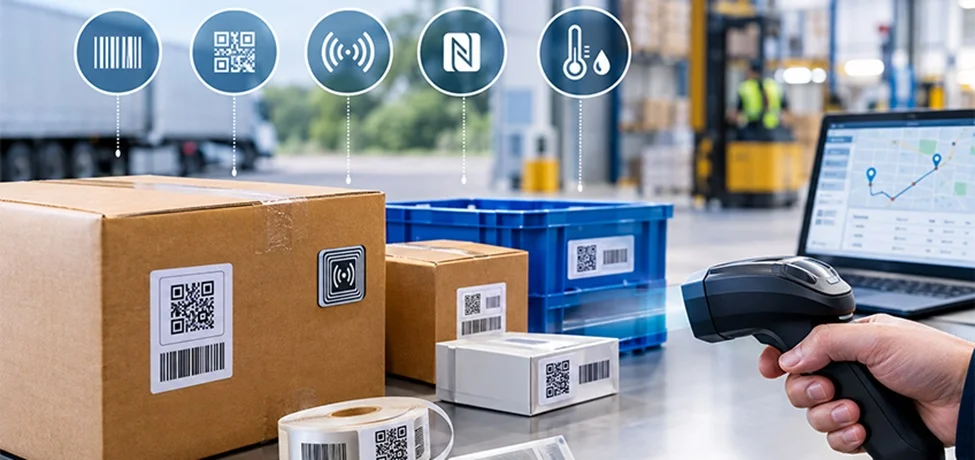
Smart packaging is packaging that carries data. A barcode, QR code, RFID tag, NFC chip or sensor lets a pack identify itself, record where it has been and, in some cases, report its condition, such as temperature or tampering.
For manufacturers, this turns every carton, pallet and tote into a data point. Smart packaging solutions for supply chain teams answer questions that once took phone calls and spreadsheets: where is this batch, was it stored correctly, and which supplier lot did this part come from?
It matters more each year because customers, regulators and retail partners now expect proof of origin and handling, not just a promise.
Buyer Tip: Before you look at any technology, write down the one problem you want to solve: lost shipments, counterfeits, slow stock counts or recall readiness. Buyers who start with the problem choose better than buyers who start with the gadget.
2. Types of Smart Labelling Technology
Smart labeling solutions for manufacturers fall into four groups, and most real projects mix them.
|
Technology |
What It Does |
Best For |
|
Barcode / 2D (QR, DataMatrix) |
Stores an ID, read by line-of-sight scan |
Low-cost identification, consumer engagement |
|
RFID labels |
Reads via radio waves, no line of sight |
Bulk scanning, warehouse and asset tracking |
|
NFC tags |
Short-range, phone-readable |
Authentication, product info, anti-counterfeiting |
|
Sensor / indicator labels |
Record temperature, shock, humidity, tamper events |
Cold chain, pharma, fragile goods |
A common setup is a printed 2D code on every unit plus an RFID label on the case or pallet.
3. Barcode vs RFID Labels
Barcodes are cheaper and proven; RFID is faster and cuts manual work. This is the most common question in any packaging and labeling procurement guide, so here is the side-by-side view.
|
Factor |
Barcode |
RFID |
|
Cost per label |
Very low |
Higher (varies by tag type) |
|
Line of sight needed |
Yes |
No |
|
Scan speed |
One at a time |
Many at once |
|
Data capacity |
Small |
Larger, can be rewritten |
|
Durability |
Fails if scratched or dirty |
Reads through dirt and packaging |
|
Best use |
Retail, simple tracking |
Pallets, assets, high-value parts |
Thumb Rule: if you scan a few items at checkpoints, stay with barcodes. If staff spend hours counting stock by hand or opening cartons to verify contents, RFID labels for supply chain tracking usually justify the extra cost. Many manufacturers use barcodes at unit level and RFID at case and pallet level.
Buyer Tip: Never decide on a spec sheet alone. Test candidate labels on your actual packaging, because metal, liquids and tight stacking can change RFID read rates sharply.
4. Smart Packaging Selection Criteria
How to choose smart packaging solutions: match the technology to your use case and read environment first, then check integration, standards and scale. Use these smart packaging selection criteria:
- Use case fit: tracking, authentication, condition monitoring or consumer engagement each need a different technology.
- Read environment: metal, liquids, heat, cold storage and outdoor exposure all affect which tag works.
- Read range and speed: will you scan at a dock door, on a conveyor or by hand?
- Data needs: a simple ID, or a full history that must be updated later?
- Label durability: check adhesive strength, abrasion resistance and temperature tolerance.
- Integration: can data flow into your ERP, WMS or traceability platform without custom work?
- Standards: look for GS1, ISO and EPC compliance so labels work across partners.
- Sustainability: ask whether labels interfere with paper or corrugated recycling.
- Scalability: will it still work at ten times your volume?
A label is only as reliable as the box it sits on. Confirm board strength and surface quality with your corrugated supplier, since a smooth printable surface and consistent dimensions make scanning far more dependable.
5. Smart Labels for Automotive Parts Tracking
Automotive is a strong case for smart packaging because one missing or mislabelled component can stop a line. Smart labels for automotive parts tracking typically deliver:
- Lot and batch traceability: link each part to its supplier, production date and inspection record.
- Returnable packaging control: track reusable bins and racks that often go missing.
- Sequenced delivery: confirm the right part reaches the right line on time.
- Recall readiness: narrow a recall to specific batches, not whole runs.
- Counterfeit protection: authenticate high-value or safety-critical parts.
Labels here must survive heat, oils, vibration and long storage. Ask suppliers for durability test data for automotive conditions, and check compliance with your OEM's labelling standards, many of which follow AIAG-style guidelines.
6. Smart Packaging ROI Calculation
A smart packaging ROI calculation compares total cost against measurable savings over 12 to 24 months. Three steps are enough.
1. Add up costs: labels or tags (unit price × annual volume), printers and readers, software and integration, training, and pilot testing.
2. Estimate savings: labour hours saved on counting and verification, fewer shipping errors, lower losses of stock and reusable packaging, and reduced recall and claims costs.
3. Apply the formula:
ROI (%) = Annual Savings - Annual Costs
------------------------------------------ X 100
Total Investment
Example (illustrative only): a plant spends ₹20 lakh on RFID infrastructure and labels and nets ₹3 lakh a month in labour and error savings. Payback is about 7 months. Use your own figures.
Buyer Tip: Pilot one product line or one route first. Real pilot data makes a stronger business case than any vendor projection.
7. Packaging Supplier Evaluation Checklist
A supplier who answers these questions clearly and quickly will usually support you after the order too. Before you sign, verify:
- Live demos or samples on your actual packaging
- Case studies from your industry
- Certifications (ISO 9001, GS1 membership, FSC for paper-based items)
- Written print quality, adhesive performance and tag read-rate test results
- Software and ERP integration support
- MOQ, lead time and pricing at different volumes
- Data security and ownership terms
- After-sales support, replacement policy and warranty
- References or verified transaction history on the marketplace
- Artwork, data format and proof approval process
8. Common Mistakes Buyers Make
- Choosing technology before defining the problem
- Buying on label price alone and ignoring integration costs
- Skipping the pilot and going straight to full rollout
- Skipping read-rate tests on real products and packaging
- Forgetting that metal and liquids interfere with RFID
- Having no plan for how scanned data will be used
- Overlooking partner readiness: if partners cannot read your labels, the benefit shrinks
- Treating packaging traceability solutions as an IT project instead of a cross-team process
Buyer Tip: The best traceability setup is the one your warehouse team will actually use. Involve them early.
9. Frequently Asked Questions
What is smart packaging in simple words?
Smart packaging has a built-in way to share information, such as a QR code, RFID tag or sensor. It helps track products, verify authenticity and monitor conditions in transit and storage.
How do I choose smart packaging solutions?
Start with your main goal: tracking, authentication or condition monitoring. Then match it to your environment, read range, budget and system integration, and pilot two or three options before committing.
Is RFID better than barcode?
Not always. RFID reads faster and without line of sight, but barcodes cost less and suit simple tracking. Many manufacturers use barcodes on units and RFID on cases and pallets.
How much do smart labels cost?
Costs vary by technology, volume and durability needs. Barcodes are cheapest, RFID costs more per unit, and sensor labels cost the most. Compare total cost, including readers, software and integration.
What is a typical payback period?
It depends on volume and the problem solved. Many projects aim for payback within 6 to 24 months, and a pilot gives a realistic estimate.
Can smart packaging be recycled?
Often yes. Paper-based labels and minimal-plastic designs recycle more easily, so ask suppliers about recyclability before ordering.
What are packaging traceability solutions?
They combine labels, readers and software to record a product's journey from production to delivery, so you can locate, verify or recall it quickly.
Ready to compare suppliers? Share your product, volume and tracking goal, and request quotes from verified smart packaging and labelling suppliers today.
 Our Services
 Media Pack Download
 Newsletters
 Industrial Events