


Stand-Up Pouches Buying Guide for Brand Managers and Product Specialists
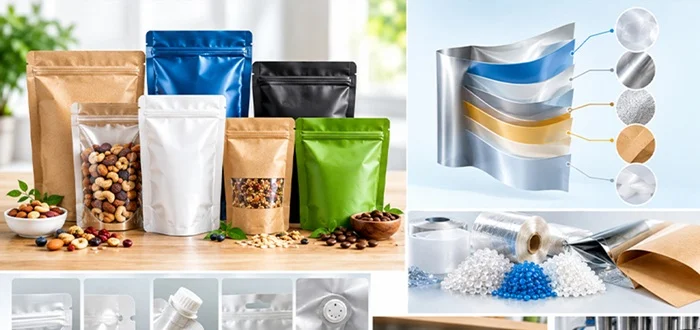
Table of Contents
1. What Are Stand-Up Pouches?
2. Stand-Up Pouch Materials and Material Structure
3. Stand-Up Pouch Barrier Properties
4. Stand-Up Pouch Specifications to Check
5. Stand-Up Pouch Dimensions and Size Guide
6. MOQ, Lead Time and Pricing Factors
7. Printing, Finishing and Sustainability
8. Stand-Up Pouch Supplier Checklist
9. Stand-Up Pouch Quality Checklist and Common Mistakes
10. Frequently Asked Questions
1. What Are Stand-Up Pouches?
Stand-up pouches are flexible packaging bags with a gusseted bottom, so they stand upright on a shelf and hold their shape once filled. They're built from laminated film layers, which give you a light package that still protects the product and leaves plenty of print area for branding.
You'll find them holding coffee, snacks, pet food, spices, supplements, sauces, powders, cosmetics and household products. Brands like them because they use less material than rigid jars or cans, cost less to ship, and give a strong shelf presence.
If this is your first time sourcing them, this stand-up pouch buying guide will help you ask suppliers the right questions. Most problems come from a mismatch between the product and the pouch, not from a bad supplier.
Buyer Tip: Before you request quotes, write down your product's form (dry, liquid, powder), fill weight, shelf-life target and filling method (manual, auto-filler, hot fill). These four details drive nearly every decision below.
2. Stand-Up Pouch Materials and Material Structure
Knowing how to choose stand up pouches starts with the film. Almost all pouches are laminates, meaning two or more layers bonded together, and each layer has a job. The outer layer carries the print and gives stiffness. The middle layer supplies the barrier. The inner layer is the heat-seal layer that touches your product.
The most common stand-up pouch materials:
• PET (polyester): Clear, stiff and print-friendly. Usually the outer layer.
• BOPP: A cost-effective outer layer with good clarity, popular for matte and glossy looks.
• Nylon (PA): Adds puncture resistance and flexibility, useful for sharp or frozen contents.
• Aluminum foil (AL): The strongest barrier against oxygen, moisture and light.
• VMPET (metallized PET): A thin aluminum coating on PET. It offers a good barrier at lower cost than foil, though it's less robust.
• PE / CPP (inner layer): Heat-sealable, food-contact-safe layers that form the seal.
• Kraft paper: A natural, earthy outer layer, always laminated to a barrier film underneath.
Common stand-up pouch material structure examples:
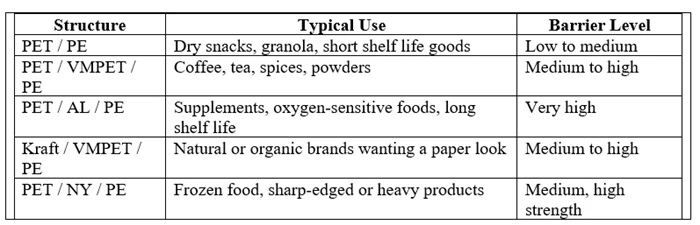
Total thickness usually falls between 80 and 200 microns. Thicker isn't always better. Match the thickness to your product weight and handling conditions.
Buyer Tip: Ask for the full layer-by-layer structure and thickness in writing (for example, "PET12 / VMPET12 / PE80"). "Premium laminate" is not a specification.
3. Stand-Up Pouch Barrier Properties
Barrier performance decides how long your product stays fresh. Three measurements matter:
• OTR (oxygen transmission rate): How much oxygen passes through the film. Lower is better for fats, coffee and anything that oxidizes.
• WVTR (water vapor transmission rate): How much moisture gets in or out. Critical for crisp snacks, powders and hygroscopic products.
• Light barrier: Protects vitamins, oils and colorants from degradation. Foil and metallized layers block light; clear films don't.
A rough guide: clear PET/PE structures suit products with weeks of shelf life, metallized structures cover months, and foil structures cover a year or more. Match the barrier to your real shelf-life target, not the highest grade available, because over-specifying adds cost without benefit.
Also consider aroma. Coffee and spices need to keep flavor in and outside odors out, and a one-way degassing valve may be needed for freshly roasted coffee.
Buyer Tip: Ask suppliers for OTR and WVTR test data at the conditions you'll actually face (for example, 23°C at 50% RH, or tropical storage conditions).
4. Stand-Up Pouch Specifications to Check
Before approving a quote, confirm these stand-up pouch specifications:
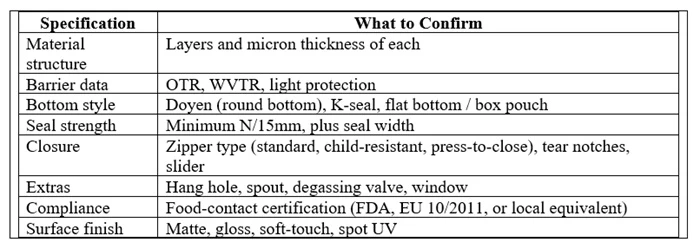
Bottom style deserves attention. Doyen and K-seal bottoms are the classic, economical choices. Flat-bottom (box) pouches stand more stable, offer five printable panels, and cost more, so they're common for premium coffee and pet food.
Buyer Tip: Compatibility with your filling line is a specification too. Tell the supplier your machine type and speed, since pouch stiffness and seal design affect how smoothly it runs.
5. Stand-Up Pouch Dimensions and Size Guide
Dimensions are written as width × height + bottom gusset, in millimeters or inches (for example, 130 × 200 + 70 mm). Height is measured from the bottom fold to the top edge, and the usable fill height sits below the zipper.
This stand-up pouch size guide gives rough capacities for a typical dry product like coffee beans. Actual capacity changes with product density, so always test with your real product.
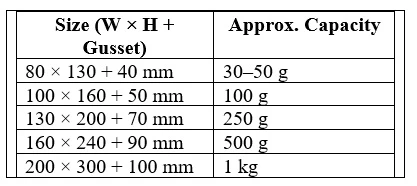
Light, fluffy products like chips need more volume per gram; dense products like sugar or rice need less. Leave headspace for sealing and, if there's a zipper, for comfortable opening and closing.
Buyer Tip: Never size on paper alone. Request stock samples or a printed prototype, fill them with the actual product, and check that they stand, seal and fit the shelf.
6. MOQ, Lead Time and Pricing Factors
Stand up pouch MOQ and lead time depend mostly on the printing method:
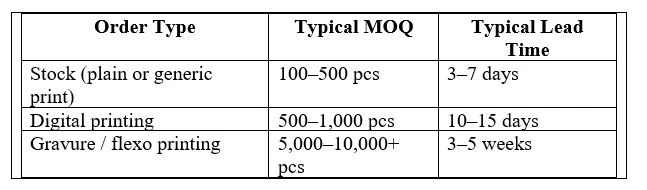
Gravure requires printing cylinders, which is a one-time setup cost, but it delivers the lowest per-unit price at volume. Digital printing suits launches, seasonal editions and multiple SKUs with small runs.
Key cost drivers include material structure, pouch size, number of colors, finishes, zippers and valves, and volume. Sea freight lead time is on top of production time, so build that in. If your volume is predictable, ask about scheduled or blanket orders to secure better pricing.
Buyer Tip: Ask what the MOQ covers. Some suppliers count per design and some per size, which changes the math for multi-SKU brands.
7. Printing, Finishing and Sustainability
Your pouch is your billboard, so the finish matters. Matte looks premium, gloss pops on shelf, and soft-touch adds tactile appeal. Windows let shoppers see the product, and spot UV highlights logos.
Sustainability is now a common sourcing requirement. Options include mono-material PE pouches designed for recycling, PCR (post-consumer recycled) content, compostable films, and paper-based structures. Be aware of the trade-off: recyclable mono-material films usually have lower barrier performance than traditional laminates, so confirm your shelf-life targets are still met. Ask for the certifications behind any claim, and check local recycling infrastructure before printing "recyclable" on your pack.
8. Stand-Up Pouch Supplier Checklist
Use this stand-up pouch supplier checklist before committing:
• Request physical samples and a printed proof before bulk production
• Confirm material structure, thickness and barrier data in writing
• Verify certifications (ISO 9001, BRCGS Packaging, FDA/EU food-contact compliance)
• Ask for references or verified transaction history on the marketplace
• Clarify MOQ, lead time, payment terms and cylinder or plate ownership
• Check in-house capabilities (printing, lamination, bag making) versus outsourcing
• Confirm tolerances, defect policy and return or reprint terms
• Ask about experience with your product category and filling equipment
9. Stand-Up Pouch Quality Checklist and Common Mistakes
When the first shipment arrives, run this stand-up pouch quality checklist on a sample of the batch:
• Dimensions match the approved drawing within tolerance
• Print color, registration and text sharpness match the proof
• Seals are clean, even and free of wrinkles or channels
• Zippers open, close and hold securely
• No delamination between layers
• Pouches stand upright when filled
• Leak or drop test passes with real product
• No odor from inks or adhesives
• Batch labeling and traceability are present
Common mistakes to avoid:
• Choosing on price without checking barrier data
• Over-specifying barrier, and paying for protection the product doesn't need
• Ordering without a filled-sample test
• Ignoring filling line compatibility
• Approving artwork without a physical proof, since screen colors differ from print
• Forgetting lead time for cylinders and shipping
Buyer Tip: A small investment in sampling and specification checks is far cheaper than a full run that fails on the filling line or in the warehouse.
10. Frequently Asked Questions
What's the difference between a stand-up pouch and a flat pouch?
A stand-up pouch has a bottom gusset that lets it stand upright and hold more volume. A flat (pillow or three-side seal) pouch lies flat and suits sachets and single-use portions.
Which material is best for coffee?
Usually a PET/VMPET/PE or PET/AL/PE laminate with a one-way degassing valve and a zipper. The right choice depends on shelf life and whether the coffee is whole bean or ground.
Can I get small quantities with custom printing?
Yes. Digital printing makes MOQs of 500 to 1,000 pieces possible. Per-unit prices are higher than gravure, but there are no cylinder costs.
How long does a custom order take?
Digital orders typically take about two to three weeks, and gravure orders three to five weeks or more, plus shipping. Allow extra time for artwork approval on a first order.
How do I know if a pouch is strong enough?
Ask for seal strength and drop test results, then fill sample pouches with your real product and test them under real shipping and storage conditions.
 Our Services
 Media Pack Download
 Newsletters
 Industrial Events