


Sustainable Flexible Packaging: Advancing Recyclable, Mono-Material, and Circular Packaging Solutions
Why Sustainable Flexible Packaging Is No Longer Optional
Flexible packaging touches almost everything we buy - food pouches, snack wrappers, personal care refills, industrial liners. It's lightweight, cost-efficient, and reduces material use compared to rigid alternatives. But there's a catch: most flexible packaging has traditionally been built from multi-layer laminates, combining plastics like PET, nylon, and PE to achieve strength, barrier protection, and shelf life.
The problem? Multi-layer structures are nearly impossible to recycle economically. Different polymers don't separate cleanly in recycling streams, so most of it ends up incinerated or landfilled.
This is exactly why sustainable flexible packaging has become one of the most urgent conversations in the packaging industry. Brands, converters, and regulators are converging on one answer: mono-material packaging built for real-world recyclability, not just theoretical recyclability.
What Is Mono-Material Packaging? (Quick Answer)
Mono-material packaging is packaging made from a single polymer family - most commonly polyethylene (PE) or polypropylene (PP) - instead of blending multiple different plastics into one laminate. Because it's structurally uniform, it can be processed through existing plastic recycling streams without the sorting and separation problems that multi-layer packaging creates.
This single change is what unlocks true circularity. A pouch made entirely of PE can be collected, sorted, and reprocessed into new PE resin. A pouch made of PET/foil/PE cannot.
Recyclable Flexible Packaging: What "Recyclable" Actually Means
Not all packaging labeled "recyclable" is actually recycled in practice. There's a meaningful difference between:
- Technically recyclable – the material could be recycled if the right facility exists
- Widely recyclable – the material is actually collected and processed at scale in most regions
- Store drop-off recyclable – accepted only through specific collection points (common for PE film today)
Recyclable flexible packaging in the mono-material sense usually falls into the second or third category, particularly PE films collected through retail take-back programs across the US and Europe. This is a critical distinction for brands trying to make honest sustainability claims - and increasingly, a legal one.
Mono-Material Solutions Driving the Shift
Several mono-material solutions have moved from pilot projects to mainstream commercial use over the last few years:
- PE mono-material film – flexible, sealable, widely used for pouches, bags, and overwraps
- PP mono-material packaging – higher heat resistance, often used for snack and confectionery packaging
- MDO-PE packaging – machine direction-oriented PE that mimics the stiffness, clarity, and printability of PET while staying fully PE-based
Each of these solves a different formulation challenge, but they share a common goal: replacing multi-layer barrier laminates without sacrificing shelf performance.
PE Mono-Material Film: The Workhorse
Recyclable PE film has become the default starting point for many brands transitioning away from laminates. It's flexible, cost-competitive, and compatible with existing PE recycling infrastructure. The tradeoff is barrier performance - standard PE alone doesn't block oxygen or moisture as effectively as multi-layer structures.
PP Mono-Material Packaging: Where It Fits
PP mono-material packaging tends to show up in categories needing higher stiffness or heat resistance - think hot-fill applications or products requiring a firmer pack feel. Like PE, it faces barrier limitations in its base form, which is where innovation in coatings and additives comes in.
MDO-PE Packaging: Bridging the Gap
MDO-PE packaging deserves special attention because it directly addresses one of the biggest objections to mono-material PE: that it doesn't look or perform like premium laminate packaging. The orientation process gives PE improved stiffness, optical clarity, and print quality - making it viable for applications that previously required PET.
Barrier Properties of Mono-Material Films: The Real Technical Challenge
This is where most conversations about mono-material packaging get stuck. The barrier properties of mono-material films - their ability to block oxygen, moisture, light, and aroma - are inherently lower than multi-layer laminates that combine specialized barrier resins.
The industry's response has been to develop recyclable high-barrier flexible packaging through methods like:
- Nano-coatings and metallization compatible with PE/PP recycling streams
- EVOH-free barrier PE resins engineered for oxygen sensitivity
- Advanced coextrusion techniques within a single polymer family
- Compatible tie-layers that don't compromise recyclability
This is arguably the most active area of R&D in flexible packaging today - because it's the piece that determines whether mono-material can actually replace laminates in demanding categories like coffee, pet food, and pharmaceuticals, not just dry snacks.
Mono-Material vs Multi-Layer Packaging: A Direct Comparison
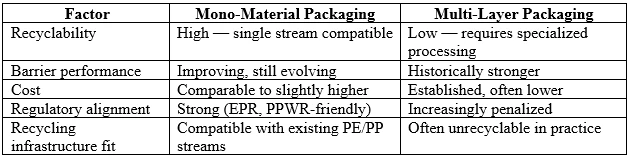
The mono-material vs multi-layer packaging decision increasingly isn't just a sustainability question - it's a compliance and cost-avoidance question, given where regulation is heading.
EPR Compliance Packaging: The Regulatory Push
EPR compliance packaging refers to designing packaging in line with Extended Producer Responsibility regulations, which make brand owners financially responsible for the end-of-life impact of their packaging. Under EPR frameworks - already active in parts of the EU, Canada, and several US states - non-recyclable multi-layer packaging often carries higher fees than mono-material, recyclable formats.
This is turning sustainable packaging from a marketing decision into a financial one. Brands using hard-to-recycle laminates are increasingly paying more per unit of packaging placed on the market, while mono-material adopters see reduced fee exposure.
Sustainable Packaging Procurement: What Buyers Should Look For
For procurement teams, sustainable packaging procurement now involves evaluating suppliers on more than price and lead time. Key criteria include:
- Verified recyclability (not just "recyclable" claims)
- Compatibility with How2Recycle or equivalent regional labeling
- Barrier performance data specific to the product category
- EPR fee modeling and regional compliance support
- Post-consumer recycled (PCR) content availability
- Transition roadmaps from multi-layer to mono-material formats
Procurement is becoming a sustainability checkpoint, not just a cost center - and suppliers who can document real recyclability outcomes are winning long-term contracts over those making vague claims.
Circular Packaging Solutions: Closing the Loop
Circular packaging solutions go beyond recyclable design - they require the full loop to function: collection, sorting, reprocessing, and remanufacturing back into usable resin. Mono-material packaging is the design enabler, but packaging for circular economy goals also depends on:
- Expanding store drop-off and curbside collection for flexible film
- Investment in sorting technology (like near-infrared detection) tuned for film formats
- Brand participation in extended producer responsibility programs
- Consumer education on how and where to recycle flexible packaging
Without these systems, even a perfectly designed mono-material pouch can end up in a landfill. Packaging design and recycling infrastructure have to evolve together.
Frequently Asked Questions
What is the difference between mono-material and multi-layer packaging?
Mono-material packaging uses a single polymer type (like PE or PP), making it compatible with standard recycling streams. Multi-layer packaging combines different plastics, which are difficult to separate and typically not recyclable in practice.
Is PE mono-material film fully recyclable?
PE mono-material film is recyclable primarily through store drop-off programs in most regions, not standard curbside recycling. Check local How2Recycle guidelines for specific applicability.
Can mono-material packaging match the barrier performance of multi-layer laminates?
It's improving rapidly through high-barrier coatings and MDO-PE technology, but for highly sensitive products (like coffee or pharmaceuticals), multi-layer barrier performance is still sometimes superior - though the gap is closing fast.
Why does EPR compliance matter for packaging design?
EPR regulations charge brands based on the recyclability of their packaging. Non-recyclable multi-layer formats often incur higher fees, making mono-material design a financial as well as environmental decision.
What is MDO-PE and why is it important?
MDO-PE (machine direction-oriented polyethylene) is a specialized PE film that gains stiffness and clarity through an orientation process, allowing it to replace PET in many applications while remaining a recyclable mono-material.
The Bottom Line
The shift toward mono-material packaging isn't a trend - it's a structural response to recycling economics, regulatory pressure, and genuine environmental need. PE and PP mono-material films, boosted by innovations like MDO-PE and high-barrier coatings, are steadily closing the performance gap with multi-layer laminates. For brands and procurement teams, the question isn't whether to transition to sustainable flexible packaging - it's how fast they can do it before EPR fees and consumer expectations make the decision for them.
 Our Services
 Media Pack Download
 Newsletters
 Industrial Events