

Automation vs Human Workforce in Packaging: Real Cost Savings and Efficiency Gains
Ask ten manufacturers whether automation or human labor is "better" for packaging, and you'll get ten different answers - because the real answer isn't either/or. It's about matching the right mix to your product, your volume, and how much your line changes week to week. This is the real story of packaging industry transformation: not robots replacing people, but a redrawing of who does what, and where the actual savings come from.
If you're evaluating packaging automation solutions for your operation, the honest answer to "automation vs. human workforce" is: it depends on what you're packaging, at what volume, and how much variability your line has to absorb. Let's break down the real numbers and where each approach wins.
The Short Answer
Automated packaging systems typically cut per-unit labor costs by 25–60% and increase line throughput by 20–50%, but the payback period (usually 12–36 months) depends heavily on product variability. High-volume, low-mix operations see automation pay for itself fastest. Highly variable, low-volume, or seasonal operations often get better ROI keeping skilled labor in manufacturing roles, or blending both through collaborative robotics.
That's the headline. Now here's why.
Where Packaging Automation Solutions Actually Save Money
The pitch for automation is usually framed around labor cost alone, but that's only part of the equation. The real savings show up in four places:
1. Consistency, not just speed. Human packers get tired, distracted, or inconsistent across an 8-hour shift. Industrial robotics in packaging don't. A robotic case-packer running at a fixed cycle time produces the same output in hour eight as it does in hour one. That consistency alone reduces rework, product damage, and the hidden cost of "good enough" packing.
2. Reduced injury and turnover costs. Repetitive lifting, awkward reach positions, and high-speed manual packing are among the most common sources of manufacturing injury claims. Automating the physically punishing parts of a line lowers workers' comp exposure and - just as important - reduces turnover in roles that are historically hard to staff.
3. Better yield through data. Modern AI-driven packaging systems don't just move product; they collect data on every cycle. Fill weights, seal integrity, misalignment rates - all logged and analyzed in real time. That data feeds back into the process, catching problems before they become returns or recalls.
4. Smaller footprint, tighter cycles. Smart packaging technologies - vision-guided robotics, adaptive conveyors, sensor-driven changeovers - let manufacturers run smaller batches profitably. That matters as more brands move toward customization and shorter product runs.
Where the Human Workforce Still Wins
Despite the automation push, manual packaging processes haven't disappeared, and in some cases they shouldn't. A few scenarios where people still outperform machines:
- High-mix, low-volume production. If your line changes product format daily - different box sizes, different fill patterns, different labeling - the changeover time and programming cost of full automation can outweigh the labor savings.
- Delicate or irregular products. Fresh produce, artisanal goods, and irregularly shaped items still often need a human hand and eye for quality judgment that machine vision hasn't fully replicated.
- Final-mile flexibility. People adapt to a jammed conveyor or a mislabeled batch in seconds. A rigid automated cell may need a technician and downtime to do the same.
This is exactly why skilled labor in manufacturing hasn't been replaced so much as redefined. The packaging worker of 2026 is less likely to be manually taping boxes and more likely to be monitoring dashboards, running quality checks, or maintaining robotic cells - a shift that raises the skill floor across the industry, even as it reduces headcount on the most repetitive tasks.
The Middle Ground: Collaborative Robots
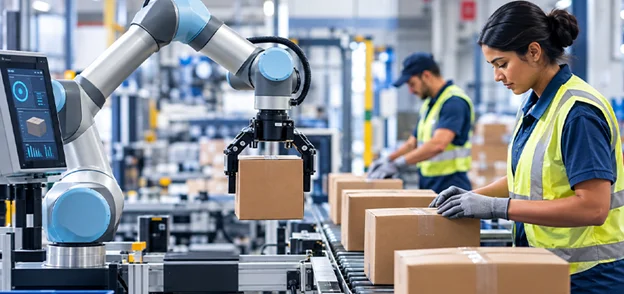
This is where most facilities are actually landing. Collaborative robots in packaging - cobots - are built to work alongside people rather than replace an entire line. A cobot might handle repetitive box erecting or palletizing while a human handles final inspection and exception handling on the same line.
Cobots typically cost less to install than full robotic cells, don't require the same safety caging, and can be redeployed to different tasks as product lines change. For mid-sized operations that can't justify a fully automated line but are drowning in repetitive strain injuries and turnover, cobots are often the most realistic starting point.
How Machine Learning Is Changing the Equation
Machine learning in packaging has moved past novelty and into everyday operations. Predictive maintenance models now flag when a sealing machine is likely to fail before it actually does, cutting unplanned downtime. Computer vision models trained on thousands of packaging defects catch flaws human inspectors miss at speed. Demand forecasting models feed directly into packaging line scheduling, reducing overproduction and waste.
This is the backbone of what's often called Industry 4.0 in packaging: connected sensors, real-time data, and predictive systems working together rather than isolated machines running fixed programs. It's not automation for its own sake - it's automation that gets smarter the longer it runs.
Sustainability Is Now Part of the Cost Equation
Sustainable automated packaging isn't just a marketing angle - it directly affects cost. Automated systems using precise, sensor-guided material application use less film, tape, and void-fill material than manual packing, where operators tend to over-pack "to be safe." Reducing material waste by even 10–15% compounds significantly at scale, and it's increasingly a factor buyers and regulators are pricing into supply chain decisions.
What This Means for Packaging Line Productivity
When people ask about packaging line productivity, they usually want one number - but the real driver is uptime, not raw speed. A line running slightly slower but with near-zero downtime will consistently outproduce a faster line that jams twice a shift. This is where the strongest ROI cases for automation actually come from: not "robots pack faster than people," but "robots don't need breaks, don't get injured, and don't introduce the variability that causes downstream jams."
Where the Industry Is Headed
Current packaging workforce trends point toward a hybrid model becoming the default, not the exception. AI-powered packaging lines will keep expanding into quality control, demand forecasting, and predictive maintenance - but the fully "lights-out" packaging facility remains rare outside of a few high-volume commodity categories. Most operations will keep a core of skilled workers whose jobs shift from manual labor to oversight, troubleshooting, and exception handling.
Frequently Asked Questions
Does packaging automation eliminate jobs?
It changes them more than it eliminates them. Automation typically removes the most repetitive, injury-prone tasks while creating new roles in robot programming, maintenance, and quality oversight. Net headcount often drops on high-volume lines, but the remaining roles require more technical skill.
Is automation worth it for a small or mid-sized packaging operation?
Often yes, but usually through collaborative robots or targeted automation of a single bottleneck (like case erecting or palletizing) rather than a full line overhaul. Full automation tends to make financial sense only at higher, steadier volumes.
What's the typical ROI timeline for packaging automation?
Most facilities see payback in 12 to 36 months, depending on product variability, labor costs in the region, and how much downtime the new system removes.
Can automation and human workers really work side by side safely?
Yes - this is what collaborative robots are specifically designed for. Unlike traditional industrial robots that require safety cages, cobots use force-limiting and sensor technology to work in shared space with people.
 Our Services
 Media Pack Download
 Newsletters
 Industrial Events