

MAP vs Vacuum Packaging: Shelf-Life Extension, Cost, and Retail Performance
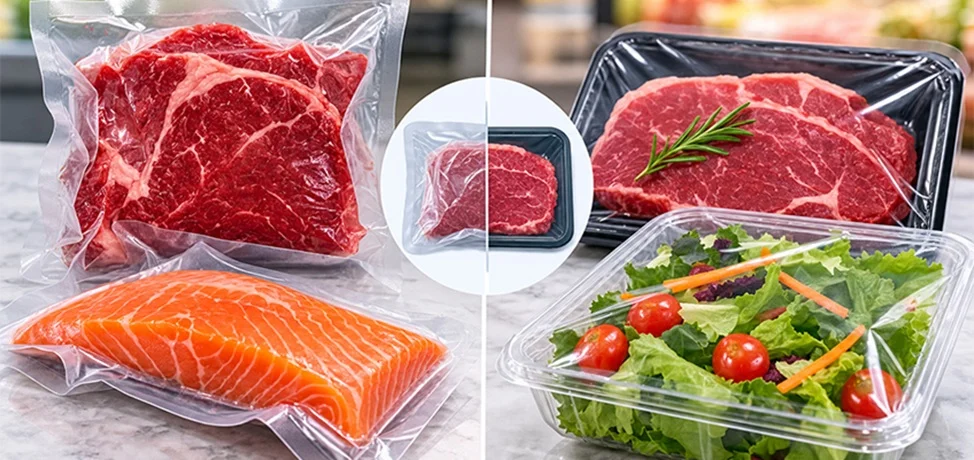
You've got a great product. Now you need it to survive the trip from your plant to a shopper's basket, and look good doing it. That's the real job of packaging, and it's why the MAP vs vacuum packaging debate matters so much.
The short answer: vacuum packaging gives the longest shelf life at the lowest cost, but it can make fresh products look flat or dark. Modified atmosphere packaging (MAP) costs more, but it keeps products looking natural and fresh on the shelf, which often means better sales. The right choice depends on what you sell, where you sell it and how long it must last.
Let's compare them on the three things that actually decide the question.
What Is the Difference Between MAP and Vacuum Packaging?
Vacuum packaging removes almost all the air from a high-barrier bag or pouch and seals it. With almost no oxygen left, spoilage bacteria that need air slow down sharply.
Modified atmosphere packaging replaces the air in a tray or pouch with a gas blend chosen for that specific food. Instead of an empty space, the pack holds a protective atmosphere.
A simple way to remember it: vacuum takes the oxygen away, and MAP swaps it for something more useful.
Pillar 1: Shelf-Life Extension
MAP packaging shelf-life extension
Fresh food in ordinary air-filled overwrap often lasts only a few days. MAP can commonly double that, provided the cold chain holds. Typical industry ranges (always confirm with your own trials):
- Fresh red meat (high-oxygen MAP): roughly 7–10 days, versus 3–5 days in overwrap
- Poultry: roughly 7–14 days
- Fish: roughly 5–10 days
- Cut produce and salads: often 5–14 days
Vacuum packaging shelf life
Vacuum generally goes further. Beef primals and sub-primals in good vacuum bags can last several weeks under properly chilled conditions, often 3–6 weeks or more. Cured meats and cheeses also store very well this way.
Which lasts longer?
For fresh meat, vacuum usually wins on days. But shelf life is only useful if the product is still sellable at the end of it, which brings us to appearance.
One warning for both methods: temperature matters more than packaging. A MAP or vacuum pack left in a warm truck loses most of its advantage. Neither method fixes poor starting quality or poor hygiene.
Modified Atmosphere Packaging Gas Mixtures (CO2, N2, O2)
MAP lives or dies by its gas blend. Each gas has a clear job:
- Carbon dioxide (CO2): slows bacteria and mould. It's the main preservative gas, but too much can collapse the pack or affect taste.
- Nitrogen (N2): an inert filler. It displaces oxygen and keeps the pack from collapsing.
- Oxygen (O2): keeps red meat bright red and supports breathing in some produce. For most other foods, it drives rancidity and spoilage.
Typical starting points (validate for your own product):
|
Product |
Common gas blend |
|
Fresh red meat |
~70–80% O2, 20–30% CO2 |
|
Poultry |
~25–40% CO2, balance N2 |
|
Fish |
~30–60% CO2, balance N2 (sometimes some O2 for lean fish) |
|
Fresh produce |
~3–5% O2, 3–10% CO2, balance N2 |
|
Cheese and bakery |
High CO2 or N2, little to no O2 |
Some markets permit trace carbon monoxide in meat packs to hold colour, but rules vary by country. Check local regulations first.
MAP Packaging Materials and Barrier Films
A gas blend is useless if it leaks out. Film choice is critical.
- PET and PP trays give rigidity and clarity
- EVOH is the standard oxygen barrier layer
- PE is the heat-seal layer
- Polyamide (nylon) or PVDC are alternative barrier layers
- Anti-fog coatings keep the product visible to shoppers
Fresh produce is the exception. Because fruits and vegetables keep breathing, they need films with controlled permeability rather than a full barrier. Seal them too tightly and you create low-oxygen conditions that cause off-flavours.
Pillar 2: Cost
Vacuum packaging vs MAP cost comparison
Prices vary by country, volume and supplier, so treat these as rough guides and request real quotes.
Equipment
- Chamber vacuum sealers: from around $1,000 for small units to $10,000+ for industrial models
- Tabletop gas-flush MAP sealers: typically, several thousand to $15,000 or more
- Thermoforming or high-speed MAP lines: often $50,000 to $250,000+
Cost of modified atmosphere packaging equipment: what else to budget for
The machine price is only the start. Add:
- A gas supply or gas mixer
- A gas analyser to check residual oxygen
- Higher-cost barrier trays and lidding film
- Staff training and maintenance
Cost per pack
Vacuum bags are usually cheaper per pack. MAP costs more because of gas, trays and films. But the full picture includes waste. If MAP's better appearance means fewer markdowns and write-offs, the extra cost can pay for itself. Work out your current spoilage and markdown rate before you decide.
Pillar 3: Retail Performance
Vacuum vs MAP packaging for retail display
Retail is where MAP usually pulls ahead.
MAP advantages
- Natural shape and colour
- Clear view of the product
- Less visible purge (liquid)
- Easy to stack and merchandise in rigid trays
Vacuum advantages
- Compact and space-saving
- Low drip during handling and transport
- Long life from a single pack
- Suited to products that don't need a "fresh-cut" look
Modified atmosphere packaging for fresh meat
Fresh meat is the classic MAP application because shoppers buy with their eyes. High-oxygen MAP keeps meat bright red, and a bright red steak sells faster than a dark purple one. The trade-off is shorter life, because oxygen also speeds oxidation over time. Many retailers accept that trade because the pack still looks fresh on day five.
Vacuum skin packaging vs MAP
Vacuum skin packaging (VSP) drapes a heated film over the product and tray, then pulls it tight like a second skin. Compared with MAP:
- Shelf life: generally longer, since almost no oxygen remains
- Look: glossy, tidy and premium, though red meat may look dark until the pack is opened and the meat blooms
- Cost: film and machinery usually cost more
- Best for: premium steaks, fish fillets, seafood and gourmet lines
Best packaging for extending shelf life of fresh produce
For most fresh produce, MAP beats vacuum. Vacuum can crush leaves and berries and stress living tissue that still needs some oxygen. Good produce MAP needs:
1. A film whose permeability matches the product's respiration rate
2. A tight cold chain, because respiration rises fast with warmth
3. A low-O2, moderate-CO2 gas blend
How to Choose Between MAP and Vacuum Packaging
Work through these six questions:
1. What are you packing? Fresh red meat on display points to MAP or VSP. Primal cuts and cured meats point to vacuum. Salads and berries point to MAP.
2. Where will it be sold? Self-service retail favours MAP or VSP. Foodservice and bulk distribution favour vacuum.
3. How long must it last? Under two weeks, MAP is often enough. Several weeks, choose vacuum or VSP.
4. What's your budget? Low volume and a tight budget, start with vacuum. A growing retail business should plan for MAP.
5. Is your cold chain reliable? If not, fix that first. Neither method will save a warm product.
6. What do customers expect? A bright, natural look means MAP. A premium, tidy look means VSP.
Still undecided? Run a simple pilot. Pack 20 units each way, store them under your real conditions and compare smell, colour, drip and micro results at days 3, 7 and 14. Real data beats any rule of thumb.
Frequently Asked Questions
Is MAP better than vacuum packaging? Neither wins every time. MAP suits retail display and delicate foods. Vacuum suits maximum shelf life and bulk distribution.
Which lasts longer, MAP or vacuum packaging? For fresh meat, vacuum usually lasts longer because it removes oxygen almost completely.
What gases are used in MAP? Mainly carbon dioxide, nitrogen and oxygen, blended for each food.
Is MAP more expensive than vacuum packaging? Usually yes, both for equipment and per pack. Lower waste and better shelf appeal can offset the difference.
Can you use MAP for fresh meat? Yes. It's one of the most common MAP uses, typically with a high-oxygen blend to keep meat red.
Is MAP safe? Yes, when combined with good hygiene and proper temperature control. It slows spoilage but doesn't replace food safety practices.
Final Thoughts
MAP and vacuum packaging solve different problems. Vacuum gives you the longest life at the lowest cost. MAP gives you the best-looking, best-selling pack. Vacuum skin packaging sits between them with a premium finish.
Start with your product, your customer and your cold chain, then pick the method that fits. And whichever you choose, test it before you scale it.
 Our Services
 Media Pack Download
 Newsletters
 Industrial Events