
Semi-Automated Lines vs Robotic Packaging Systems: ROI, Scalability, and Labor Challenges
Every plant manager reaches the same point. Orders are climbing, the packing table is crowded, and someone finally asks, "Should we just automate the whole thing?"
It's a fair question, and the answer isn't always yes. Packaging line automation is a spectrum, from a few machines that help your team to a fully robotic line that runs with minimal hands. This guide walks through both ends so you can decide with numbers, not hype.
Quick Answer: Which Is Better?
Robotic packaging systems deliver stronger long-term ROI, higher speed, and easier growth. A semi-automated packaging line costs less upfront and pays back faster at lower volumes. The right choice depends on your output, product variety, labor market, and cash flow.
What's the Difference Between Robotic and Semi-Automated Packaging?
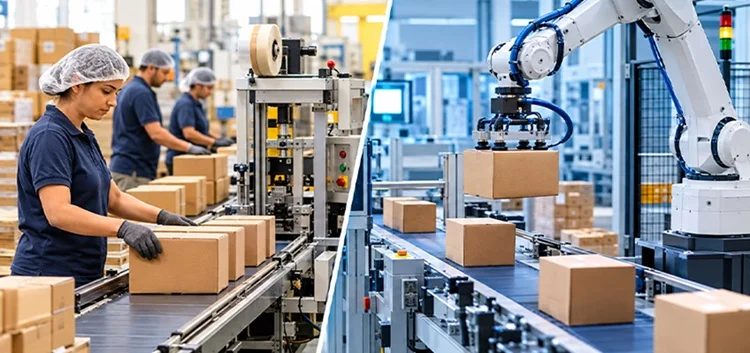
A semi-automated packaging line combines machines with human operators. A person might load products, while a machine seals, labels, or wraps them. Operators still handle transfers, adjustments, and quality checks.
An automated packaging line, sometimes called an automatic packaging line, moves products through filling, sealing, labeling, and palletizing with little human input. Robotic packaging systems take this further. Using vision-guided arms, pick-and-place units, and smart controls, robotic packaging equipment can handle varied shapes, sizes, and orientations that fixed machines struggle with.
Think of it this way: semi-automation gives your team power tools, while robotics gives you a tireless extra crew.
How Does Packaging Automation ROI Compare?
Packaging automation ROI measures how much you gain, in savings, output, and fewer errors, relative to what you spend. The two setups usually behave differently.
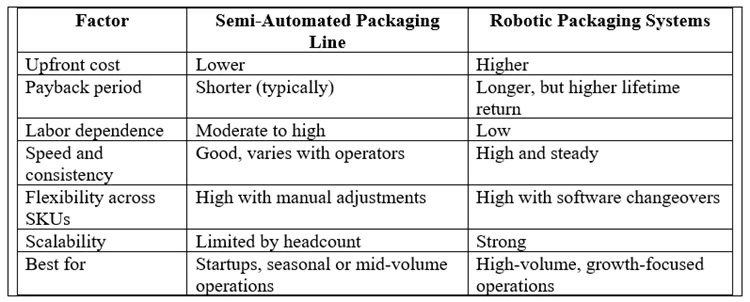
Semi-automated lines have a lower entry price, so the packaging automation payback period is often shorter, sometimes 12 to 24 months. You spend less, so you recover it sooner.
Robotic systems cost more upfront, and payback commonly stretches longer, often 2 to 4 years depending on volume, shifts, and labor rates. But automated packaging line ROI tends to grow over time. Once the system is running, the savings compound through higher throughput, fewer rejects, and lower labor dependence.
Illustrative example: Say a plant packs 3,000 units per shift with six operators. Adding robotic case packing might free four of those people for higher-value work and cut damaged cartons. The savings may not appear in month one, but by year three they usually outweigh the semi-automated alternative. These figures are examples, so run your own numbers.
Rule of thumb: low or unpredictable volume favors semi-automation. Steady, high volume favors robotics.
Side-by-Side Comparison
How Do Labor Challenges Change the Equation?
Labor is often the deciding factor, and it's rarely just about wages.
Packaging automation labor costs include salaries, overtime, benefits, training, and turnover. Packing is repetitive, physically demanding work, and many facilities struggle to hire and keep people for it. Every time someone quits, you pay to recruit, train, and absorb the mistakes a new person makes.
Robotic packaging equipment addresses this directly. It handles the repetitive lifting, sorting, and stacking, which reduces injury risk and lets your team move into supervision, maintenance, and quality roles. Many companies find that automation doesn't eliminate jobs so much as change them, and those jobs tend to be more stable.
A semi-automated line still relies on people, so it stays exposed to labor shortages, absenteeism, and wage inflation. If your area has a tight labor market, that risk is worth pricing in.
Which Option Offers More Scalable Packaging Automation?
Growth is where the two paths really split.
With a semi-automated line, higher output usually means more operators, more shifts, and more floor space. That works until you hit a ceiling.
Scalable packaging automation means you can raise speed and volume without adding headcount at the same rate. Robotic packaging systems can be reprogrammed for new products, sized up with additional modules, and run longer shifts with consistent quality. When a big retailer contract lands or peak season hits, an automatic packaging line absorbs it far more gracefully.
That said, scalability also depends on design. A rigid robotic setup built for one product can be harder to adapt than a simple semi-automated line. Look for modular equipment and open control systems that let you expand in stages.
What Is the Real Cost? Understanding Total Cost of Ownership
The sticker price is only part of the story. Packaging automation total cost of ownership (TCO) covers everything you'll spend over the equipment's life:
- Purchase and installation
- Integration with existing conveyors, ERP, and warehouse systems
- Maintenance, spare parts, and service contracts
- Operator and technician training
- Energy use
- Downtime and changeover time
- Upgrades and eventual replacement
A cheap semi-automated line can carry hidden costs in constant labor and inconsistent output. A robotic system can carry hidden costs in specialized maintenance and integration work. Comparing TCO over five to ten years gives a much fairer picture than comparing purchase prices.
How Do You Choose the Right Packaging Line Automation Strategy?
Ask yourself these questions:
1. What's my current and projected volume? If you expect steady growth, plan for scalability now.
2. How stable is my product mix? Highly varied SKUs need flexible, vision-guided equipment.
3. How hard is hiring in my area? The tougher it is, the stronger the case for robotics.
4. What's my capital situation? Lower cash reserves may point toward a phased approach.
5. How much floor space do I have? Robotic cells can be compact, but they need planning.
6. What's my quality tolerance? Customers who penalize errors reward consistency.
Is a Hybrid or Phased Approach Smarter?
For many businesses, yes. You don't have to choose between the two extremes on day one.
A common path is to start with a semi-automated packaging line, prove the process, and collect real data. Then automate the biggest bottleneck first, usually case packing or palletizing, since those are the most labor-intensive and physically taxing steps. Over time, connect the pieces into a fully automated packaging line.
This approach spreads out investment, lowers risk, and lets your team learn as the technology grows. It also gives you actual performance data to justify the next round of spending.
Common Mistakes to Avoid
- Automating a broken process. Fix workflow problems first, or you'll just make mistakes faster.
- Ignoring integration. New machines must communicate with existing equipment and software.
- Underestimating training. Even the best robotic packaging equipment needs skilled people around it.
- Buying for today only. Choose equipment that can grow with you.
- Skipping the pilot. Test with your actual products before committing.
Frequently Asked Questions
What is a semi-automated packaging line?
It's a packaging setup where machines handle certain tasks, such as sealing or labeling, while people handle loading, transferring, or inspection.
How long is the typical packaging automation payback period?
It varies widely. Semi-automated lines often pay back in roughly one to two years, while robotic systems often take two to four, depending on volume and labor costs.
Do robotic packaging systems replace workers?
They reduce repetitive manual tasks, but most facilities redeploy staff into oversight, maintenance, and quality roles rather than simply cutting headcount.
Is packaging automation worth it for small businesses?
Often yes, if you start small. Semi-automated equipment can deliver strong returns without a huge investment.
What affects automated packaging line ROI the most?
Production volume, labor rates, product variety, uptime, and how well the system is integrated.
Can I upgrade a semi-automated line to robotic later?
Frequently, yes. Choose modular equipment and plan your layout with future upgrades in mind.
The Bottom Line
There's no universal winner. Robotic packaging systems reward high volume, tight labor markets, and long-term growth with better returns over time. A semi-automated packaging line rewards caution, lower budgets, and unpredictable demand with faster, safer payback.
The smartest move is usually to calculate your own numbers, compare total cost of ownership instead of purchase price, and automate in stages. Do that, and your packaging line becomes a competitive advantage rather than a bottleneck.
 Our Services
 Media Pack Download
 Newsletters
 Industrial Events