
Smart Packaging as a Marketing and Traceability Power Tool
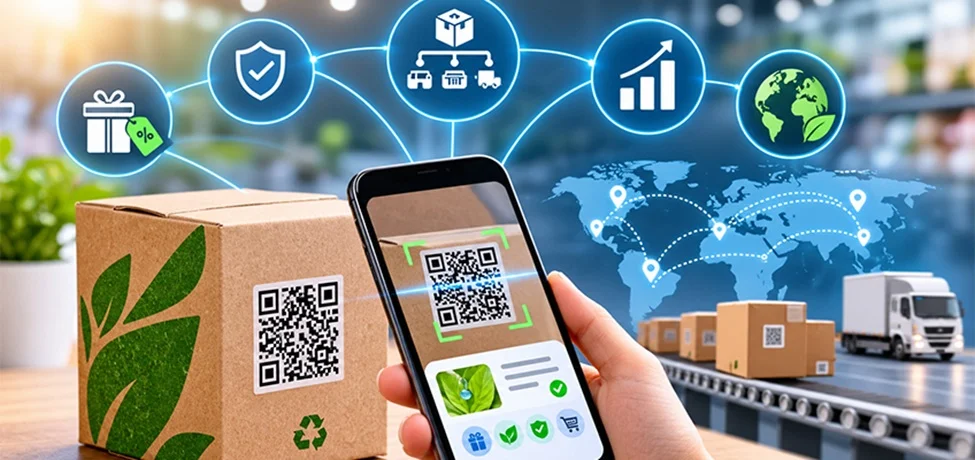
Your package spends more time in a customer’s hands than any ad you run. Most brands still treat it as a container. It can also be a storyteller, a security guard, and a data source.
What is smart packaging for marketing and traceability?
Smart packaging uses QR codes, NFC tags, RFID, or sensors to connect a physical product to digital content and supply chain data. Customers scan it for stories, offers, and authenticity checks. Brands get scan data and a verifiable product history.
Smart packaging benefits for brands
- Direct consumer relationships: QR code packaging for consumer engagement gives you first-party data without relying on third-party ads.
- Trust: Shoppers can verify origin and authenticity in seconds.
- Faster recalls: Batch-level data lets you act on one lot, not your whole inventory.
- Insight: You learn where, when, and how often products are scanned.
NFC vs QR code packaging (and RFID vs QR code for product traceability)

Quick answer: Use QR codes for reach, NFC for premium authentication, and RFID for logistics. Many manufacturers combine two of them.
Anti-counterfeiting packaging technologies
Strong smart packaging solutions for manufacturers layer protection: unique serialized QR codes, NFC tags with cryptographic signatures, tamper-evident seals, and invisible inks. A single layer can be copied. Several layers rarely can.
Digital product passport packaging and GS1 Digital Link QR codes
With the EU rolling out digital product passport requirements, packaging is becoming a compliance tool. GS1 Digital Link QR codes let one code serve shoppers, retailers, andregulators. It can open a marketing page for a consumer and show batch or recycling data at a scanner. Adopting this standard now saves you a costly relabeling later.
Smart packaging ROI for marketing teams
Track four numbers: scan rate, repeat scans, opt-in conversions, and counterfeit or recall costs avoided. Start with a pilot on one SKU. If 5% of buyers scan and a share of them join your email list, you can compare that cost per lead against your paid channels.
How to implement smart packaging in your supply chain
1. Set one goal: engagement, authentication, or compliance.
2. Choose the technology using the table above.
3. Adopt GS1 Digital Link so your codes stay future-proof.
4. Serialize at the line: print unique codes during production.
5. Build a mobile-first landing page worth scanning (a discount, a recipe, a proof of origin).
6. Connect your ERP or traceability platform so scan data and batch data meet.
7. Pilot, measure, scale.
Final thought
Smart packaging is no longer a gimmick. It is where marketing, trust, and compliance meet. Start with one product and one clear goal, then let the data guide your next step.
 Our Services
 Media Pack Download
 Newsletters
 Industrial Events