


Top 10 Eco-Friendly Packaging Options That Reduce Costs and Strengthen Marketing Claims
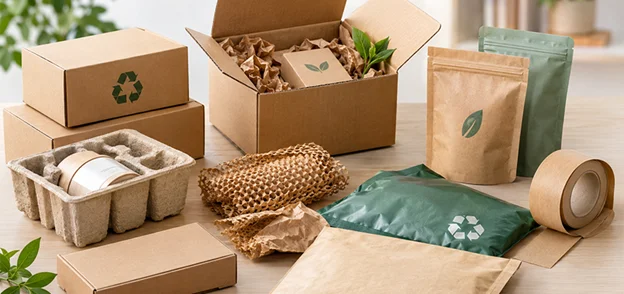
Quick answer: The best eco-friendly packaging options for cutting costs are recycled corrugated boxes, molded pulp inserts, right-sized packaging, paper-based void fill, and recycled-content mailers. They reduce material use, shipping weight, and damage rates, and they give you specific, provable claims for your marketing.
"Sustainable" doesn't have to mean "expensive"
Most small brands assume going green means paying more. We hear it all the time: "We'd love to, but the margins just aren't there."
The truth is more interesting. Plenty of eco-friendly packaging alternatives cost the same as, or less than, what you use now. The savings hide in places people forget to look: lighter shipments, fewer damaged orders, less storage space, and fewer returns.
This guide covers 10 eco-friendly packaging options that make financial sense, how each one supports your marketing, and how to avoid the greenwashing trap.
Why sustainable packaging pays off
Sustainable packaging cost savings usually come from four places:
- Less material. Right-sizing and lightweighting mean you buy less stuff.
- Lower shipping costs. Smaller, lighter parcels reduce dimensional-weight charges.
- Fewer damages. Better protection means fewer replacements and refunds.
- Higher perceived value. Customers often accept a slightly higher price for brands that look responsible.
Keep these in mind as you read. Each option below ties back to at least one.
The top 10 eco-friendly packaging options
1. Recycled corrugated packaging
This is the workhorse of cost-effective sustainable packaging. Recycled corrugated packaging is widely available, strong, and easy for customers to recycle at home or curbside.
- Cost angle: Competitive with virgin cardboard, and bulk orders bring prices down fast.
- Marketing angle: "Made with X% recycled content" is a claim you can verify with your supplier.
- Watch out for: Over-sized boxes. A recycled box that's too big still wastes money.
2. Molded pulp packaging
Molded pulp packaging is made from recycled paper or plant fibers and shaped into trays, corners, and inserts. It replaces foam, and it looks premium.
- Cost angle: It often costs less than custom foam once you include tooling and volume. It also stacks compactly, which saves warehouse space.
- Marketing angle: The "no plastic foam" message is easy to show in unboxing photos.
- Watch out for: Tooling costs on custom shapes. Start with stock designs.
3. Right-sized packaging
Not a material, but possibly the biggest saver on this list. Fitting the box to the product cuts material, filler, and shipping charges all at once.
- Cost angle: One of the most reliable packaging cost reduction strategies available. Even trimming a few centimeters can drop you into a cheaper shipping tier.
- Marketing angle: "We ship smarter, not bigger" is a message customers understand instantly.
- Watch out for: Don't trim protection. Test with drop tests first.
4. Paper-based void fill and cushioning
Crinkled kraft paper, honeycomb wrap, and paper pads can replace air pillows and bubble wrap.
- Cost angle: Paper void fill is cheap, and many paper cushioning systems ship flat to save storage.
- Marketing angle: Customers can toss it straight into the recycling bin, and they notice.
- Watch out for: Very fragile or heavy items may need extra protection.
5. Recycled-content mailers
Poly mailers made with post-consumer recycled (PCR) plastic, or paper mailers, suit apparel and soft goods.
- Cost angle: They're lightweight, which keeps postage low, and the price gap with virgin plastic has narrowed in many markets.
- Marketing angle: "Made from 80% recycled material" beats a vague "eco" label every time.
- Watch out for: Local recycling rules. Say exactly how customers should dispose of them.
6. Kraft paper tape and water-activated tape
Switching from plastic tape to paper tape is a small change with a surprisingly big payoff.
- Cost angle: Water-activated tape often needs fewer strips per box and seals more securely, which can reduce tampering and re-taping.
- Marketing angle: It makes the whole box recyclable without peeling anything off.
- Watch out for: It needs a dispenser, so factor that into your budget.
7. Reusable and returnable packaging
Think sturdy totes, refillable containers, or return-and-reuse programs.
- Cost angle: The upfront cost is higher, but the per-use cost drops with every cycle. This is where sustainable packaging ROI gets exciting for repeat-order businesses.
- Marketing angle: A built-in loyalty hook. Customers come back to return the packaging.
- Watch out for: Logistics. You need a simple, low-effort return process.
8. Compostable mailers and wraps
Made from plant-based materials such as PLA or similar blends, these suit brands whose customers can access composting.
- Cost angle: Usually pricier than standard options, so use them selectively for premium lines.
- Marketing angle: Strong appeal, but only if you're clear about home versus industrial composting.
- Watch out for: The biggest greenwashing risk on this list. If your customers can't actually compost it, don't lead with the claim.
9. Mono-material recyclable pouches
Pouches made from a single material are far easier to recycle than multi-layer laminates.
- Cost angle: Lightweight, space-saving, and cheap to ship, ideal for food, supplements, and beauty products.
- Marketing angle: These are strong recyclable packaging alternatives for flexible formats, as long as you state the real recycling route.
- Watch out for: Not every area accepts flexible plastics. Check before you claim.
10. Minimalist and lightweight design
Cut the extra layers: the inner box, the second wrap, the printed insert that nobody reads.
- Cost angle: Every layer removed is money saved, which makes this a cornerstone of affordable sustainable packaging.
- Marketing angle: Simple, clean packaging looks modern and signals confidence.
- Watch out for: Don't remove anything that protects the product or carries legal information.
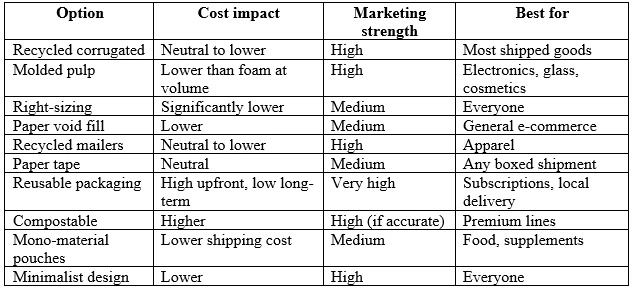
Quick comparison table
How to avoid greenwashing in your packaging
Your sustainable packaging marketing claims are only as good as your proof. Regulators in many markets, such as the FTC in the US, have guidelines on environmental claims, and customers are more skeptical than ever. Here's how to avoid greenwashing in packaging:
- Be specific. "Made with 70% recycled content" beats "eco-friendly."
- Have proof. Keep supplier certificates and test reports on file.
- Explain disposal. Tell customers exactly what to do with the packaging.
- Don't overstate. "Recyclable" isn't the same as "recycled," and neither means "compostable."
- Be honest about progress. "We're 60% of the way to plastic-free" builds more trust than a perfect claim you can't back up.
- Avoid vague imagery. Green leaves and earth icons without facts can read as fluff.
An honest claim might not sound as flashy, but it lasts longer and protects your reputation.
How to calculate sustainable packaging ROI
You don't need a fancy model. Try this:
Total savings = (material savings + shipping savings + damage reduction + storage savings) − (switching costs)
Then divide by your switching costs to get your ROI.
Track these for 60 to 90 days:
- Cost per shipped order (packaging + postage)
- Damage and return rate
- Storage space used
- Customer feedback and repeat purchase rate
A small test batch is better than switching everything at once. That's the safest sustainable packaging cost reduction approach for small and mid-sized brands.
Frequently asked questions
What is the cheapest eco-friendly packaging?
Right-sized recycled corrugated boxes with paper void fill are usually the most budget-friendly combination, since you cut both material and shipping costs.
Is sustainable packaging more expensive?
Not always. Some options cost more upfront, but savings in shipping weight, damage reduction, and material use often balance it out over time.
What's the difference between recyclable and recycled packaging?
Recyclable means it can be recycled after use. Recycled means it's made from previously used material. Many products can be both.
Is molded pulp packaging cost-effective?
Yes, particularly as a replacement for foam inserts. Costs drop with volume, and stock designs avoid tooling fees.
How do I know my sustainability claims are legitimate?
Be specific, keep documentation, explain how customers should dispose of the packaging, and avoid broad terms like "green" or "eco-safe" without proof.
Final thoughts
Switching to sustainable packaging isn't about spending more to look good. It's about spending smarter and telling the truth about it. Start with the easy wins: right-size your boxes, move to recycled corrugated, swap foam for molded pulp, and replace plastic tape and fillers. Then build your marketing around real numbers.
Your next step: Pick two options from this list, test them on 50 to 100 orders, and track your costs. You might be surprised how quickly the savings show up.
 Our Services
 Media Pack Download
 Newsletters
 Industrial Events