


Top 6 Robotics and Automation Providers Maximizing ROI in Packaging Lines
Packaging teams don't struggle to find robots. They struggle to find the right robot for their line, their SKU mix, and their budget - and to prove the ROI before the CFO signs off. This guide breaks down six established providers actually powering packaging line automation today, what each is genuinely good at, and how to think about ROI before you buy.
Quick answer: The most established names in packaging robotics companies right now are ABB Robotics, FANUC, KUKA, Yaskawa Motoman, Universal Robots, and Krones AG - each covering a different slice of the line, from high-speed case packing to flexible cobot palletizing.
Why Packaging Lines Are Automating Faster Than Ever
Labor shortages on the floor, rising e-commerce order volumes, and tighter margins have pushed robotic packaging automation from "nice to have" to standard capital planning. Three forces are driving adoption specifically at end-of-line:
- Labor availability — palletizing and case-packing roles are among the hardest positions to keep staffed
- Throughput pressure — e-commerce and retail SKU proliferation demand faster changeovers
- Injury and safety costs — repetitive lifting at the end of a line is a leading source of workplace injury claims in manufacturing and distribution
This is why packaging automation providers are increasingly building modular, faster-to-deploy systems instead of custom one-off installations.
What "ROI" Actually Means on a Packaging Line
Before comparing vendors, it helps to know what you're actually measuring. Packaging automation ROI typically comes from four levers:
1. Labor cost offset — fewer manual palletizing/packing roles per shift
2. Throughput gain — more cases or pallets processed per hour
3. Downtime reduction — fewer changeover delays and fewer line stoppages from manual error
4. Injury and turnover savings — lower workers' comp exposure and reduced hiring/training cycles
Most integrators will build a payback model around these four inputs. A realistic conversation with a supplier should include a payback-period estimate specific to your volume and shift pattern - be cautious of any vendor quoting a universal "X months" figure without seeing your data.
The Top 6 Providers, Compared
1. ABB Robotics
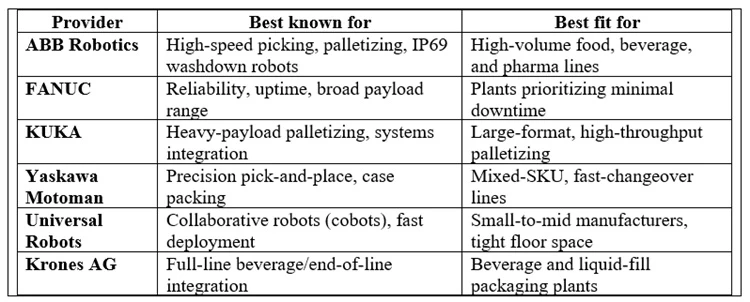
ABB is one of the most widely deployed names among packaging automation suppliers, particularly for food, beverage, and pharmaceutical lines that need washdown-rated equipment. Its Delta-style and articulated arm robots (including IP69-rated models built for wet, sanitary environments) are common on high-speed pick-and-place and casepacking lines.
Why it matters for ROI: ABB's strength is throughput at high cycle rates - useful when the ROI case depends on units-per-hour rather than headcount reduction alone.
2. FANUC
FANUC is consistently cited for reliability and uptime, which matters more to ROI than most buyers initially assume - a robot that runs three extra shifts a month without unplanned downtime often outperforms a marginally faster but less consistent competitor over a payback period. FANUC's range spans small collaborative units to heavy-payload industrial arms, making it a flexible choice among robotic packaging systems for plants with varied case and pallet weights.
Why it matters for ROI: Lower unplanned downtime directly protects the throughput assumptions your ROI model is built on.
3. KUKA
KUKA is a go-to name in heavy-duty robotic palletizing systems, especially where pallet loads are large, mixed, or irregular. Its integration partnerships mean KUKA robots often arrive as part of a broader turnkey cell rather than a standalone arm - useful for plants that want one vendor accountable for the whole palletizing station.
Why it matters for ROI: Turnkey integration reduces the hidden costs (engineering time, controls integration, commissioning delays) that quietly erode ROI on DIY robot deployments.
4. Yaskawa Motoman
Yaskawa is a strong fit for lines dealing with frequent SKU changeovers - a growing pain point as more manufacturers run shorter batches for e-commerce and private-label retail. Its robots are widely used in case packing and secondary packaging where precision pick-and-place matters as much as raw speed.
Why it matters for ROI: Faster changeovers mean less line downtime between SKUs, which is often the single biggest hidden cost in mixed-product packaging operations.
5. Universal Robots (UR)
Universal Robots popularized the collaborative robot (cobot) category, and it remains one of the fastest ways for small and mid-sized manufacturers to get started with robotics for packaging lines without a full safety-caging overhaul. Cobot-based palletizing kits - often built around UR arms paired with a vertical lift axis - can be deployed for well under six figures, which changes the ROI math significantly for smaller operations.
Why it matters for ROI: Lower upfront capital and faster deployment timelines mean a shorter payback period, even if raw throughput is lower than a full industrial cell.
6. Krones AG
Krones is less of a single-robot supplier and more of a full end-of-line systems integrator, particularly dominant in beverage and liquid-fill packaging. For plants that need end-of-line packaging automation spanning case packing, palletizing, and stretch-wrapping as one connected system, Krones offers a single point of engineering responsibility.
Why it matters for ROI: Fewer integration seams between machines means fewer failure points - and fewer vendors to coordinate with when something needs troubleshooting.
How to Choose Between Packaging Automation Companies
There's no universal "best" among packaging automation companies - the right fit depends on three questions:
- What's your SKU variability? High mix favors cobots or Yaskawa-style flexible pick-and-place; low mix, high volume favors ABB or KUKA.
- What's your floor space and safety setup? Cobots need less guarding infrastructure than traditional industrial arms.
- Do you need one vendor or a best-of-breed stack? Full-line integrators like Krones reduce coordination overhead; specialist vendors can be cheaper per component but require more internal integration work.
FAQ
What is packaging line automation?
Packaging line automation is the use of robotics, conveyors, sensors, and control systems to perform packing, case-forming, palletizing, and wrapping tasks with minimal manual labor.
Which companies are the leading packaging robotics companies?
ABB Robotics, FANUC, KUKA, Yaskawa Motoman, Universal Robots, and Krones AG are among the most established packaging line automation companies currently deployed across food, beverage, pharma, and e-commerce packaging lines.
How long does it take to see ROI from packaging automation?
Payback periods vary widely by volume, labor costs, and shift patterns - commonly cited industry ranges fall between 12 and 36 months, but any specific figure should come from a vendor's analysis of your actual production data, not a generic estimate.
Are cobots or industrial robots better for packaging ROI?
Cobots typically have lower upfront cost and faster deployment, which can shorten payback periods for smaller operations. Industrial robots handle higher throughput and heavier payloads, which tends to favor ROI at higher production volumes.
What is end-of-line packaging automation?
It refers to the final stages of a packaging line - case packing, palletizing, and stretch-wrapping - where robots take finished, packaged products and prepare them for shipping.
 Our Services
 Media Pack Download
 Newsletters
 Industrial Events