Biodegradable Containers for Food: Safe, Sustainable & Ready-to-Serve Solutions
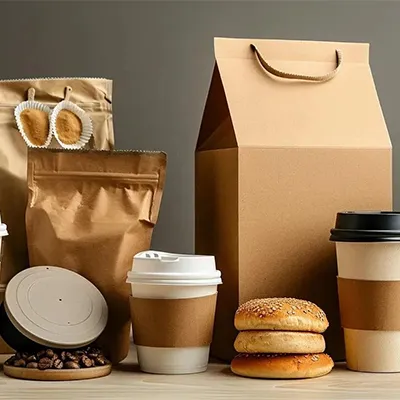
Biodegradable food containers have become the unsung heroes of the modern-day food consumption world in the attempt to strike a balance between convenience and conscience. Whether it is your favorite salad bowl, a hot soup cup, a well-packed biryani box, or any other environmentally friendly containers, whatever the case, these containers are redefining how we eat, serve, and think of waste. But how safe are they? What is the sustainability of such? And, most of all, are they the future of food packaging?
We are going to unveil the world of green food packaging - a world where intentions meet innovation, and where green food packaging solutions are not a fad, but a must.
The Shift toward Sustainable Dining
Consumers are now demanding questions - not on what they are eating, but on what their food is packed in. The food industry is under a revolution in the packaging industry due to the alarming increase in single-use plastics. The traditional plastic, which was being praised as convenient, now raises a critical question for the environment. The answer? Takeaway containers that are eco-friendly and can be used to serve your favorite meals also benefit the planet.
Dining establishments, cafes, and cloud kitchens are progressively adopting eco-friendly restaurant packaging in order to attract the eco-conscious consumer market. What used to be seen as a niche movement is now expected to be mainstream. As recent industry data shows, more than 60 percent of urban consumers would now want to have their meals packaged in biodegradable disposable products, despite the fact that it will cost them slightly more.
Why? Since sustainability has been transformed into an attribute of trust, clients trust caring brands.
The Science behind Biodegradable Food Containers
What is really biodegradable about biodegradable food containers? The solution is in the substance. They are also supposed to be manufactured using renewable resources as opposed to the conventional plastic which is made using petroleum-based polymers; these containers can be manufactured using cornstarch, sugarcane bagasse, PLA (polylactic acid), bamboo fiber, or palm leaves.
Food containers made of biodegradable plastics can be disposed with the correct composting conditions and will break down into water, carbon dioxide, and other organic materials and leave no toxic remains. This decomposition process is usually natural and takes place in 60-90 days, given the industrial composting conditions.
Interestingly, biodegradable hot and cold food containers have state-of-the-art coatings that repel oil, moisture, and heat to demonstrate the fact that sustainability and performance can be used together.
Eco-Friendly Food Packaging: Safety Meets Style
The question that has been largely posed in the industry is: Can biodegradable containers be used with hot food?
Definitely - as long as they are prepared by the well-known suppliers who use food-grade products. Contemporary sustainable alternatives to plastic food wrapping are subjected to extensive testing to make sure that they do not leach chemicals, change the taste of the food, or lose their structure when hot liquids or cold desserts are loaded.
As a matter of fact, most restaurants have been boasting of their biodegradable takeaway containers that are eco-friendly as their restaurant branding. Imagine a smoothie bar with sugarcane cups or an organic cafe with salads in palm leaf bowls; both are safe, stylish, and easily compostable.
Not only are customers aware of this change, but they also recall it, linking such places with creativity and accountability.
A Comparative Glance: Plastic vs. Biodegradable Containers
| Aspect | Plastic Containers | Biodegradable Food Containers |
| Material | Petroleum-based polymers | Cornstarch, sugarcane, PLA, bamboo |
| Decomposition Time | 400+ years | 60-90 days |
| Environmental Impact | High – contributes to landfill waste and microplastics | Low – decomposes into organic matter |
| Food Safety | May leach toxins under heat | Food-grade, safe for hot and cold food |
| Consumer Perception | Outdated and unsustainable | Innovative and eco-conscious |
This is the stark difference as to why the hospitality industry is fast shifting to the use of eco-friendly food packaging. Not a change of materials but a change of attitude.
The Growing Market for Compostable Takeaway Containers
It is estimated that the food delivery compostable packaging solutions will have an astronomical demand across the globe within the next five years. Due to the increase in the number of food delivery websites, the necessity of the implementation of compostable takeaway containers that can withstand the journey, water, and temperature variations is urgent.
Analysts in the industry believe that the worldwide market of sustainable food packaging solutions will exceed USD 400 billion by 2030, with the restaurant, catering, and ready-to-eat industries contributing to the majority of the market. The governments are taking action too - most areas already prohibit single-use plastic, and food companies are forced to switch to biodegradable disposable containers in large volumes.
The aesthetic nature of this transformation is its circularity. Upon their use, eco-friendly food packaging can be discarded in the form of compost, which is used to produce new plants to continue the cycle of sustainability magnificently.
Hot and Cold Food Biodegradable Containers: Performance that Sparks.
The misconception is that because biodegradable can be used as a sign that it is weak or less strong. That's far from true.
The new generation biodegradable containers of hot and cold food are made to withstand high and low temperatures, will not absorb oil, and will not distort when subjected to high temperatures.
Think about the possibility of ordering a spicy curry or chilled dessert and get it in the container that appears high-end, works well, and leaves no environmental guilt behind. That is the wizardry of the environmentally friendly restaurant packaging because it can prove that sustainability and performance can be a perfect match.
It can be a bakery with frosted pastries or a canteen with hot lunch packages; biodegradable food containers now serve all cuisines and states of all possible conditions.
The Business Case for Sustainable Packaging
There is a strong business case to use sustainable substitutes for plastic food containers in addition to environmental advantages. The restaurants which changed to use bio friendly biodegradable take-away containers to the restaurants have been reported to have high customer satisfaction rates and brand loyalty.
Besides that, eco-friendly food packaging does not only meet the corporate sustainability goals and ESG (Environmental, Social, and Governance), but investors and the stakeholders also find this more significant as time goes. In brief, sustainability is no longer a decision but a strategy.
The following is an interesting observation:
In a survey presented by Packaging Europe (2024) 72 percent of the customers stated that they would be more attracted to repurchase a product with a brand whose disposable containers are biodegradable. Green packaging is taking the hearts and minds.
Difficulties with Adopting Compostable Packaging Solutions for Food Delivery
It is not so easy with revolution. Cost is one of the challenges that the compostable takeaway containers face. These materials are cheaper than plastic because they are sourced from renewable resources, but are specialized and therefore are a bit expensive. Nevertheless, there will be a decline in prices as technology increases, as well as economies of scale.
The other issue is infrastructure. Industrial composting facilities to deal with compostable packaging solutions to deliver food are not present in all regions. When that happens, the containers might still get into the landfills, which retards the decomposing process.
To reduce this, governments and other local municipalities are currently collaborating with the suppliers of packaging to establish effective waste segregation and composting structures.
Best Biodegradable Containers for Food Packaging: What to Look For
The market nowadays is overtaken by choices, but not every biodegradable product is created in the same way. Restaurants should consider: when selecting the most suitable biodegradable containers to use in packaging their food items.
- The kind of food that is served (hot, oily, or cold food)
- Shelf life requirements
- Compostability standards (e.g., BPI, ASTM D6400, or EN 13432)
An example is bagasse containers that are extremely strong when it comes to fried or spicy food, and PLA-coated cups are more than suitable when the beverage is iced. This diversity will guarantee that no food business will lack a sustainable food packaging solution adaptable to the business.
Eco-Friendly Restaurant Packaging: The Aesthetic Edge
Not merely a question of morals, but a question of taste, as well. Environmentally friendly restaurant packages provide a natural and classy appearance that customers identify with. Natural fabrics of bagasse or bamboo immediately portray authenticity and attention.
Picture a time when you open your lunch and you do not see shiny plastic, but a matte-finished, biodegradable box in an appearance that is friendly and feels high quality. This minor design message makes the dining experience more high-end and builds brand recognition.
This is a visual and touch experience that distinguishes a first-time order and a regular customer in a competitive F&B environment.
Sustainability in Motion: Global Innovations
Some of the world’s innovators are testing the boundaries of sustainable substitutes to plastic containers for food. Start-ups in Europe are working on an algae packaging that can be dissolved in water. In India, there are entrepreneurs who are producing edible spoons and cups that are composed of millet. In the United States, the large chains are collaborating with packaging companies in the development of reusable and compostable packages that can be used in the delivery of food.
The innovations like this demonstrate the unlimited possibilities of environmentally friendly food packaging. It not only involves replacing plastic, but it also involves rethinking the whole life cycle of packaging.
Market Outlook: The Future of Sustainable Food Packaging Solutions
| Year | Market Value (USD Billion) | Growth Driver |
| 2022 | 230 | Rise in takeout culture |
| 2025 | 310 | Plastic bans and regulations |
| 2030 | 410+ | Innovation in biodegradable food containers |
The momentum is undeniable. Green food packaging is becoming a backbone of responsible business practices and policy, and popular opinion is supporting the direction.
By the year 2030, analysts expect that restaurants, including the delivery chains, will absolutely abolish plastic containers in their takeaway by fully transitioning into biodegradable containers.
Conclusion: From Waste to Worth
Biodegradable food containers are not only about packaging, but it is also about purpose. It is all about making decisions that have a long-term impression.
By selecting food restaurant packaging that is eco-friendly, restaurants are not packaging meals; they are wrapping values - such as sustainability, safety, and care. Using biodegradable packaging and environmentally friendly alternatives to plastic food packaging, any meal is a move towards making the world a cleaner place.
Food can convert garbage into value. And as biodegradable disposable containers are driving the frontier, the future of dining not only tastes good, but it is also making a strong sustainability choice.
 Our Services
 Media Pack Download
 Newsletters
 Industrial Events