
Coated kraft can replace more plastic when the evidence comes first
Barrier-coated kraft deserves a larger role in packaging. Provided every proposed switch is judged on product protection and the fate of the finished pack, there is an opportunity to extending the applications that paper can serve.
A bag for a warm pastry has a different job from a sealed pack expected to protect a moisture-sensitive product for months. Both might be described as food packaging, yet their requirements differ considerably. Claims that a paper grade can replace plastic mean little until the product, conditions and duration of use are defined.
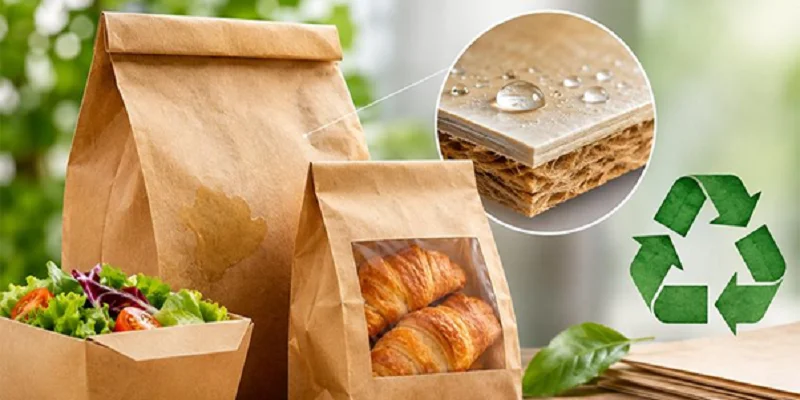
Water-based barrier coatings give designers more ways to meet those requirements. They can improve resistance to grease and water, helping kraft move into uses where untreated paper would struggle. The next stage of fibre packaging innovation depends on specifying that protection accurately and demonstrating what happens to the complete pack after disposal.
How the barrier forms
Kraft is a network of cellulose fibres, with pores between them. Cellulose attracts water, while gaps in the sheet provide routes for liquids to penetrate. A coating changes how the paper surface interacts with the substances it encounters.
In a typical waterborne polymer dispersion, tiny polymer particles are distributed through water. As the applied layer dries, the water evaporates and the particles come together to form a film. That film can cover pathways through which grease would otherwise reach the fibres. Its chemistry also influences how readily it takes up water. 1
The water acts as a carrier; the functional material remains after drying. A synthetic polymer can be dispersed in water, so a water-based formulation may still leave a plastic-containing coating. Neither water solubility nor recyclability follows from the choice of carrier.
Grease resistance and moisture protection also need separate attention. A coating that limits oil penetration may still allow water vapour to pass through. The formulation must match the substance being kept out, or kept in. Describing a material as having a ‘barrier’ leaves too much unspecified.
Specify the journey before choosing the coating
The specification should begin with the pack’s actual use. What will it contain? At what temperature will it be filled? How long will contact last, and what humidity or condensation might it encounter? For a carrier bag, the load and exposure during transport matter as well.
Those answers should determine the required protection. A bakery bag intended for brief contact with a greasy product needs a different specification from packaging that must prevent a dry food absorbing moisture throughout storage. Adding the strongest available coating to both would overlook the opportunity to use less material where the demands are modest.
The paper and coating must also work together. Paper porosity, surface condition and coating coverage influence the result. Dry coat weight, measured in grams per square metre, identifies how much coating remains once the water has evaporated. It is a useful specification, but a heavier layer cannot compensate reliably for defects in coverage.
Experimental work on coated paperboard has shown how surface defects can govern oil penetration. In one study, a thicker single layer performed worse than a thinner one because it contained more and larger defects. That finding illustrates why application quality deserves attention alongside formulation. 2
Buyers should therefore ask how the converter controls application and drying, and how it verifies consistency across production. A successful laboratory coating needs a manufacturing process that can reproduce its protection at commercial speed.
Test the converted bag under realistic conditions
Studies on waterborne-coated paperboard illustrate both the opportunity and the need for care. Selected dispersion formulations have achieved water, moisture or grease barrier results comparable with PET-coated samples. The same research found that converting could damage coatings. These findings support further development, while leaving individual bag designs to prove their performance. 3
Flat-sheet results provide a starting point. Bag-making introduces folds, seams and glued areas that require separate scrutiny. Bag trials should establish whether the chosen material retains its protection through folding and handling.
Testing also needs to distinguish different forms of moisture exposure. A Cobb test measures the water absorbed by paper over a specified period. A water vapour transmission rate measures how much vapour passes through a material under stated conditions. A favourable result in one does not establish performance in the other. 3
For hot food, trials should use representative temperatures, grease exposure and contact times. For chilled applications, they should consider condensation. Packs with a shelf-life requirement need validation with the actual product and closure system. Food-contact documentation should cover the intended food type, temperature and duration of contact.
The same discipline applies to strength. A surface that resists a splash does not, by itself, prove that a loaded bag will remain sound when damp. Acceptance criteria should cover the complete bag’s ability to carry and protect its contents throughout the intended journey.
Recyclability must be proved for the finished pack
A successful barrier must survive its intended use. During recycling, the structure must also allow useful fibres to be recovered without unacceptable disruption to the process or the resulting paper. Achieving both outcomes requires deliberate design.
Repulpability describes the ability to break down in the pulping process and release fibres. It is an important part of recyclability, but the assessment must also consider material rejected during screening and the quality of the recovered output.
Cepi’s Recyclability Laboratory Test Method for conventional recycling mills reproduces key stages of pulping, screening and sheet formation. Used with an appropriate evaluation protocol, such as 4evergreen’s, it helps assess whether a structure is technically compatible with that recycling process. Buyers should request the findings and assessment, including fibre recovery, rejects and effects on the resulting sheets. 4
The test sample must represent the proposed packaging. A report on coated base paper does not automatically cover a bag with additional inks, adhesives, handles or windows. Evidence should identify the construction assessed and explain which production variants it covers.
Compatibility also depends on the recycling process. 4evergreen’s design guidance distinguishes conventional, deinking and specialised mill routes, and calls for testing of aqueous polymer dispersion coatings. A structure suitable for one process cannot simply be assumed suitable for all paper mills. 5
Laboratory compatibility must then connect with a collection and sorting route in the intended market. UK guidance, for example, lists greaseproof, siliconised and waxed papers among formats that are not widely collected at kerbside. The classification and acceptance of the specific coated product therefore need checking; its paper appearance cannot settle the question. 6
Foodservice businesses should examine the disposal conditions at their own sites as well. A pack entering mixed general waste will not reach a paper mill merely because a suitable recycling technology exists. Collection arrangements and clear disposal instructions belong in the design brief.
Choose applications where the evidence supports a switch
Short periods of contact with bakery products or takeaway food offer sensible starting points for trials where grease resistance is the main requirement. Retail bags needing limited protection from incidental moisture offer another potential application. These are opportunities to validate, rather than blanket endorsements of coated kraft for every product in those categories.
For dry retail goods, uncoated paper may already meet the brief. A coating should solve an identified problem. Where sustained liquid contact, demanding humidity conditions or long shelf life are involved, the evidence threshold rises. Oxygen-sensitive products need relevant oxygen-barrier data as well as moisture testing. Some applications will continue to require a different structure or material.
The comparison should include the whole packaging system. If a substitute requires an extra liner or more secondary packaging, or leads to more product damage, those consequences must enter the assessment. A change of base material alone cannot establish an environmental improvement.
What buyers should ask suppliers
A useful supplier discussion should resolve six questions before a specification is approved:
- Which product, temperature, contact time and handling conditions does the proposed barrier cover?
- What remains in the dried coating, including any plastic content, and what food-contact evidence applies?
- Which tests establish grease, liquid-water or water-vapour protection, and do they cover the converted bag?
- Which complete construction was assessed for recycling, by what method, and with what findings and limitations?
- Which collection, sorting and mill routes accept the pack in each intended market, and what disposal instructions follow?
- How will changes to paper, coating weight, printing or adhesives be controlled and checked against the evidence?
Coated kraft can earn a wider role when suppliers answer those questions precisely. The most useful innovation will be a bag whose protection matches its job, whose manufacturing process delivers consistent results and whose recycling claim reflects an accessible route. That is how fibre can credibly close more of the performance gap with plastic.
Sources for editorial reference
Article length 1,413 words excluding title, byline, subheadings and references. Sources checked on 10 November 2026.
1. Bakker et al. Water Barrier Properties of Resin-Stabilized Waterborne Coatings for Paperboard
Macromolecular Materials and Engineering, 2022, 307, 2100829. Supports the explanation of waterborne polymer dispersions, film formation and water uptake.
2. Bakker et al. Understanding and Improving the Oil and Water Barrier Performance of a Waterborne Coating on Paperboard
ACS Applied Polymer Materials, 2022. Supports the discussion of surface defects, coating coverage and oil penetration.
3. Marinelli et al. Barrier, converting, and tray-forming properties of paperboard packaging materials coated with waterborne dispersions
Packaging Technology and Science, 2024, 37, 149–165. Supports the distinction between barrier tests and the need to assess converting effects. Findings concern paperboard; bag trials are recommended to establish performance in the proposed application.
4. Cepi Recyclability Test Method Version 3
Cepi, March 2025. Describes the conventional-mill laboratory test and its use with 4evergreen’s evaluation protocol.
5. Circularity by Design Guideline for Paper-Based Packaging
4evergreen, Version 4, February 2026. Relevant sections include recyclability definitions, mill processes and barrier coatings. Supports process-specific assessment and testing of aqueous polymer dispersion coatings.
6. Recyclability assessment methodology assessing materials
Department for Environment, Food & Rural Affairs, updated 4 September 2025. See Paper and board — collection for the listed kerbside collection exceptions. This guidance does not classify every barrier-coated kraft construction identically.

About: Jon Marling - Founder and Managing Director of BagKraft
Jon Marling is the founder and Managing Director of BagKraft, a specialist in sustainable retail and promotional packaging. With over 30 years of industry experience, he previously founded Paper Bag Company. At BagKraft, he combines packaging expertise with digital innovation to help businesses source distinctive, responsibly produced bags and packaging.
 Our Services
 Media Pack Download
 Newsletters
 Industrial Events